Dataro vs competitors: how the decision layer compares
How Dataro compares to other tools in the fundraising stack
Fundraising leaders are stretched thin. Budgets are tighter, donor expectations are higher, and the tooling market keeps expanding. So when teams ask "how is Dataro different from a CRM, a wealth screener, or a predictive point solution?" — it's a fair question.
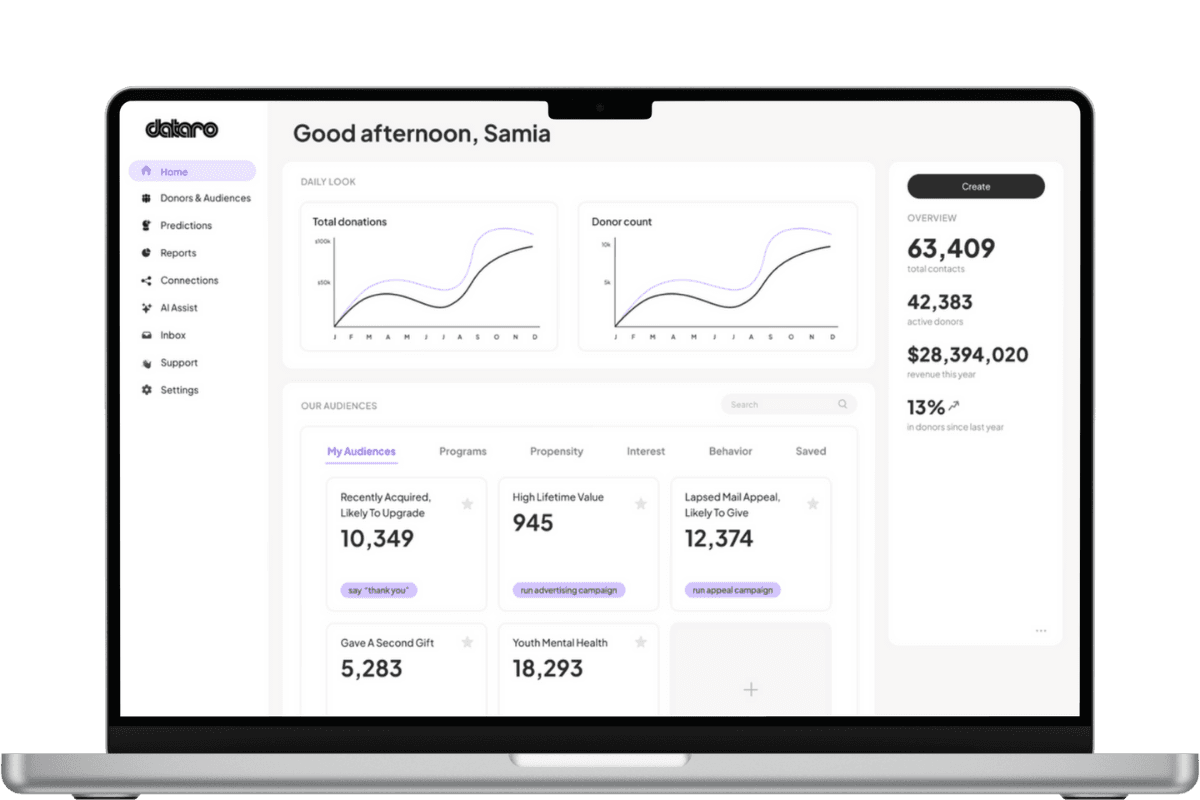
The short answer: Dataro isn't trying to replace any of them. Dataro is a fundraising intelligence platform that sits on top of your CRM and turns your data into clear, ranked actions — so you can decide who to focus on, who to engage now and what to do next.
Here's how that compares to the other categories you're likely weighing.
What Dataro is (and isn't)
Before the comparisons, a quick frame. Dataro is the decision layer between your data and your team's next move.
Not a CRM. Your CRM is the system of record. Dataro reads from it and writes back to it.
Not BI. Dashboards describe the past. Dataro produces ranked, execution-ready outputs for the week ahead.
Not marketing automation. Automation tools scale sends. Dataro decides who should be in the send — and who shouldn't.
The loop is simple: predict, act, measure, repeat.
Dataro vs. CRMs (Salesforce, Blackbaud, Bloomerang, Virtuous, Bonterra)
CRMs are systems of record. They store constituents, gifts, interactions and campaign history. Most now bolt on "AI" features — scores, recommendations, generative tools — as part of broader suites.
That's useful, but it's not the same job.
Dataro sits on top of the CRM and turns the data already there into defensible decisions across programs: appeals, regular giving, mid-value, retention and stewardship. The outputs land back in the CRM as audiences, tasks, tags or fields — so fundraisers work where they already work.
If your CRM is the filing cabinet, Dataro is the decision rhythm that runs across it.
Dataro vs. wealth screening (iWave, Windfall, DonorSearch, Hatch)
Wealth screening tools enrich records with capacity and affinity signals, mostly for major gifts. They answer: who has the means to give a large gift?
Dataro answers a broader question: across your full donor file, who should we prioritize this week, on which channel, with what next step? That includes major-gift prospects, but also regular givers at risk of cancelling, mid-value donors ready to upgrade, and one-off donors worth a second ask.
Wealth screening is an input. Cross-program decisioning is the output. They're complementary, not the same thing.
Dataro vs. predictive point solutions (Avid, Squark AI)
This is the closest comparison. Other predictive tools produce scores and, in some cases, automation.
Where Dataro differs:
Workflow-real. Outputs are usable next week, not after a six-month integration project.
Multi-program. One decision layer across appeals, retention, regular giving, mid-value and major gifts — not a separate model for each use case.
Explainable. Cutoffs and rankings are inspectable. If a team can't defend a decision internally, they won't use it.
Measurable. Holdouts, lift and impact are built into the rhythm, not bolted on.
A score by itself isn't a decision. A ranked list with a clear cutoff, a recommended channel and a next action is.
Dataro vs. digital fundraising platforms (Fundraise Up, Classy, giving networks)
Digital fundraising platforms optimize a channel — usually the donation form, the checkout flow or a giving day surge. They're good at converting traffic that's already arrived.
Dataro works one layer up. It decides who across the full donor file should be contacted, when and through which channel — direct mail, email, phone, SMS or face-to-face. Digital platforms then execute on the slice of that audience that lives online.
Think of it as: Dataro chooses the audience and the moment. Channel tools convert the click.
Dataro vs. agencies (Moore, RKD, AGP, Pursuant)
Agencies bring strategy, creative and execution muscle. For many nonprofits, that's essential — especially in direct mail and integrated campaigns.
Dataro isn't a replacement for that relationship. It's the in-house capability that compounds it. Agencies execute better when the audience strategy is sharper, the cutoffs are defensible and the next actions are clear. Several Dataro customers run with both, and the agency work gets stronger as a result.
The shorthand
Here's the quickest way to hold the distinctions in your head:
CRMs store the data.
BI reports on the past.
Wealth screening enriches major-gift records.
Predictive point tools produce scores.
Digital platforms optimize a channel.
Agencies execute strategy and creative.
Dataro turns all of that into the next decision — focus, engage, next.
What to ask when you're comparing tools
If you're evaluating Dataro alongside other vendors, these questions cut through the noise:
Can the output be used inside our existing workflow next week, or does it require a new dashboard to babysit?
Does it work across programs, or only one use case?
Can we explain and defend the decision internally — to a board, a CFO or a skeptical colleague?
Is the impact measurable, with holdouts and clear attribution?
Does it sit on top of our CRM, or ask us to migrate?
Those five questions matter more than feature checklists. They're the difference between a tool that produces insights and a tool that produces decisions.
Where Dataro fits
Fundraising teams don't need more analysis. They need less manual triage and clearer next steps. Dataro is built for that — a decision layer that helps fundraisers mail fewer people with confidence, retain donors before they churn and spend their time on judgment instead of list-pulling.
If you'd like to see what that looks like against your own data, the best next step is a working session. We'll walk through one decision — a focus cutoff, an at-risk list, a next-best-action — and you can judge from there.
Related articles
Find more nonprofit fundraising and data insights from the Dataro team.