More Art, Less Effort: A Sustainable Path to Personalization
General
Personalization does not have to mean more work. Learn how to move from hunch-based segmentation to signal-led decisions, and repurpose one authentic conversation into many on-brand donor touchpoints using a simple 10–80–10 workflow.
Most fundraising teams agree on the goal: make communications feel more personal, more relevant, and more effective.
But there is a catch.
The moment you go from “one donor audience” to “five, ten, or fifteen,” personalization starts to feel like an impossible amount of work. In this webinar, Salvatore Salpietro (Dataro) and John Wilson (Arbor) laid out a practical way forward: stop guessing, start using signals, and turn the content you already have into many formats, without losing authenticity.
Here is the core framework.
The problem with “basic personalization”
A lot of organizations think they are doing personalization because they include a first name, a location, or a birthday.
That is not nothing, but it is also not enough.
In the webinar, Sal framed “real personalization” more broadly:
Personalization is how people want to consume content.
Some people will watch video.
Some want a graphic.
Some want long-form text.
Personalization is the right ask.
Do not ask someone for $1,000 if $10 was a meaningful stretch gift.
Personalization is the right channel.
Some people respond to SMS.
Some still engage with direct mail.
You cannot assume without evidence.
In other words, personalization is relevance.
And relevance requires more than surface-level segmentation.
Why traditional segmentation breaks down
Most teams segment donors using familiar buckets:
Interest areas (cats, dogs, oceans, forests)
Gift frequency (one-time vs monthly)
Gift amount thresholds (“$500+ is mid-level”)
Age cohorts (millennials, boomers)
Wealth indicators
Those buckets feel practical, but the webinar highlighted a problem: they encourage hunch-based decisioning.
Sal used a simple example.
If you are choosing who to prioritize, and you see:
Person A: hoodie, waiting for the bus
Person B: button-down shirt, sports car
Most people pick B.
But appearances mislead. Someone who looks “average” might have significant capacity. Someone who looks wealthy might be overextended.
The same issue shows up in gift amount thresholds.
A $500 donor could be:
Someone who just gave their absolute maximum for the year.
Someone for whom $500 is a very small gift.
If you treat both people the same, you risk:
Wasting staff time chasing the wrong donors.
Sending the wrong message to the wrong person.
Making a loyal donor feel bad when they cannot do more.
The shift: from arbitrary attributes to signals
The webinar’s key message was not “segment more.”
It was “segment differently.”
Instead of grouping people based on a single visible attribute (age, location, amount), the recommendation was to segment based on signals.
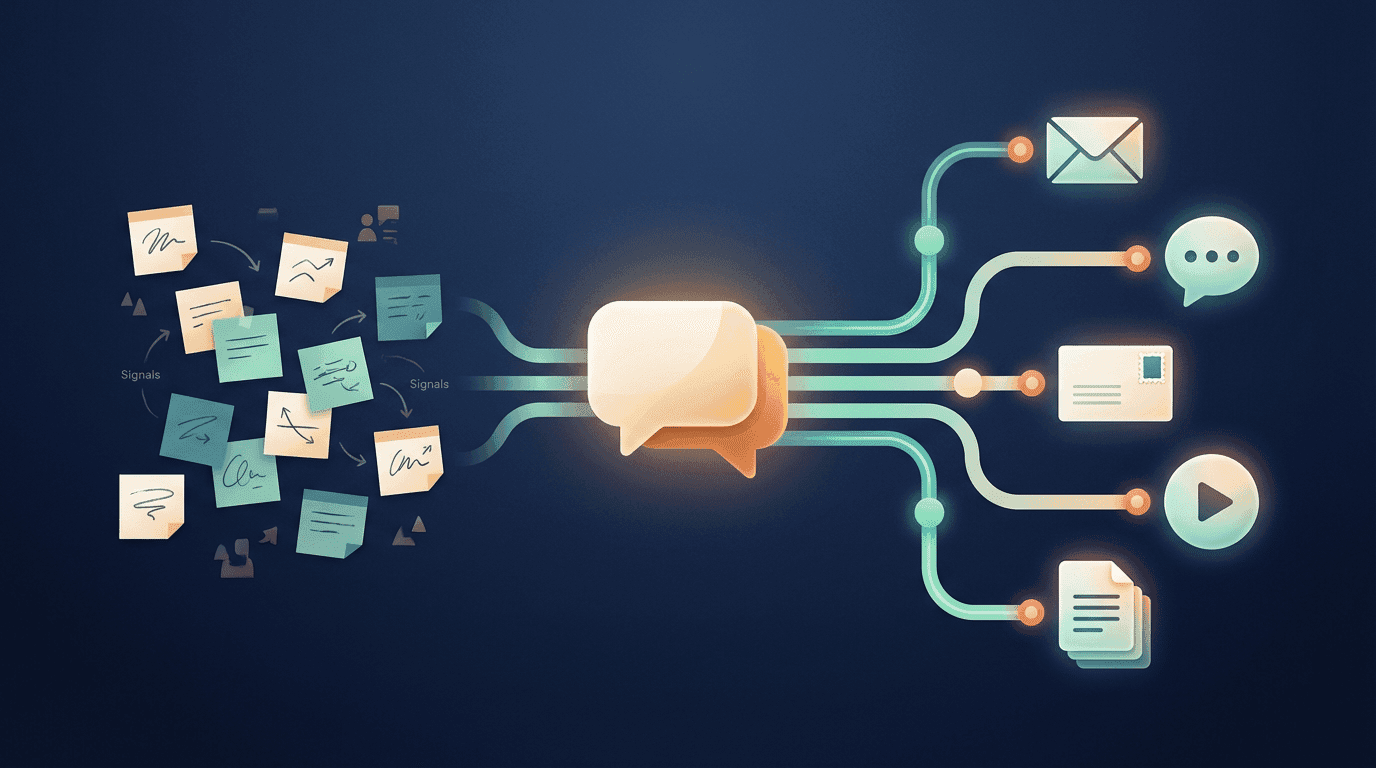
Signals are patterns in donor behavior and context that are hard for a human to “chew on” manually, but can be identified by technology through:
Behavior tracking
Cross-referencing similar profiles
Finding correlations across many data points
This is the move from “throwing darts” to making defensible decisions about:
Who is likely to give again
Who is at risk of churning
Who might upgrade
Who has never given but is likely to
It is also the move from “one-size-fits-all messaging” to content that matches what each group is actually ready for.
The content bridge: you already have the content
The second half of the webinar shifted from “who do we talk to?” to “how do we keep up with content demand?”
John’s “reality check” was simple:
Attention is fragmented. People need more touchpoints than before. At the same time, not everyone wants the same format.
Some want short-form video.
Some still want long-form writing.
Some will respond best to direct mail.
Some will respond best to digital.
So how do you keep up?
John’s argument was that most teams are already sitting on the content they need, especially in the form of:
Webinar recordings
Zoom calls
Interviews
Presentations
Internal conversations worth sharing
The goal is not to constantly create new content from scratch.
The goal is to reformat what you already have.
A practical workflow: “10–80–10” (human-led, AI-assisted)
To address fears about AI being inauthentic, John proposed a specific way to use it.
Not “let the AI do everything.”
Instead:
First 10% (human): decide what you are trying to do
audience
goal
brand voice
boundaries
Middle 80% (AI): do the heavy lifting
turn video into transcript
generate first drafts for different formats
create variations for different audiences
Final 10% (human): review, fact-check, and make it feel real
edit for tone
remove anything sensitive
ensure it sounds like your organization
A key point: today’s models are much better at working with text than “watching video like a human.”
So the recommended workflow starts with video → transcript.
Authenticity is the advantage (not polish)
One of the most useful themes in the webinar was this:
Authenticity does not come from perfect production.
Authenticity comes from real people saying real things.
Once you have that, AI can help you package it for different channels, without losing the human core.
It also helps reduce the “treadmill” problem: the feeling that you need to constantly produce more content, in more places, for more audiences, with the same (or fewer) staff.
The takeaway: sustainable personalization is precision plus repurposing
If you want personalization that your team can sustain, the webinar’s model is:
Use signals, not hunches, to decide who to talk to.
Use transcripts to turn one real conversation into many formats.
Keep humans at the beginning and end so the work stays on-brand and authentic.
That is how you get “more art” without more effort.
And it is how personalization stops being a one-off project and becomes a repeatable system.
Related articles
Find more nonprofit fundraising and data insights from the Dataro team.