Automated prospect research: why wealth screening alone isn't enough
General
Wealth screening tells you who has capacity. It doesn't tell you what to do.
Most fundraising teams run prospect research the same way: pull the file, screen it against wealth databases, and hand back a list of people with the means to give. That's useful. But capacity is only half the decision.
Knowing someone could give a major gift doesn't tell you whether they will, when to ask or what to do for them across the rest of your programs. Automated prospect research promises to fix the manual grind of screening. The real opportunity is bigger: turning enrichment data into a clear decision about who deserves your attention right now.
What automated prospect research actually does
Prospect research, or wealth screening, matches your constituent records against external data: real estate, business affiliations, giving history, philanthropic markers and more. Automation speeds up the matching and refreshes it over time, so you're not re-screening the file by hand every campaign.
That solves a real problem. Manual screening is slow, gets stale fast and pulls technical staff into ad hoc list requests. Automation removes the busywork.
But here's the gap most teams hit:
A screening score tells you capacity, not likelihood.
A wealth rating ranks people by net worth, not by readiness to act.
An enriched list still leaves you guessing on the cutoff and the next step.
You end up with a longer, richer list and the same hard question you started with: who should we focus on, and what should we do for each of them?
The two decisions screening leaves unanswered
If prospect research software didn't exist, fundraisers would still have to make two decisions. Screening helps with the inputs. It rarely closes the loop.
Focus: who deserves attention right now
This is the prioritization decision. With limited capacity and pressure to hit goal, you need a short list your team can approve and a cutoff you can defend.
Wealth screening gives you raw signal here. But a wealth score on its own isn't a defensible cutoff. It doesn't account for affinity, giving patterns or the likelihood that this person responds now rather than in two years. Lead with capacity alone and you'll spend major-gift time on people who look wealthy but show no intent to give to you.
Act: what to do for each of them, across every program
This is the part screening almost never touches. A high-capacity donor might be ready for a major-gift cultivation move. Or they might be a mid-value donor to upgrade, a lapsing supporter to protect or someone to steward before you ask again.
Most screening tools stop at "who has capacity." They don't tell you whether to upgrade, steward, suppress or hand off to a different program. So the list lands, and the work resets every campaign.
Capacity is an input, not a decision
The shift worth making is simple: treat wealth screening as one signal feeding a decision, not the decision itself.
Modern fundraising decisions need reliable signals, not last year's rules and gut feel. Capacity is one of those signals. So is engagement, recency, frequency and predicted likelihood to give. The teams getting value from prospect research combine these into a ranked, donor-level view rather than sorting a spreadsheet by net worth.
This matters because precision is the strategy. Winning isn't expanding your major-gift portfolio to feel safe. It's doing fewer things with higher confidence: a shorter prospect list, prioritized by likelihood and capacity together, that your gift officers can actually work.
What good looks like
Good automated prospect research produces decisions, not dashboards. You should be able to walk away with:
A ranked list of prospects, scored on likelihood and capacity, not capacity alone
A defensible cutoff you can take to leadership and get approved
A clear next action for each person: cultivate, upgrade, steward, suppress or hand off
An owner and a workflow, so the action lands in the tools your team already uses
The test is whether a gift officer can pick up the output and start working it next week. If the result is another report someone has to interpret, you've added analysis, not decisions.
How Dataro approaches it
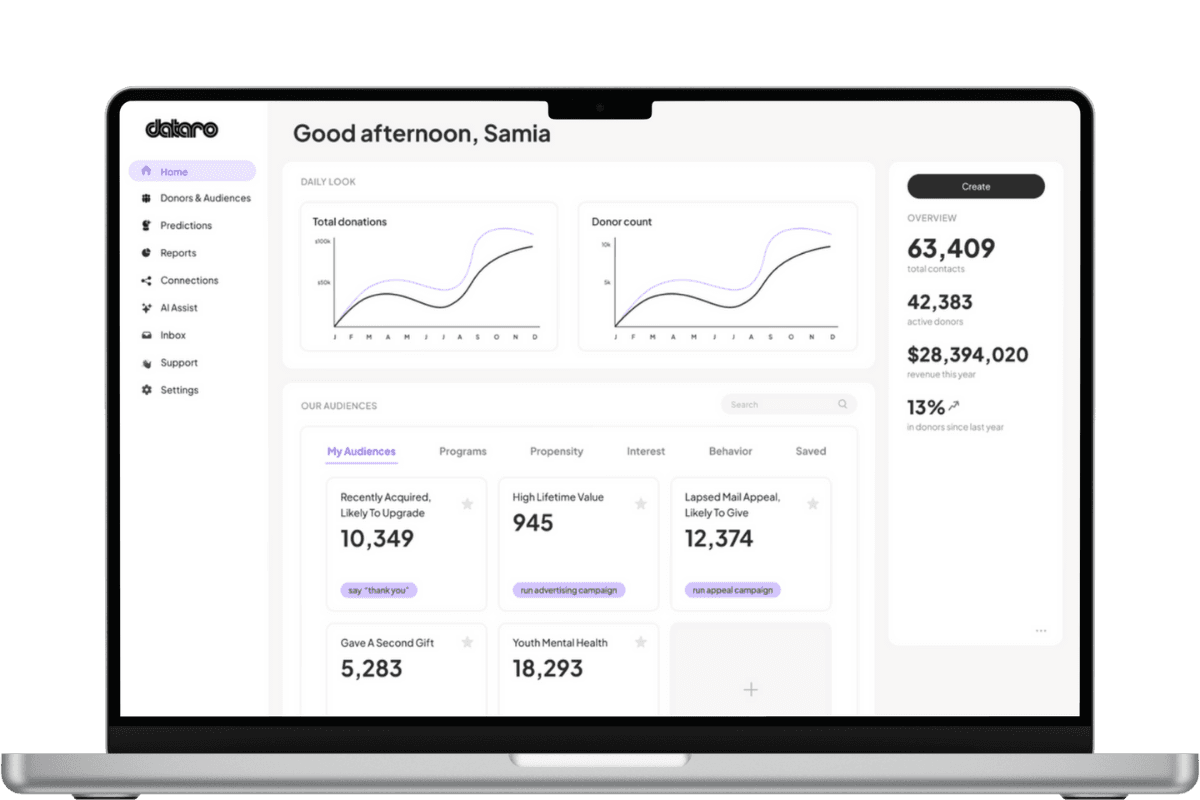
Dataro is a fundraising intelligence platform. We sit on top of your CRM, read your data and return ranked actions into your workflow. We don't replace your CRM, and we're not a wealth screening tool in the traditional sense.
The difference is the predictive layer. Where prospect research tools answer "who has capacity," we drive cross-program decisioning: who to prioritize, when and what to do next. Capacity becomes one signal in a model that also weighs likelihood to give, engagement and giving history.
That means a prospect doesn't just get a wealth rating. They get a place in a ranked list and a next-best action that fits a real program: major gifts, mid-value, retention, stewardship or legacy. The output lands back in your CRM as audiences, tasks or tags so the team can run it.
The operating loop is straightforward: predict, act, measure, repeat. Produce a decision the team can approve. Make the action easy to execute. Show what changed so the next cycle gets sharper.
What happens if you stop at screening
The cost of treating capacity as the answer is quiet but real. You over-invest in high-net-worth prospects who never engage. You miss mid-value donors ready to upgrade because they didn't score high on wealth. Gift officers chase the wrong names, and the list resets every quarter.
Meanwhile, approvals stay slow because a wealth rating isn't a defensible reason to prioritize one person over another. If you can't explain the decision, leadership keeps asking you to justify it.
The shift worth making
Automated prospect research is worth doing. It removes the manual screening grind and keeps your file fresh. But the value isn't in the enrichment. It's in what you do with it.
Treat wealth screening as one input into two decisions: who to focus on and what to do for each of them. Combine capacity with likelihood. Turn the result into a ranked list, a defensible cutoff and a next action your team can run. That's the difference between knowing who could give and knowing what to do about it.
Want to see what ranked, action-ready prospect decisions look like for your file? Book a working session and we'll show you an example output.
Related articles
Find more nonprofit fundraising and data insights from the Dataro team.