AI-powered donor segmentation vs. RFM: a definitive guide
Strategy & Frameworks

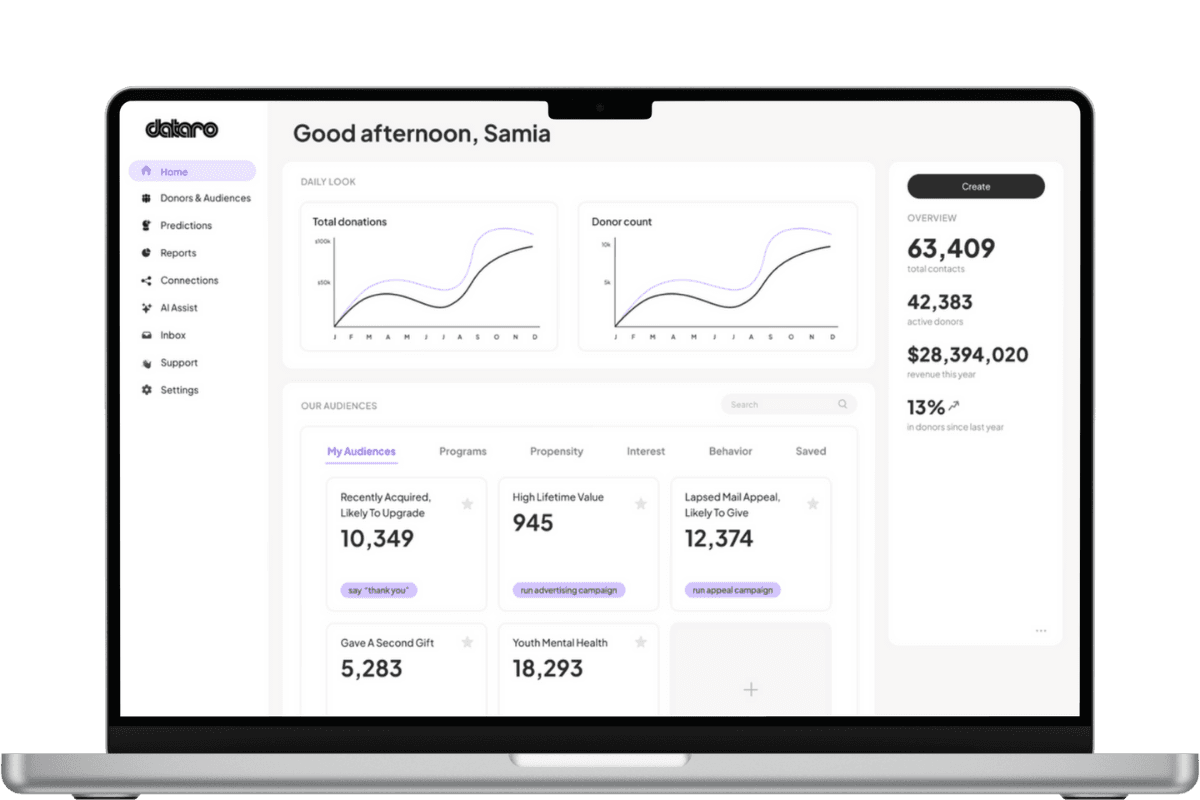
Contrast between AI-powered donor segmentation using behavioral signals and propensity scores versus traditional static RFM buckets
Quick answer
AI-powered donor segmentation uses machine learning to score and group donors by predicted behavior, such as likelihood to give, upgrade or lapse. It updates as new data arrives.
Traditional RFM segmentation sorts donors into fixed buckets based on three past-looking measures: recency, frequency and monetary value. It is manual and static.
The core difference: RFM describes what a donor did. AI segmentation predicts what a donor is likely to do next, then ranks who to focus on.
What is AI-powered donor segmentation?
AI-powered donor segmentation is the use of predictive models to group and rank donors by likely future behavior rather than by past activity alone.
Instead of a handful of rules, the model weighs hundreds of signals per donor: gift history, channel response, email and event engagement, tenure and more. It returns a propensity score for each action you care about, such as making a gift, upgrading or lapsing.
Because the model reruns as data changes, segments update on their own. A donor who re-engages this week moves up the ranking without anyone rebuilding a list.
What is traditional RFM segmentation?
RFM stands for recency, frequency and monetary value. It scores donors on how recently they gave, how often they give and how much they give, then combines those into a segment.
RFM is simple, transparent and easy to run in most CRMs. It has been a fundraising staple for decades because it needs no data science and little setup.
Its limits are structural. RFM looks backward, ignores non-transactional engagement and treats every donor in a bucket the same. The segments are only as fresh as the last time someone rebuilt them.
AI segmentation vs. RFM: side-by-side comparison
Dimension | Traditional RFM / manual lists | AI-powered segmentation |
|---|---|---|
Data used | Recency, frequency, monetary value | Hundreds of behavioral and transactional signals |
Time horizon | Backward-looking | Forward-looking prediction |
Output | Fixed buckets | Ranked donors with propensity scores |
Updates | Manual rebuild | Refreshes as data changes |
Personalization | Bucket-level | Donor-level |
Setup effort | Low | Moderate, model-dependent |
Explainability | High, easy to read | High when scores are inspectable |
Best for | Small files, simple programs | Large files, multi-program teams |
The trade-off is real. RFM wins on speed and simplicity. AI segmentation wins on precision, freshness and the ability to treat donors as individuals rather than buckets.
Key terminology, defined
Propensity score: a model-generated probability that a donor will take a specific action, such as give, upgrade or lapse. Higher scores rank higher.
Engagement scoring: a measure of how actively a donor interacts across channels, including email, events, web and giving. It captures signals RFM ignores.
Donor personas: composite profiles that describe distinct donor types by motivation and behavior. Personas guide messaging and tone.
Psychographic segmentation: grouping donors by values, attitudes and motivations rather than demographics or gift size.
Nurture paths: planned sequences of touches that move a donor toward a goal, such as a first upgrade or a monthly commitment.
Behavioral signals: the actions a donor takes over time, such as opening appeals, attending events or responding to a channel. These feed predictive models.
How is AI segmentation different in practice?
Three differences matter most for fundraising teams.
First, AI ranks rather than buckets. You get an ordered list of who to contact, so you can set a defensible cutoff and mail fewer people with confidence.
Second, it uses signals RFM cannot see. A lapsed donor who just opened three appeals looks dormant to RFM but active to a behavioral model.
Third, it updates automatically. Segments reflect this week's behavior, not last quarter's rebuild, so your targeting stays current.
A framework to choose the right approach
Use this four-step check to match the approach to your data maturity and team size.
1. Assess data volume. Under a few thousand active donors, RFM is often enough. As files grow into the tens of thousands, manual segmentation strains and AI ranking pays off.
2. Assess data breadth. If you capture only gift transactions, RFM fits your data. If you also hold email, event and web engagement, a predictive model can use signals RFM wastes.
3. Assess team capacity. Small teams spending hours pulling and defending lists gain the most time back from automated ranking. Note where manual list work is a bottleneck.
4. Assess program complexity. Single-channel programs run fine on RFM. Multi-program teams juggling appeals, mid-value, retention and stewardship benefit from donor-level scores that coordinate across programs.
A practical rule: start with RFM to build discipline, then layer predictive scoring as your data and programs grow. The two are not mutually exclusive. Many teams use RFM as a baseline and AI rankings to sharpen the cutoff.
Practical takeaways
RFM answers what happened. AI segmentation predicts what happens next and ranks who to prioritize.
Ranked, propensity-scored lists let you mail fewer people with confidence and protect results.
Behavioral and engagement signals surface donors RFM misses, including quiet re-engagers.
Match the approach to your file size, data breadth, team capacity and program complexity.
You can run both: use RFM as a baseline and predictive scores to refine targeting.
Conclusion
RFM is a solid starting point, but it describes the past and treats donors as buckets. AI-powered segmentation predicts future behavior and ranks donors as individuals, so teams can focus effort where it counts and keep targeting current.
The right choice depends on your data and capacity, not hype. Start where your data allows, then add prediction as you grow. Dataro sits on top of your CRM and turns your data into ranked lists and clear next actions, so you can decide who to focus on and what to do next.
Related articles
Find more nonprofit fundraising and data insights from the Dataro team.