Where should donor intelligence live? Comparing six vendor models
Strategy & Frameworks

Donor intelligence belongs in a predictive layer on top of your CRM, not locked inside any single system of record.
Fundraising leaders keep asking the same question when they evaluate new tools: where should donor intelligence actually live? Every vendor claims to own it. The CRM says it belongs in the system of record. The engagement platform says it belongs where donors interact. The prospect research tool says it belongs with wealth data.
The answer matters because it decides two things your team has to get right: who to focus on, and what to do next for each donor across every program. Put that intelligence in the wrong place and it ends up trapped in a dashboard nobody acts on.
This guide compares six common vendor archetypes, with clear trade-offs for each.
What is donor intelligence?
Donor intelligence is the set of predictions and rankings that tell a fundraising team who to prioritize and what action to take next. It usually includes propensity scores, lifetime value forecasts, churn risk and recommended ask amounts. Good donor intelligence produces ranked actions a team can run next week, not just charts that describe what already happened.
The key distinction: a system of record stores donor data, reporting explains what happened, and donor intelligence decides what to do next. Where it lives determines whether those decisions reach the people doing the work.
The six vendor archetypes
Each model below can hold some form of donor intelligence. They differ in how much they predict, how well outputs reach the workflow and how much they lock you into one vendor.
1. All-in-one suite
A single platform that bundles the CRM, email, donation pages and reporting. Intelligence is an add-on feature inside the suite.
Strength: one login, one vendor, one data model. Simple to buy.
Trade-off: prediction is rarely the core competency. Scores tend to be shallow, and you inherit the suite's limits across every program. Switching later is hard.
Best for: smaller teams that value simplicity over predictive depth.
2. Fundraising-first CRM
A CRM built specifically for organisations, with fundraising workflows and some native scoring.
Strength: strong fit for gift processing, moves management and sector reporting.
Trade-off: native AI is usually a bolt-on, not the reason the product exists. Models are generic and hard to tie to measurable lift.
Best for: teams that want a sector-specific system of record and treat insight as a secondary benefit.
3. Enterprise platform
A large, configurable platform (often a general CRM adapted for organisations) with analytics and AI modules available at extra cost.
Strength: scales to complex, multi-entity organizations with heavy customization.
Trade-off: power comes with cost and complexity. Getting intelligence into the daily workflow often needs consultants and long builds.
Best for: large organizations with technical resources and strict compliance needs.
4. Retention and engagement platform
A tool focused on donor communications, journeys and engagement scoring across channels.
Strength: good at timing and personalizing touches once a donor is in a journey.
Trade-off: engagement scores describe channel behavior, not cross-program priority. It optimizes the touch, not the choice of who to focus on first.
Best for: teams whose main gap is communication cadence rather than prioritization.
5. Prospect-intelligence layer
Wealth screening and prospect research tools that enrich records with capacity and affinity data.
Strength: valuable for major gifts. Tells you who has the capacity to give.
Trade-off: capacity is not readiness. Wealth tells you who is rich; behavior tells you who is ready to act. These tools rarely drive cross-program decisions beyond major gifts.
Best for: major-gift teams that need capacity data layered onto behavioral signals.
6. Integration-led ecosystem
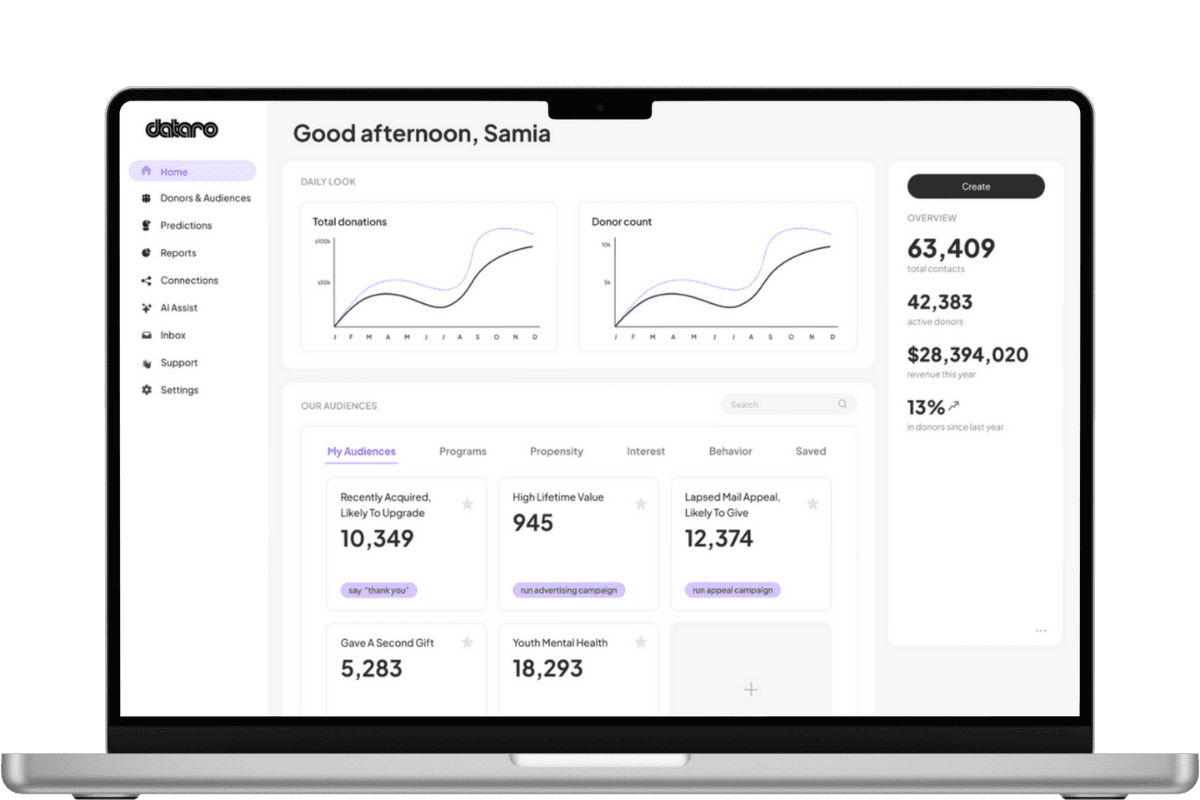
A predictive layer that sits on top of your existing CRM, reads your data and returns ranked actions into the tools you already use.
Strength: prediction is the core job, not an add-on. Outputs land back in the CRM as audiences, tasks and fields, so the team acts without changing systems. Works across appeals, retention, mid, major and legacy.
Trade-off: it is not a system of record, so you keep your CRM. That is the point, but it means buyers must be comfortable running two connected tools.
Best for: teams that want deeper, workflow-ready predictions without replacing their CRM.
Comparison at a glance
Model | Predictive depth | Cross-program reach | Workflow fit | Lock-in risk |
|---|---|---|---|---|
All-in-one suite | Low | Medium | Medium | High |
Fundraising-first CRM | Low to medium | Medium | Medium | High |
Enterprise platform | Medium | Medium | Low without build | High |
Retention/engagement platform | Medium | Low | High for touches | Medium |
Prospect-intelligence layer | Medium for major gifts | Low | Medium | Low |
Integration-led ecosystem | High | High | High | Low |
So where should donor intelligence live?
Donor intelligence should live where it can do two jobs well: rank who to focus on, and return a clear next action into the workflow your team already runs.
That is rarely inside the system of record. A CRM is built to store and report, so prediction tends to be a feature it tolerates rather than a job it is designed for. Engagement and prospect tools solve narrower slices, timing and capacity, but neither answers who to prioritize across every program.
The model that fits both jobs is a predictive layer that sits on top of your CRM. It reads your data, returns ranked actions and writes them back so the team executes in the tools they know. You keep your system of record. You add the layer that turns stored data into who to contact and what to do next.
Practical takeaways
Separate the jobs. Keep the CRM as your system of record and judge intelligence tools on prediction quality and workflow fit, not feature counts.
Ask for proof of lift. Native AI add-ons often cannot show measurable results tied to outcomes. Ask any vendor to demonstrate it, not claim it.
Test the handoff. The real question is whether a ranked list reaches the person running the appeal. If outputs stay in a dashboard, the intelligence is not working.
Check cross-program reach. Prioritization and retention should share one rhythm so appeals, mid, major and stewardship compound instead of resetting.
Protect optionality. Favor models with low lock-in so you can change one part of the stack without rebuilding everything.
Conclusion
No single system owns donor intelligence by default. Suites and CRMs are built to store and report. Engagement and prospect tools solve specific slices. If you need intelligence that ranks who to focus on and tells you what to do next across every program, it belongs in a predictive layer that sits on top of your CRM and feeds ranked actions back into the workflow. Decide where it lives on that basis, and the rest of the stack gets easier to run.
Related articles
Find more non-profit fundraising and data insights from the Dataro team.