Predictive vs generative AI for fundraising: what each is good at, and when to use which
General

Predictive AI ranks who to contact and generative AI drafts the message, and using them in that order makes fundraising sharper.
Predictive and generative AI get grouped under one label, but they do two different jobs. For fundraising teams, the difference decides which tool to trust with which task.
Predictive AI ranks people. It reads your donor history and forecasts an outcome, like who is most likely to give or who is slipping toward lapse. Generative AI creates content. It drafts an email, a thank-you note or a social post from patterns it learned in text.
The split is about purpose, not a hard technical wall. Both are built on machine learning. A large language model, the engine behind chatbots, works by predicting the next word in a sequence. That is why a chatbot can sound authoritative on almost anything. Sounding right and being a purpose-built predictive model are not the same thing.
Use predictive AI to decide who to contact
Your first question in any campaign is a Focus question: who deserves attention right now, and why? That is the job predictive AI is built for.
A predictive model scores each donor on likelihood to give or risk of lapsing. You get a ranked list and a clear cutoff you can explain to your team. You mail fewer people with more confidence, instead of defaulting to last year's segments or a wider list to feel safe.
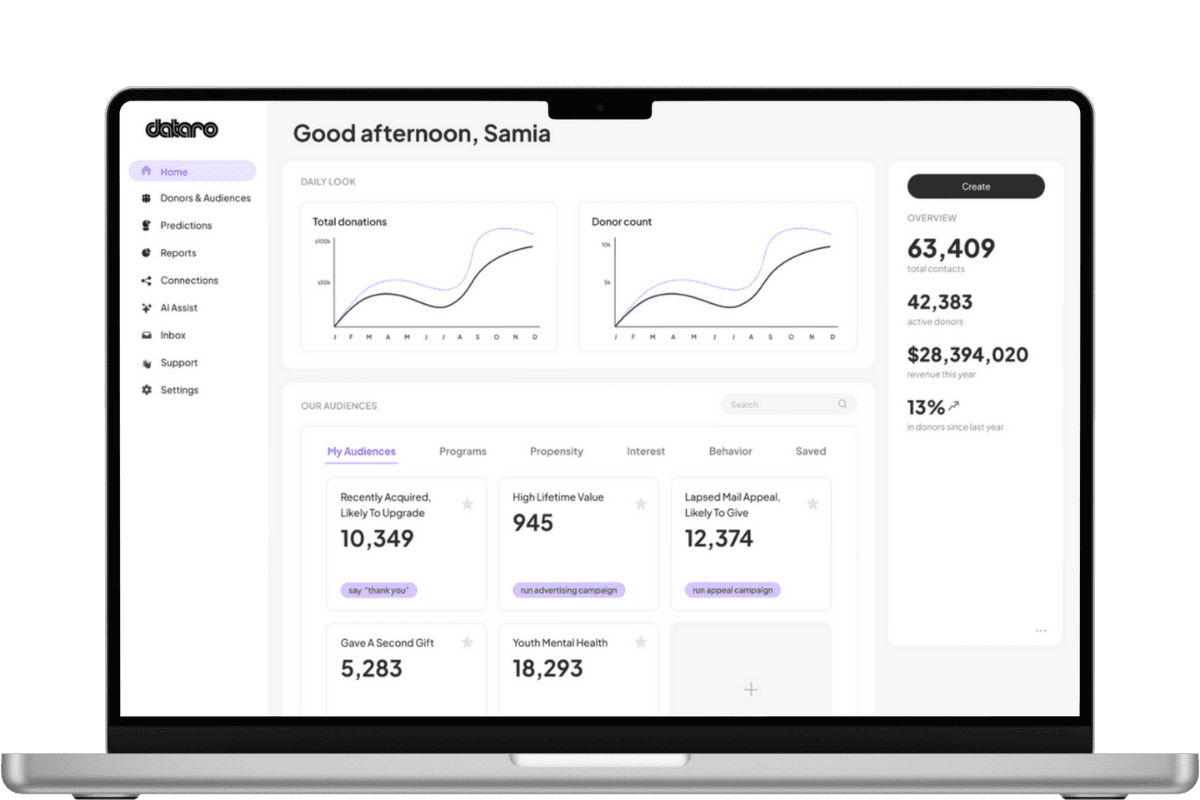
This is where Dataro sits. It works on top of your CRM, reads your data and returns ranked lists and propensity scores, so you can decide who to prioritize before you spend budget.
Use generative AI to draft, with a human in the loop
Once you know who to contact, the next question is what to say. Generative AI helps here. It can produce a first draft fast: appeal copy, subject lines, a stewardship message.
Treat every draft as a starting point, not a finished product. Generative models can hallucinate, which means they present invented details as if they were true. IBM notes this happens because the model generates plausible text rather than checking facts. So ground any research or impact claim in your approved records, and have a person verify it before it goes out.
Don't ask a chatbot to predict who will give
This is the most common mix-up. A chatbot can write a confident paragraph about which donors will upgrade, and it will sound convincing, but it is still not a predictive model trained on your giving data.
Forecasting who will give is a prediction task. Use a model built and tested for that job, not a text generator improvising an answer.
What the research says about the models
On donor-style tabular data, the kind that lives in neat rows and columns in your CRM, gradient-boosted trees remain a strong baseline. A NeurIPS 2022 study by Grinsztajn and colleagues found tree-based models like XGBoost still outperform deep learning on medium-sized tables of roughly 10,000 samples, before you even count their speed advantage.
The picture is not fixed, though. Newer work on parameter-efficient deep learning, such as the TabM research, reports results competitive with boosted trees in some settings. The honest takeaway is fit-for-purpose: the best model depends on the data and the task, not on a single winner.
Combine the two for better results
The strongest pattern uses both in sequence. Score the decision first, then draft the outreach.
Parkinson's UK shows what this looks like in practice. Dataro scored each donor's likelihood of giving and built an appeal list that returned a response rate over 14%, compared with just under 9% for the traditional selection. The approach added 411 gifts worth more than £15,000 while mailing fewer donors.
Predict who to contact, then write for them. That order protects both your budget and your results.
Practical takeaways
Use predictive AI to rank donors and set a defensible cutoff.
Use generative AI to draft content, then have a person review and verify it.
Never ask a chatbot to forecast who will give. That is a prediction job.
Ground any claim in approved records to avoid hallucinated facts.
Combine the two: score first, then draft reviewed outreach.
The two tools are not rivals. Predictive AI tells you who to focus on. Generative AI helps you act. Used in that order, with human judgment in the loop, they make your fundraising sharper and easier to justify.
Want to see what a ranked donor list looks like on your data? Book a demo with Dataro.
Related articles
Find more non-profit fundraising and data insights from the Dataro team.