How to attribute major and mid-level gifts to relationship touchpoints
Strategy & Frameworks

Major and mid-level gifts need an attribution model that credits relationship touchpoints, not digital multi-touch rules borrowed from the annual fund.
Most attribution models in fundraising were built for the annual fund. They track clicks, email opens and form submissions, then split credit across digital touches with fixed rules. That logic breaks down for major and mid-level gifts, where the decisive moments are an officer call, an in-person visit, a handwritten note or a stewardship event.
This guide answers a buyer question we hear often: how should organisations attribute major and mid-level gifts to relationship-driven touchpoints rather than defaulting to digital-channel multi-touch models?
What is relationship-based gift attribution?
Relationship-based gift attribution is a method for assigning credit for a major or mid-level gift to the human touchpoints that influenced it, such as officer calls, visits, personal notes and stewardship events, rather than to digital channels alone.
It answers two questions: which touchpoints moved the donor, and which officer or programme should get credit for the result.
Why digital multi-touch models fail for major and mid-level gifts
Digital multi-touch attribution assumes high volume, short cycles and touches that are logged automatically. Major giving is the opposite. Gifts close over months or years, the sample size is small, and the most important touches are offline and recorded by hand, if at all.
Three problems follow:
Offline touches go uncounted. A model that only sees email and web activity credits the channels it can measure and ignores the visit that actually closed the gift.
Small numbers distort fixed rules. Linear or time-decay weights need volume to average out. Across a 40-gift portfolio, one mislabelled touch skews the whole picture.
Credit lands on the wrong work. When digital gets the credit by default, officer time looks unproductive and gets cut, even though it drove the result.
What good attribution looks like for relationship giving
Start from the decision the model should support, not the channels it can track. For major and mid-level programmes, the goal is to show which relationship touchpoints precede gifts and upgrades, so leaders can route officer time to the donors most ready to move.
Good attribution here is:
Touch-complete: it captures offline moments, not just clicks.
Officer-aware: it credits the people doing the relationship work.
Decision-useful: it informs who to call next, not just who to thank.
A practical model: moves-based attribution
The most workable approach borrows from moves management. Instead of splitting fractional credit across channels, you log substantive moves and track how they relate to gift outcomes.
Define what counts as a move. Agree on a short list: qualification call, first visit, proposal, ask, stewardship event, handwritten note. Keep it tight so officers will actually record it.
Log the move at the donor level. Record the move, the owner and the date in your CRM, attached to the constituent record.
Tie moves to outcomes. Connect the sequence of moves to gifts, upgrades and renewals, so you can see which patterns precede a yes.
Credit the owner, not the channel. Attribute the gift to the officer and programme responsible for the relationship, with digital touches recorded as support, not as the headline cause.
Review on a set cadence. Look at the portfolio monthly: who moved, who stalled and where officer time should go next.
This gives you something a digital model cannot: a defensible link between relationship work and revenue, and a clear read on who to prioritise.
Comparison: digital multi-touch vs relationship-based attribution
Factor | Digital multi-touch | Relationship-based attribution |
|---|---|---|
Built for | Annual fund, high volume | Major and mid-level, low volume |
Primary signal | Clicks, opens, form fills | Calls, visits, notes, events |
Credit goes to | Channels | Officers and programmes |
Data capture | Automatic | Manual, needs discipline |
Gift cycle | Days to weeks | Months to years |
Main risk | Ignores offline touches | Under-logging by busy officers |
Best use | Measuring campaigns | Guiding officer time |
The trade-off is clear. Digital models are easy to populate but blind to the touches that matter for major gifts. Relationship-based models capture the right signals but depend on officers logging their work. The fix for that gap is to keep the move list short and make logging part of the weekly routine.
How to avoid double-counting across programs
Mid-level donors often sit in both the annual fund and a relationship portfolio, so the same gift can be claimed twice. Set a simple rule: once a donor enters a relationship portfolio with an assigned officer, credit for their gifts follows the portfolio. Keep digital touches in the record as context, but do not let two programmes book the same revenue.
Where prediction fits
Attribution tells you what already worked. It does not tell you who to call next. Those are different jobs, and relationship teams need both.
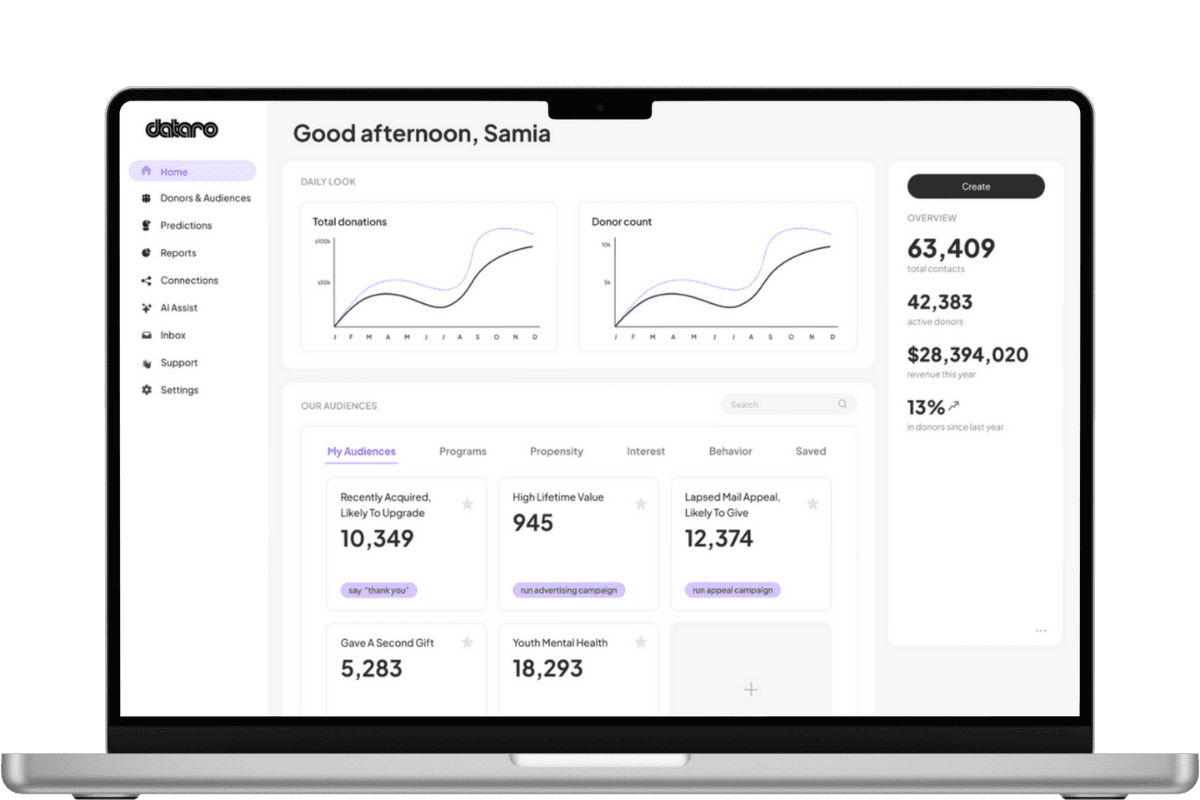
This is where a predictive layer helps. Dataro sits on top of your CRM and turns giving history and engagement signals into ranked lists, so officers can see which donors are most ready to move before they spend time on visits and calls. Behaviour shows readiness; wealth alone only shows capacity.
Used together, attribution and prediction close the loop. Attribution confirms which relationship work drives gifts. Prediction points officers at the next donors most likely to respond. The result is a portfolio built on signals, not gut feel.
Practical takeaways
Do not reuse annual fund attribution for major and mid-level gifts. The channels, volumes and cycles do not match.
Credit the officer and programme, not the channel, for relationship-driven gifts.
Use a short, logged list of moves so the model reflects real work.
Set one rule for mid-level donors to prevent double-counting across programmes.
Pair attribution with prediction so you measure what worked and act on who to contact next.
Conclusion
Major and mid-level giving runs on relationships, so the attribution model has to see relationships. Moves-based attribution credits the calls, visits and notes that actually move donors, and keeps digital in its proper supporting role. Add a predictive layer on top and your team can do more than explain last year's results. They can decide who to focus on and what to do next, with confidence they can defend.
Related articles
Find more non-profit fundraising and data insights from the Dataro team.