The Last Great Gift: How smarter prioritization is changing planned giving
Aleks Chojnacki
Strategy & Frameworks

A loyal, long-tenured donor reflecting on a meaningful legacy gift — warm, considered and human, evoking planned giving and lasting impact rather than wealth.
Bequests are one of the most durable sources of funding in the sector. Charitable bequests have held at roughly 8% to 10% of total U.S. giving for four decades, reaching an estimated $62.19 billion in 2025, even though they are the most volatile source year to year. With an aging, asset-rich population and falling donor retention, the question for most teams is not whether legacy income matters. It is how to find the right prospects without guessing.
The strongest prospects are already in your file
The instinct to chase the wealthiest names is the wrong one. Russell James's research shows that loyalty, not wealth, predicts bequest intent. The most committed bequest donors tend to be long-term supporters. One practitioner analysis found that 80% of bequest donors made 15 or more gifts in their lifetime, often over many years.
Other signals matter more than capacity. James's analysis of donors over 50 who give $500 or more a year found that the absence of children is the single strongest predictor: 50% of childless donors included a charity in their estate plans, compared with 17.1% of those with children. Neuroimaging work links bequest decisions to a donor's life story and connection to a cause, not their balance sheet.
The takeaway is clear. Many legacy gifts come from modest and mid-level donors, and Giving USA advises non-profits not to overlook them. The people most likely to leave a gift are loyal, long-tenured supporters you already have.
More prospects is not the goal. Better ones are
Most programs still identify prospects by intuition, wealth screening and the occasional chance conversation. That produces lists that are either too small to sustain a program or too broad to work. Fundraisers do not need more names. They need better ones.
This is a harder problem for small teams and for organizations without dedicated legacy staff, where the time to sift the file by hand simply is not there.
The affluence-first approach also misses how legacy gifts actually happen. CAF America found that most high-income households do not consider leaving part of their estate to charity unless prompted, and few are prompted during estate planning. The opportunity is real, but it depends on reaching the right people at the right moment.
Why RFM models fall short
Recency, frequency and monetary models predict transactional giving. They are built to forecast the next gift, so they miss the latent intender: the loyal donor who has never signaled wealth but is exactly the profile research points to.
Dataro's Gift in Will model takes a different approach. It ranks your file on legacy-specific signals to surface the top 1% to 2% most likely to leave a bequest. The rankings support fundraiser judgment rather than replace it. They tell you who to focus on first, then leave the relationship work to the people who do it best.
Proof from teams already running it
The results show up in confirmed gifts, not just model scores.
Amnesty International Australia grew confirmed bequests 60% in its first year, adding 72 new bequestors. By the end of 2024 it had confirmed 140 more supporters, an estimated $4.32 million in future income.
In the UK, Erskine uncovered 96 prospects and converted them by phone at a 34% rate. St Andrew's Hospice doubled its pipeline with 30 new pledgers, an estimated £367,000 in future revenue.
The legacy journey, and the three decisions inside it
Legacy fundraising runs over years, not weeks. It moves through identification, discovery, cultivation, disclosure and stewardship. Across that arc, the work comes down to three decisions:
Who to focus on
Who to engage now
What to do next
Get the first decision right and the rest become manageable, even for a small team.
Discovery should open with identity and life story, not legal vehicles. Donors connect to the cause they have supported for years, not to the mechanics of a will. The conversation about how to leave a gift comes later.
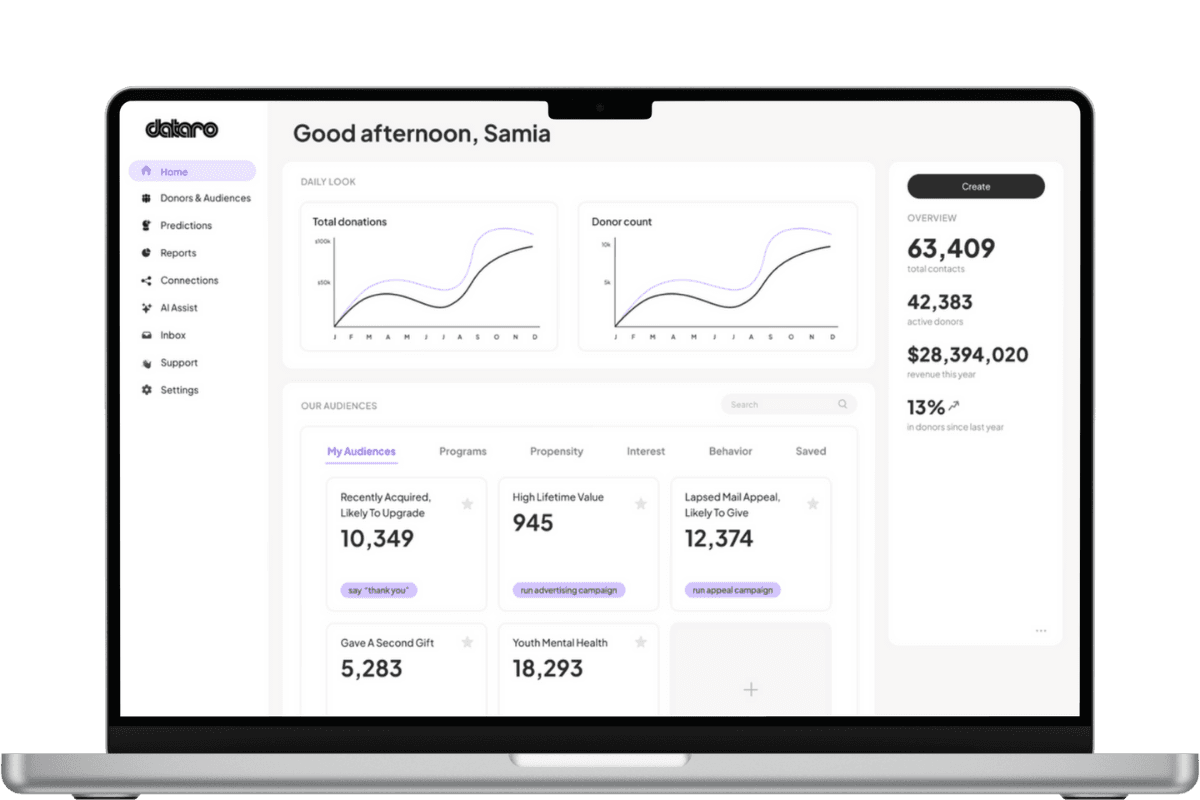
Dataro's ranked outputs live inside the CRM, where teams already work. There is no separate system to learn and no list to export. The priorities land where the day-to-day happens.
Covering the full journey
Identifying the right prospect is the start. Helping a donor act on the intention is where many programs stall.
Giving Docs lets U.S. donors create or update a will or trust in minutes, turning a prompted intention into a completed gift. Best Friends Animal Society added roughly 1,000 legacy society members a year using this kind of low-friction path. Together, ranked prioritization and an easy way to act cover the legacy journey end to end, from finding the right supporter to confirming the gift.
Practical takeaways
Look inside your file first. Loyalty and tenure beat wealth as predictors of bequest intent.
Treat modest and mid-level donors as serious prospects, not afterthoughts.
Use legacy-specific signals, not RFM, to find latent intenders.
Open discovery with identity and life story, and save the legal details for later.
Make it easy to act once a donor is ready, so intention becomes a confirmed gift.
Conclusion
The last great gift a supporter makes is rarely the largest one on paper. It is the one that reflects a lifetime of loyalty to a cause. Smarter prioritization helps teams find those supporters earlier, focus limited time where it counts and give donors a clear path to act. For small teams especially, that is the difference between a legacy program that runs on chance and one that compounds year after year.
Book a demo to see a ranked legacy pipeline inside your own CRM.
Related articles
Find more non-profit fundraising and data insights from the Dataro team.