Unlock the untapped potential of mid-level giving

Cecelia Poplin
General

Predictive rankings help fundraisers find and activate the mid-level donors already sitting in their CRM.
Most fundraising teams pour attention into major gifts and planned giving. Mid-level is the middle child that gets lost. That's a missed opportunity, because the donors with the most untapped potential are often already in your CRM.
In a recent Dataro webinar, Lolita Osorio and Phillip King of Stella joined Andrea Osorio and I to walk through why mid-level matters and how predictive rankings help you act on it. This article pulls the practical takeaways together.
Why mid-level matters
Mid-level donors make up about 5% of annual giving donors, but they represent roughly a third of annual revenue. On average, 80% to 90% of revenue comes from 10% to 20% of donors.
The long-term value is even more striking. The lifetime value of a mid-level donor is 8 to 9 times that of a standard donor, and the number of mid-level donors has grown about 10% year over year across the sector.
Think of mid-level donors as prospects in motion. They're your future major givers, your future planned givers and your future advocates. Cultivating them early builds your strongest pipeline.
The donors asleep in your data
Every organization with 5,000 or more active donors tends to have three types of mid-level donors hiding in the database:
Loyal donors who have given the same amount for years and are ready to be upgraded, but no one has asked
Downgraded donors who once gave a larger gift, then quietly self-downgraded after a low ask
Lapsed donors who gave at a mid-level range a few years ago and were never welcomed back
This churn erodes revenue over time. The good news: these donors are already in your CRM, waiting to be found.
Why RFM falls short
Recency, frequency and monetary value scoring looks through the rear-view mirror. It shows who gave last year. It doesn't show who's ready to give more.
RFM also relies on too few signals. Set the thresholds loosely and you get too many prospects to serve well. Set them tightly and you miss people. Either way, you risk impersonal outreach and wasted budget.
Donors no longer climb the giving pyramid one step at a time. They leap levels. A $40 donor's next gift can be $2,000. RFM can't see that coming.
What predictive rankings change
Dataro's mid-level model answers a different question: who's ready to give more. It assigns each donor an individual propensity score and ranks every record, like places in a race, from your best prospect down.
The model uses 37 predictive features, including engagement, lapse risk, channel, tenure, trajectory and velocity. It retrains continuously and refreshes every seven days for most customers, so it tracks behavior as it shifts. The gap between who gave and who's ready to give more is where your growth lives.
Build your mid-level audiences
In the webinar, Andrea showed how to turn predictions into working lists. The steps are simple:
Set your mid-level thresholds in settings, under mid and major donor thresholds, so the definition fits your organization
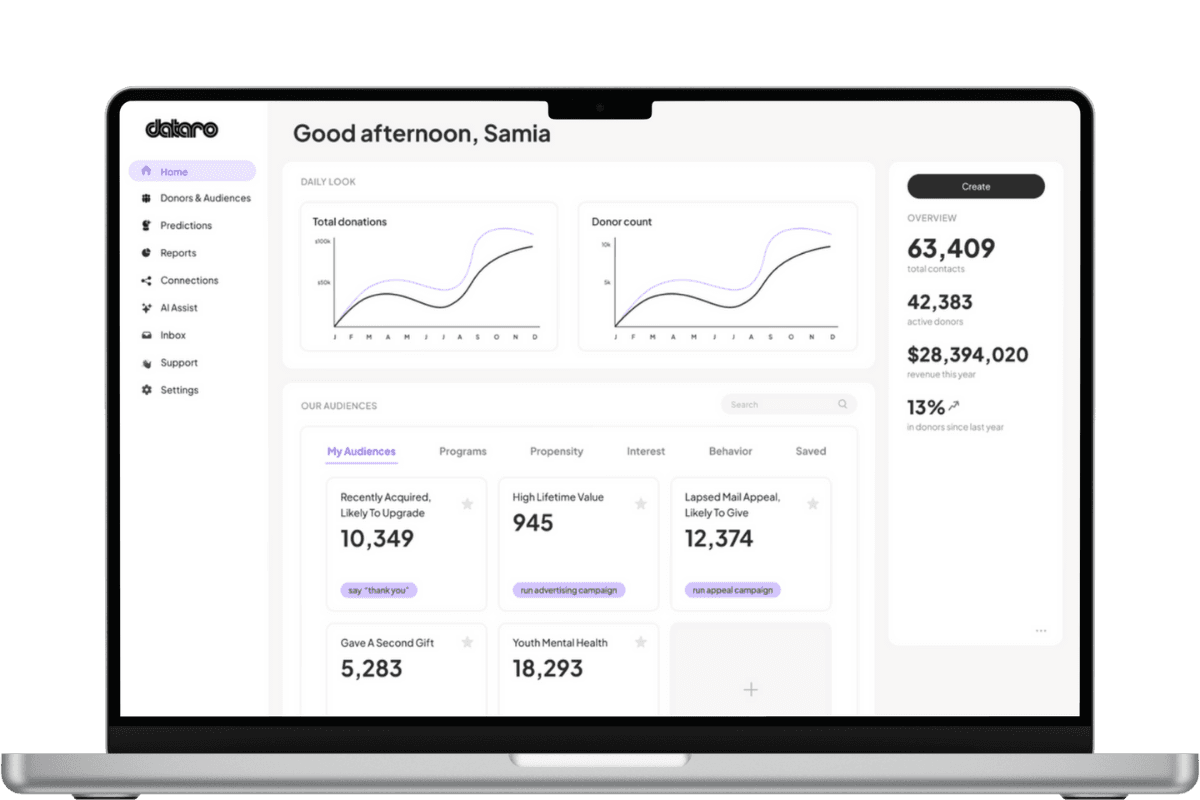
In Audience Builder, apply the mid-level ranking filter to surface your top 100 prospects
Save a prospects audience and an active mid-level donor audience, as either a static snapshot or a dynamic list that refreshes
Set up weekly alerts to track who flows into each audience
A one-year donor journey
Once you have your audiences, build a 12-month journey. You can run prospects through the same journey as existing mid-level donors to get started fast.
Personalized, multichannel outreach is key. Combine email with a phone call or mail, add an impact touchpoint that shows what the gift achieved, and consider special event invitations or small recognitions like a coffee voucher. You don't need every channel. Even two used well can lift results.
To manage the program:
Save the starting audience as a static list for the one-year journey
At least once a quarter, batch in new top-ranked prospects who weren't in the original journey
At the end of each journey, stop sending premium materials to those not giving at mid-level to control cost
Proof it works
The Canadian Cancer Society took an audience-first approach to its year-end appeal. It cut campaign effort by 80% and reached a 27% response rate among mid-level prospects identified by Dataro rankings.
Save the Children Australia converted 359 donors to mid-value giving through a single campaign. Its test group, built on Dataro mid-level rankings and given special treatment, converted nearly 20% more prospects than the control group.
How to get started
This week, log into Dataro, open Audience Builder and create your active mid-level and prospect audiences. Set weekly alerts for both.
This month, plan a one-year journey for each audience, name your next appeal as the first step and choose enhancements that fit your budget.
On an ongoing basis, review performance each quarter, update your static audiences as donors flow in and out, and consider layering in additional Dataro models. The teams that see the most success use more than one.
The takeaway
Mid-level is one of your biggest growth opportunities, and the donors are already in your database. Your existing appeals program can become a vehicle for stewardship at scale. Use predictive rankings to focus on the right donors, build a simple one-year journey and wake up the value that's been sitting quietly in your CRM.
Related articles
Find more non-profit fundraising and data insights from the Dataro team.