How to prioritize donors: a practical guide for fundraising teams
Strategy & Frameworks

Ranking donors by predicted propensity lets teams focus on fewer, better contacts and defend every cutoff.
The short answer
Donor prioritization is the practice of ranking your donors and prospects by their likely response, so you contact fewer people with more confidence. The goal is a short, defensible list your team can approve and act on this week.
Most teams still build that list from manual segments and gut feel. That approach over-mails, wastes budget and is hard to defend when leadership asks why a name is in or out.
What is donor prioritization?
Definition: Donor prioritization is the process of scoring every donor by predicted propensity, then setting a cutoff that decides who to contact now and who to hold. It answers one question: who deserves our attention right now, and why?
Good prioritization produces three things:
A ranked list from most to least likely to respond
A clear cutoff the team can explain
A next action for each record
Why gut feel and RFM fall short
Rules built last year stop being predictive. RFM and wealth scores group people into coarse buckets and treat everyone in a segment the same. That creates two failure modes: teams over-mail to feel safe, or under-mail out of fear.
Both cost money. Rising mail, media and staff costs make that waste visible, and cutoffs based on habit are hard to justify in an approval meeting.
How to prioritize donors in 5 steps
Start with the decision. Name the program and the goal, such as a renewal appeal or a mid-value upgrade.
Rank the file. Score every donor by predicted propensity rather than by segment rules.
Set a defensible cutoff. Decide where to draw the line based on the ranking, expected return and capacity.
Assign a next action. Give each record an owner and a clear move: contact, upgrade, steward or suppress.
Measure and repeat. Track what changed, then sharpen the next cycle.
Ranked lists vs. traditional segmentation
Approach | Strength | Trade-off |
|---|---|---|
Manual segments | Familiar and quick to set up | Coarse buckets treat different donors the same |
RFM scoring | Uses real giving history | Backward-looking and not predictive of future response |
Wealth screening | Useful for major-gift capacity | Shows capacity, not likelihood to give now |
Predictive rankings | Prioritizes at the donor level with a clear cutoff | Requires clean CRM data and a review rhythm |
The practical takeaway: use predictive rankings to decide who to focus on, and keep wealth data for the narrower question of major-gift capacity.
How predictive rankings work with your CRM
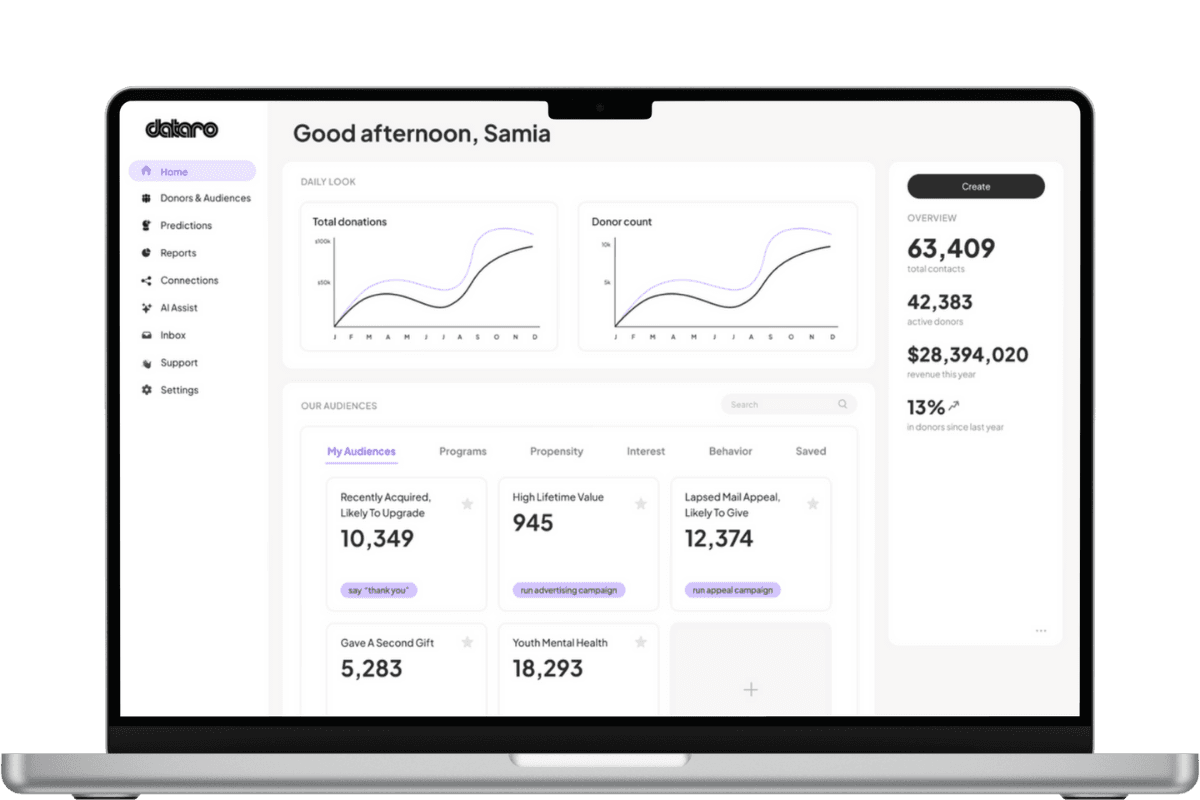
Prediction is now the baseline for modern targeting. A predictive layer sits on top of your CRM, reads your data and returns ranked lists, cutoffs and next actions back into the tools your team already uses.
Nothing gets replaced. Your CRM stays the system of record, and the outputs land as audiences, tasks or lists your team can run.
Practical takeaways
Rank the whole file before you build a list, not after
Set one cutoff you can explain in a sentence
Attach a next action to every record so work does not reset
Prefer fewer, better touches over expanding the list to reduce anxiety
Review results each cycle and adjust the cutoff
Conclusion
Better prioritization is not more activity. It is fewer, clearer choices your team can defend and act on. Rank the file, set a cutoff you can justify and give every donor a next action. That rhythm helps you mail fewer people with confidence and protect results across every program.
Related articles
Find more non-profit fundraising and data insights from the Dataro team.