Donor data enrichment: a buyer's guide to wealth screening, prospect research and AI donor intelligence
Strategy & Frameworks

Enrichment adds data to donor records, but only an embedded AI intelligence layer turns that data into who to focus on and what to do next.
Fundraising teams are asked to raise more with flat headcount and rising costs. That pressure pushes many toward buying more data: appended contact details, wealth scores, research profiles. But data alone does not tell you who to focus on or what to do next. This guide explains what donor data enrichment is, how it differs from related approaches, and how to choose the right fit.
What is donor data enrichment?
Donor data enrichment is the process of adding missing or updated information to your existing donor records. It fills gaps in your CRM: contact details, demographics, giving history from other sources, and third-party attributes such as estimated age or interests.
The goal is a more complete, accurate record. Enrichment does not, by itself, tell you which donors matter most or what action to take. It improves the raw material your team works with.
How does enrichment differ from wealth screening, prospect research, and AI donor intelligence?
These four terms overlap, but they answer different questions and serve different programs. Here is a quick way to tell them apart.
Donor data enrichment completes the record. It answers: what do we know about this person?
Wealth screening estimates capacity to give. It answers: how much could this person afford to give?
Prospect research builds a deep profile of a named individual, usually for major gifts. It answers: who is this person, and how do we approach them?
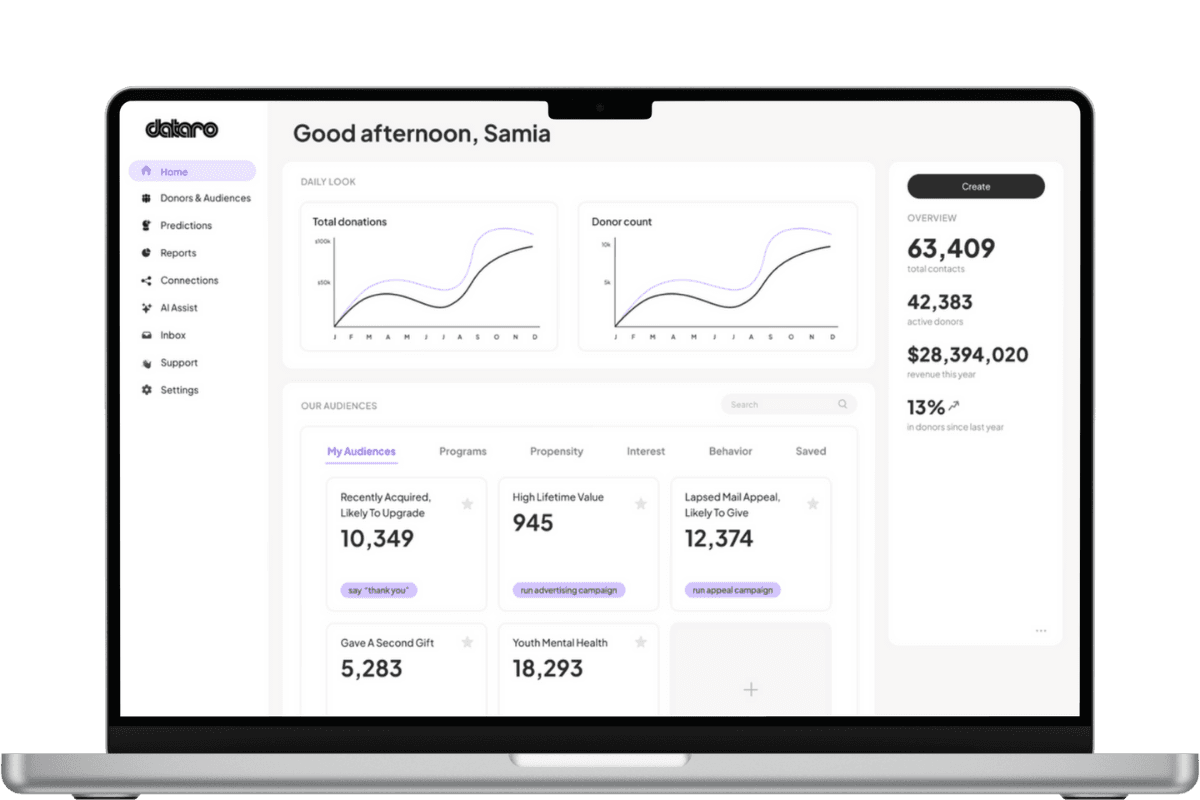
AI-driven donor intelligence predicts behaviour across your whole file. It answers: who should we focus on right now, and what should we do next?
Comparison framework: contact-centric vs. capacity-centric vs. intelligence-centric
A simple way to compare these approaches is by what they put at the centre.
Dimension | Contact-centric enrichment | Capacity-centric screening and research | Intelligence-centric AI |
|---|---|---|---|
Core question | What do we know? | How much could they give? | Who to focus on and what to do next? |
Primary output | Filled fields and appended data | Capacity ratings and wealth flags | Ranked actions and propensity scores |
Scope | Whole file | Top prospects and major gifts | Whole file, across programs |
Best for | Data hygiene and completeness | Major-gift qualification | Prioritization and next-best action |
Main limit | Data without direction | Capacity is not intent to give | Depends on data quality |
Enrichment and screening are inputs. Intelligence is what turns those inputs into a decision your team can run.

Key donor data terminology
Use these definitions when comparing vendors.
Data append: adding a specific field to a record from an external source, such as an email address, phone number, or estimated age.
Hit rate: the share of your records a vendor can match and append. A 60% hit rate means the vendor returned data for 60% of the records you submitted.
Confidence score: a vendor's estimate of how likely an appended value is correct. Higher scores mean more reliable matches.
Capacity rating: an estimate of how much a donor could give based on wealth markers such as property, stock holdings, and business ownership.
Philanthropic indicators: signals that a person gives to causes, such as past gifts to other non-profits, foundation involvement, or board roles.
Capacity and philanthropic indicators describe potential. They do not measure whether someone is likely to give to you, now.
Questions non-profits should ask enrichment and intelligence vendors
Use these questions to compare vendors on the same terms.
On data quality
What is your hit rate on files like ours, and how is it measured?
How do you report confidence scores, and how often is data refreshed?
What sources do you use, and are outputs cited?
On coverage and fit
Does your coverage match our regions and donor base?
Does this work across our whole file or only top prospects?
On output and workflow
Do we get raw data, or ranked actions we can run?
How do outputs land back in our CRM as tasks, tags, or lists?
Can our team explain and justify the outputs to leadership?
On trust and governance
Where is our data stored, and what is your security posture?
Are you SOC 2 certified and compliant with GDPR and local privacy rules?
Why an embedded AI intelligence layer outperforms stand-alone tools
Stand-alone wealth screening and manual prospect research have a place, especially in major gifts. But as your primary engine for the whole file, both have the same gap: they tell you about capacity, not about who to focus on and what to do next.
Capacity is not intent. A donor with high estimated wealth may never give to your cause. A modest donor may be your best upgrade or recurring prospect this quarter. Screening alone cannot tell the difference. Manual research does not scale past a short list, and the work resets with every campaign.
An AI-powered intelligence layer that sits on top of your CRM works differently. It reads your data, including enriched fields, and returns ranked actions across every program: appeals, retention, mid-value, major gifts, and stewardship. Instead of a spreadsheet of scores, your team gets a clear priority list and a recommended next step on each record, delivered back into the tools they already use.
Embedding matters. When intelligence lives inside the CRM workflow, outputs become tasks and lists a fundraiser can act on next week, not a report someone has to interpret. That means fewer, better touches, less manual list work, and cutoffs the team can explain.
Practical takeaways
Enrichment completes records. It is an input, not a strategy.
Wealth screening and prospect research measure capacity, not intent to give.
AI donor intelligence answers the two decisions that matter: who to focus on and what to do next.
Ask every vendor about hit rate, confidence scores, coverage, workflow fit, and governance.
Prefer an intelligence layer embedded in your CRM so outputs are ranked actions your team can run and justify.
Conclusion
More data is not the goal. Better decisions are. Enrichment, screening, and research all have roles, but on their own they leave your team with information and no clear direction. An embedded, AI-powered intelligence layer turns that data into ranked actions inside your CRM, so you can mail fewer people with confidence and protect results. Start by asking vendors how their output helps you decide who to focus on and what to do next.
Related articles
Find more non-profit fundraising and data insights from the Dataro team.