Predictive fundraising: how to decide who to focus on and what to do next
Strategy & Frameworks
Predictive scoring turns CRM data into ranked donor priorities and clear next actions fundraising teams can run this week.
The short answer
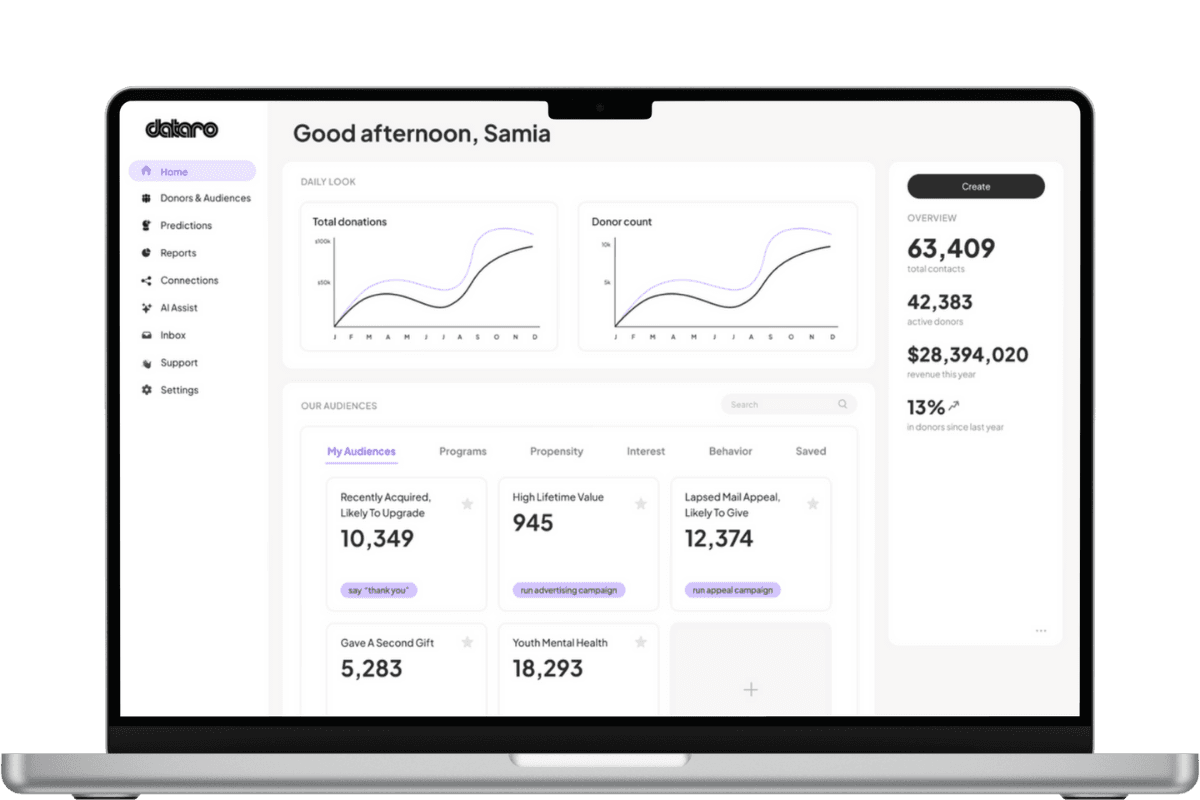
Predictive fundraising uses your existing CRM data to rank donors by how likely they are to act, then pairs each ranking with a clear next step. Instead of debating segments, your team gets a short list of who to focus on and a recommended action for each person.
The payoff is simple: fewer touches, better timing and results you can explain to stakeholders.
What is predictive fundraising?
Predictive fundraising is the practice of scoring donors on likely behaviour, such as giving, upgrading, lapsing or responding to an appeal. Those scores turn into a ranked list your team can act on.
It sits on top of your CRM. It does not replace your system of record, your reporting or your email tools. It adds a layer that answers two questions every fundraiser has to answer anyway:
Who should we focus on right now?
What should we do for each of them?
Why manual targeting falls short
Most teams still build lists with manual segmentation and last year's rules. That approach made sense when budgets were larger and staff had more time. It struggles now.
Costs are up. Teams are flat. Donor behaviour is harder to predict. So the safe default becomes "mail more people" or "reuse the segments we used last year," even when everyone suspects those cutoffs are no longer accurate.
That guesswork is expensive. Fundraisers spend hours pulling lists and negotiating exclusions. Because the cutoffs are hard to justify, approvals slow down and donor fatigue rises.
RFM vs. predictive scoring
Many teams rank donors with RFM, which scores people on recency, frequency and monetary value. RFM is easy to understand, but it looks backward. Predictive scoring looks forward.
Factor | RFM | Predictive scoring |
|---|---|---|
Basis | Past giving behaviour | Likely future behaviour |
Signals used | 3 fixed inputs | Many CRM signals combined |
Question answered | Who gave before? | Who is likely to act next? |
Best use | Quick, rough segmentation | Ranking who to prioritize and why |
Limitation | Misses new or changing donors | Needs clean data and clear outputs |
RFM is a reasonable starting point. Predictive scoring is a sharper tool when you need to cut mail volume without cutting revenue.
How predictive fundraising works in practice
Think of it as a repeatable loop: predict, act, measure, repeat.
Predict. Score donors and produce a ranked list with a defensible cutoff.
Act. Attach a next-best action to each record, such as upgrade, steward, suppress or hand off to another program.
Measure. Track what changed so the next cycle gets sharper.
Outputs land back in your CRM as audiences, tasks, tags or fields. Your team runs the work in the tools they already use.
Practical takeaways
Start with one program, such as your next appeal, rather than a full rollout.
Use rankings to set a clear cutoff, then test mailing fewer, higher-ranked donors against your usual file.
Pair every ranking with an action. A score without a next step does not move revenue.
Watch retention signals early so you can reach at-risk donors before they lapse.
Keep outputs explainable. If you cannot justify a cutoff to leadership, you cannot use it.
Conclusion
Predictive fundraising is not about more activity. It is about fewer, better decisions. When your CRM data becomes a ranked list with clear next actions, you target with more precision, protect team capacity and run programs that are easier to approve.
Start small, measure the lift and let each cycle sharpen the next.
Related articles
Find more non-profit fundraising and data insights from the Dataro team.