Personalized fundraising content: how to reach every donor right
General

Personalized fundraising: matching the right message to each individual donor rather than sending one appeal to the whole file. Clean, modern, warm and human.
The problem with one message for everyone
Most fundraising teams know personalization matters. Yet when a campaign goes out, the safe default is still a handful of broad segments and a single appeal copied across the file. Everyone gets roughly the same ask, at roughly the same time, with roughly the same next step.
That's not personalization. It's mass mail with a merge field.
The cost is real. Donors who deserve a thank-you get another upgrade ask. Lapsing supporters get nothing until it's too late. And the team spends hours arguing over list pulls instead of deciding what each donor actually needs.
The shift we believe in is simple: donors are individuals, not segments. Personalized fundraising content means deciding the right action for each person, then making that action easy to run.
What personalized fundraising content really means
Personalization gets reduced to a first name in the subject line. That's the shallow version. The deeper version answers a harder question: what should we do for this specific donor, right now, across every program we run?
That question splits into two decisions every fundraiser has to make, whether or not they have software to help:
Focus: Who deserves our attention right now, and why?
Act: What's the right thing to do for each of them, across appeals, retention, mid-value and stewardship?
Personalized content lives inside the second decision. Once you know who to focus on, the content has to match where each donor is. An at-risk monthly giver needs a different message than a first-time donor or a long-term supporter ready to upgrade.
Personalization is a decision, not a template
The template is the easy part. The hard part is knowing which template to send to whom, and when. Most teams skip that step because the data is buried in the CRM and pulling it by hand takes too long. So they widen the list and hope.
That's where personalization breaks down. Not because teams don't care, but because deciding donor by donor at scale is more than a person can do manually.
Why generic content quietly costs you money
When content isn't matched to the donor, three things happen. None of them are dramatic on their own, which is why they go unnoticed.
Donor fatigue. People who hear the same ask too often stop opening, then stop giving. Over-mailing to feel safe trains your best donors to tune out.
Missed timing. A donor at risk of lapsing needs a retention message, not a year-end appeal. Send the wrong one and you lose the value you already had.
Wasted spend. Mail, paid media and staff time go to people who were never going to respond, while the donors who would have upgraded get a generic note.
None of this is a content-writing problem. It's a targeting and timing problem. The words can be excellent and still land wrong if they go to the wrong person at the wrong moment.
What good personalization looks like
Good personalized fundraising content has three traits. It's specific, it's timely, and it's defensible.
Specific means the message reflects the donor's history and likely next step, not just their name. A lapsed donor sees a win-back message. A high-potential donor sees an upgrade ask. A loyal monthly giver sees a thank-you and an impact update.
Timely means the message goes out when the donor is most likely to respond, not when the calendar says it's appeal season.
Defensible means you can explain why each donor got what they got. "We sent the upgrade ask to these 400 people because they showed the strongest signals" is a decision a manager can approve. "We mailed everyone to be safe" is not.
That last point matters more than teams expect. If you can't explain the logic behind a segment, you can't defend the spend, and approvals slow down.
How to build personalized content without manual list work
The goal isn't more content. It's the right content, matched to the right donors, in a way the team can run next week. Here's a simple sequence to get there.
Rank your file. Start with who's most likely to respond, upgrade, lapse or give again. This turns a flat list into a prioritized one.
Match content to the action. For each priority group, decide the next-best action: appeal, steward, upgrade, win back or suppress. The content follows the action, not the other way around.
Assign an owner and a workflow. A next-best action only works if someone runs it. Push the audiences and tasks back into the tools the team already uses.
Measure what changed. Compare response, retention and revenue against your old approach so the next cycle gets sharper.
Notice that writing copy is one step of four. The other three are about deciding and executing. That's the part teams usually do by hand, and it's the part that doesn't scale.
Where the data fits
Your CRM already holds the history you need: giving patterns, recency, channel response, lapse risk. The challenge is turning that into clear, ranked actions fast enough to act on.
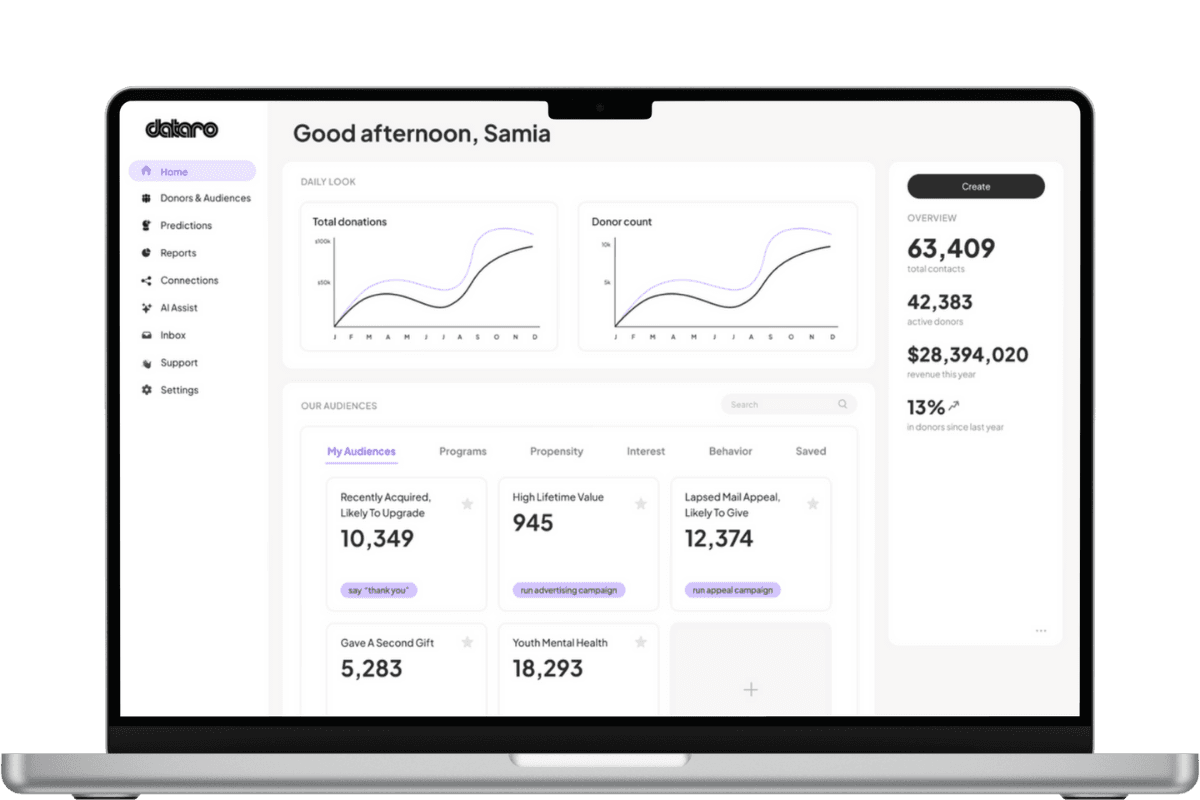
Dataro sits on top of your CRM and does exactly that. It reads your data and returns ranked priorities and next-best actions as audiences, lists and tasks, so personalized content goes to the right donors without hours of manual pulling. We add a decision layer. We don't replace your CRM, your email tool or your judgment.
Personalization is a rhythm, not a one-off
The teams that get this right don't treat personalization as a campaign feature. They treat it as a repeatable loop: predict who needs what, act on it, measure the result, then repeat.
Each cycle teaches you more. The donor who responded to a retention message moves into a different track next time. The signals get sharper. The content gets more relevant. And the team spends less time debating lists and more time on the work only people can do, like building relationships and crafting the message itself.
That's the real payoff of personalized fundraising content. Not a clever subject line, but fewer, better decisions about what each donor needs, delivered in a way the team can actually run.
The bottom line
Personalized fundraising content isn't about adding a name to a template. It's about answering two questions for every donor: who to focus on, and what to do next. Get those right, and the content takes care of itself.
If your team is still pulling lists by hand and hoping the segments hold up, the constraint isn't your writing. It's the manual work between your data and your decisions. Close that gap, and personalization stops being an aspiration and becomes a routine.
Related articles
Find more non-profit fundraising and data insights from the Dataro team.