How to increase recurring giving conversion rates
Strategy & Frameworks

Bold, dynamic visual of one-time donors converting into recurring givers — upward momentum, vibrant brand gradient, sense of compounding growth
The short answer
To increase recurring giving conversion rates, stop treating it as one metric. Split it into two jobs: acquisition, turning a first gift or a visitor into a sustainer, and retention, keeping that sustainer active month after month. Each job fails for different reasons. Match the fix to the reason, not to the tool your peers happen to use.
Most teams buy a tool before they diagnose the gap. That is why conversion stalls even after a new platform goes live. Diagnose first. Buy second.
What counts as a recurring giving conversion?
Recurring giving conversion is the rate at which a supporter moves from a lower-commitment state to an active, ongoing monthly gift. It shows up in two places:
Acquisition conversion: the share of eligible donors or visitors who start a recurring gift
Retention conversion: the share of active sustainers who keep giving past each renewal or card cycle
A healthy program needs both. A great form that feeds a leaky retention process still loses money. Strong retention on a tiny sustainer base grows slowly. Read the two numbers separately before you act.
Why one number hides the real problem
A single "recurring conversion rate" averages two very different failures. When the number drops, you cannot tell whether the form is losing people at checkout, the ask is landing with the wrong audience or existing sustainers are churning after a failed payment.
Each of those is a different gap:
Form gap: friction in the sign-up experience itself
Message gap: the ask, offer or timing does not persuade
Audience gap: you are asking the wrong people, or missing the right ones
Name the gap first. It tells you which category of tool to reach for.
The three tool types and what each one actually solves
Three software categories get pitched as the answer to recurring giving. They solve different parts of the problem.
Donation form platforms
These optimize the conversion moment: the page and checkout. Think smart defaults, one-click upsells from single to monthly, wallet payments and fewer form fields. They fix the form gap.
Use them when eligible traffic arrives but drops off at sign-up, or when your single-to-monthly upgrade prompt is weak or missing.
What they do not do: tell you which supporters to ask, or why a message underperforms with a specific audience.
Sustainer and recurring donation software
This category runs the mechanics of the recurring program: billing, scheduled gifts, self-service portals, failed-payment recovery and dunning. It protects revenue you have already won. It mostly fixes the retention side of the message and process gap, keeping active donors active.
Use it when sustainers sign up fine but churn on failed cards, expired payments or missed renewals.
What it does not do: decide who is most likely to convert or who is about to lapse before the payment fails.
Predictive donor intelligence tools
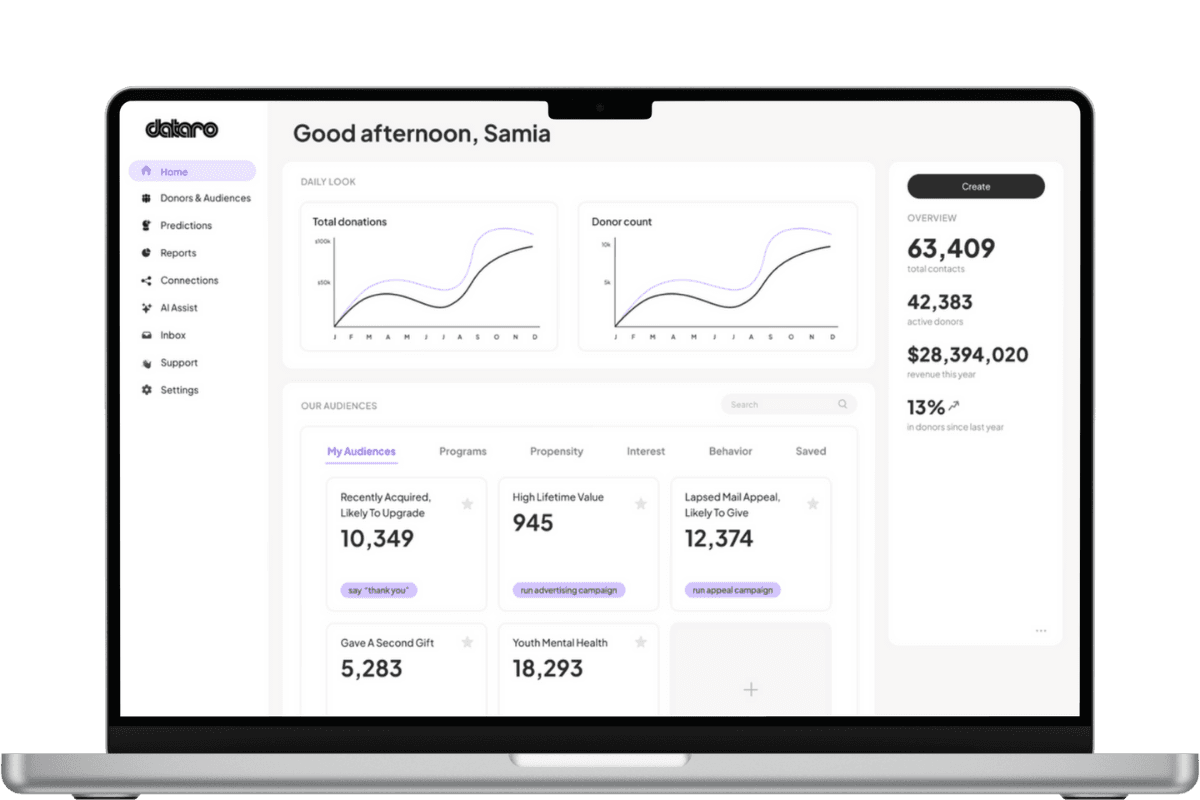
These sit on top of your CRM and turn donor data into ranked lists: who is most likely to upgrade to monthly, who is at risk of lapsing and what to do next for each person. They fix the audience gap on both jobs, acquisition and retention.
Use them when your form and billing work but you are asking everyone the same way, or when you learn a sustainer has churned only after the money stops.
What they do not do: replace your form or your billing system. They point those systems at the right people.
Which tool matches which gap?
Gap | Symptom | Tool type | Job it improves |
|---|---|---|---|
Form | Traffic arrives but drops at sign-up | Donation form platform | Acquisition |
Message and process | Sustainers churn on failed or expired payments | Sustainer/recurring software | Retention |
Audience | Same ask to everyone; churn spotted too late | Predictive donor intelligence | Acquisition and retention |
The trade-off is coverage. Form platforms and sustainer software are deep in one moment. Predictive tools are broad across the file but rely on the other two to execute the touch. Most programs need more than one. The mistake is buying a second tool that solves the gap you already closed.
A practical sequence to lift conversion
You do not need all three at once. Work in order of leverage.
Measure the two rates separately. Split acquisition conversion from retention conversion so you can see which one is dragging.
Fix the obvious form gap. If checkout is losing people, a modern form with a single-to-monthly prompt is the fastest win.
Plug retention leaks. Turn on failed-payment recovery and self-service updates so you stop losing sustainers to expired cards.
Target the audience gap. Use ranked, predictive lists to prompt the donors most likely to upgrade and to reach at-risk sustainers before the payment fails.
Measure, then repeat. Feed results back in so the next cycle gets sharper.
How predictive targeting changes the math
Form and billing tools improve the moment. Predictive donor intelligence improves the aim. Instead of showing a monthly ask to everyone, you rank supporters by likelihood to upgrade and prompt the ones most likely to say yes. Instead of learning about churn when the money stops, you get an at-risk list early enough to act.
That is the difference between reacting and prioritizing. You ask fewer people with more confidence, and you protect revenue before it lapses rather than trying to win it back after.
Key takeaways
Treat recurring conversion as two jobs: acquisition and retention.
Diagnose the gap before buying: form, message and process, or audience.
Donation form platforms fix the form. Sustainer software protects retention. Predictive donor intelligence fixes the audience across both.
Sequence the fixes by leverage and measure the two rates separately.
Conclusion
Recurring giving conversion rarely improves because of one silver-bullet tool. It improves when you diagnose the specific gap and match it to the category built to close it. Fix the form, protect retention and point both at the right people. Do that in order, measure each rate on its own and the number that matters, active sustainers, will climb.
Related articles
Find more non-profit fundraising and data insights from the Dataro team.