Campaign audience size and suppression rules: a non-profit guide
Strategy & Frameworks

Right-sizing campaign audiences and suppressing the wrong contacts protects results and donor trust.
Most fundraising teams still size campaigns the same way: start with the whole file, trim a little and send. It feels safe. It is also expensive. Bigger lists cost more, tire donors faster and rarely lift net revenue.
This guide answers a question fundraising leaders ask before every campaign: how should you determine audience size, and how should suppression rules protect your results?
The short answer: size the audience from predicted response, not from what the file allows. Then use suppression to remove the people a send would waste or annoy. Precision is the strategy, not a bigger list.
What is campaign audience size?
Campaign audience size is the number of contacts you select to receive a specific appeal. It is a choice about who deserves attention now, not a byproduct of your total file.
A well-sized audience shares two traits. It has a clear cutoff you can explain to stakeholders. And it is built from likelihood to give, not from a rule you inherited last year.
How should nonprofits determine audience size?
Work from the donor level up, not the file down. Score every contact for likelihood to respond, rank them and draw the line where expected net revenue stops rising.
Three signals do most of the work.
RFM. Recency, frequency and monetary value remain a useful baseline. RFM tells you how someone behaved in the past. Its weakness is that it looks backward and treats everyone in a bucket the same.
Engagement. Opens, clicks, event attendance and web visits show current interest. Engagement helps catch donors RFM would miss and flag lapsing donors RFM still rates highly.
Propensity scoring. A propensity score predicts how likely each person is to give to this appeal. It is the sharpest input because it is forward-looking and donor-level. Ranked propensity scores let you set a defensible cutoff and answer the only question that matters: who to contact and who to leave off.
Use RFM and engagement as inputs. Let ranked propensity scores set the cutoff.
What are suppression rules and when should you use them?
Suppression rules remove specific contacts from an audience even when they would otherwise qualify. Segmentation decides who to include. Suppression protects the send from people you should not contact right now.
Apply four suppression layers to most campaigns.
Recent donors. Someone who gave last week rarely needs the same ask again. Suppress recent gifts inside a set window to avoid double-asking.
Opt-outs and channel preferences. Never contact people who unsubscribed or asked for a different channel. This is a compliance and trust issue, not a targeting one.
Major donors in stewardship. A high-value donor in a cultivation plan should not drop into a mass appeal. Suppress them so their gift officer keeps control of the relationship.
Do-not-contact and data-quality flags. Remove deceased records, bad addresses and known complaints before they cost you money.
Good suppression is where much of the waste hides. It is also easy to get wrong when it runs on manual queries pulled by hand for every send.
How does frequency capping fit in?
Frequency capping limits how many times you contact a person across a set period, no matter how many campaigns qualify them.
Caps prevent donor fatigue and protect long-term value. Without them, your best donors get hit by every appeal because they score well everywhere. Set a cap per channel, agree it across programs and enforce it before each send. Fewer, better-timed touches beat volume.
What is audience-first budget allocation?
Audience-first budget allocation means you decide who is worth reaching before you decide how much to spend. Cost follows the audience, not the other way around.
The common mistake is to set a volume target, then find enough names to fill it. That pushes you down the ranked list into contacts with low expected return. Instead, size the audience by predicted value, then fund the channels that reach those people well. You spend less and protect net revenue.
AI-driven donor intelligence vs. manual list-building
Manual list-building and broad, unsegmented sends were built for a world with more budget and bigger teams. That world is gone. Costs are up, teams are flat and donors are harder to predict.
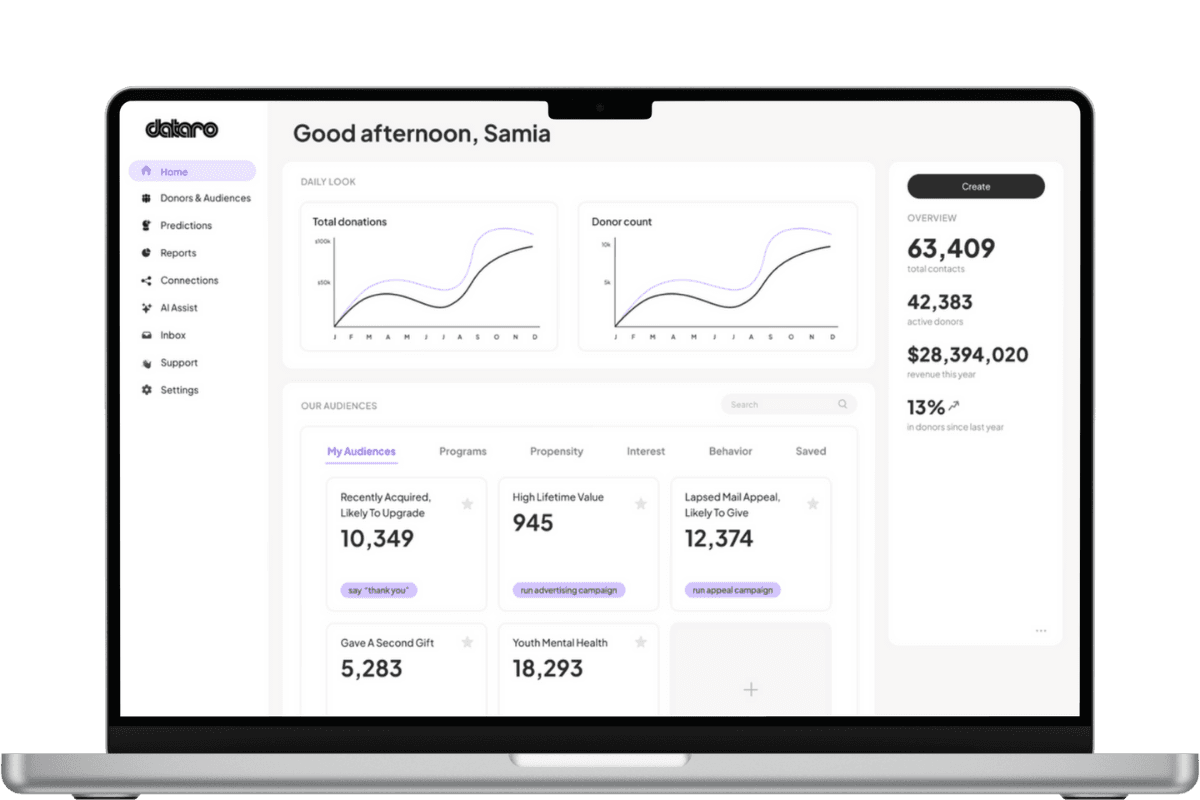
AI-driven donor intelligence sits on top of your CRM, scores every donor and returns ranked audiences, cutoffs and suppression logic you can run in the tools you already use. It replaces manual triage, not your systems.
Approach | Manual list-building | AI-driven donor intelligence |
|---|---|---|
Audience sizing | File-down, rule-based | Donor-level, ranked by predicted response |
Prioritization | Backward-looking RFM | Forward-looking propensity scores |
Suppression | Hand-pulled queries per send | Automated, repeatable exclusion rules |
Frequency capping | Inconsistent across programs | Enforced across the file |
Speed and effort | Hours of analyst time | Ranked outputs ready to run |
Explainability | Hard to defend cutoffs | Clear, inspectable cutoffs |

How to evaluate platforms
Use this framework to compare tools on the capabilities that decide audience quality. Score each on a simple scale and weight what matters to your programs.
Segmentation depth. Can it segment at the donor level using RFM, engagement and custom signals, or only coarse buckets? Ask to see a real audience built from your data.
Predictive prioritization. Does it rank each donor by likelihood to give to a specific appeal, and can it show why? A ranked list with a defensible cutoff is the core output to look for.
Automated exclusion. Can it apply suppression and frequency caps automatically across every campaign, including recent donors, opt-outs and major donors in stewardship? Manual-only suppression will not scale.
Also check that outputs land back in your CRM as audiences, tags or lists so the team can act without switching systems.
Practical takeaways
Size audiences by predicted response, not by what the file allows.
Use RFM and engagement as inputs. Let ranked propensity scores set the cutoff.
Run four suppression layers every time: recent donors, opt-outs, stewarded major donors and data-quality flags.
Cap frequency per channel and enforce it across programs.
Allocate budget to the audience you chose, not to a volume target.
Evaluate platforms on segmentation depth, predictive prioritization and automated exclusion.
Conclusion
Bigger lists do not protect results. Better decisions do. When you size audiences from ranked propensity, suppress the contacts a send would waste and cap how often you reach anyone, you mail fewer people with confidence and protect net revenue. That is the shift from reactive list-building to precise, respectful fundraising, and it is a rhythm your team can run every campaign.
Related articles
Find more non-profit fundraising and data insights from the Dataro team.