Donor segmentation vs. AI audience building: a definitive guide
Strategy & Frameworks

AI audience building ranks donors by real-time propensity, replacing static segments with a repeatable predict-act-measure loop.
What is donor segmentation?
Donor segmentation is the practice of grouping supporters so a fundraising team can decide who to contact, with what message and when. It answers the first decision every team faces: who deserves attention right now.
Traditional segmentation sorts donors into fixed buckets based on past behaviour or attributes. AI-powered audience building goes further. It ranks each donor by their predicted likelihood to give, upgrade or lapse, then returns that ranking into your CRM as an audience you can act on.
The short answer: segmentation groups people by rules. AI audience building ranks people by signals, and it updates as the data changes.
The three main approaches to donor segmentation
Most fundraising programs use one or more of these methods. Each has a place, and each has limits.
RFM segmentation
Definition: RFM groups donors by recency, frequency and monetary value: how recently they gave, how often and how much.
RFM is simple, transparent and easy to run in most CRMs. It's a reasonable starting point for appeals. But it only looks backward. A donor who gave last month lands in the same bucket as thousands of others, even if their real likelihood to give again is very different. RFM tells you what happened. It doesn't tell you what's likely to happen next.Persona-based segmentation
Definition: Persona-based segmentation groups donors by shared traits such as age, cause interest, giving channel or communication preference.

Personas help shape messaging and creative. They're useful for planning and for keeping content relevant. The weakness is precision. Personas describe broad types, not individuals, so two donors in the same persona can behave in opposite ways. Treating them the same means over-mailing some and neglecting others.
Predictive segmentation
Definition: Predictive segmentation uses machine learning to score each donor on a specific outcome, such as the propensity to give to the next appeal, to upgrade to a monthly gift or to lapse.
Instead of a fixed bucket, each donor gets a propensity score. You can rank the whole file, draw a defensible cutoff and mail fewer people with more confidence. This is the approach that moves fundraising from coarse groups to donor-level prioritization.
Static list-building vs real-time AI audience building
The deeper divide isn't just which method you use. It's whether your audiences are static or live.
Static list-building is a point-in-time export. A team pulls a segment, argues over exclusions, then runs the campaign. The list is stale the moment it's saved, and the next campaign starts from scratch.
Real-time AI audience building sits on top of your CRM, reads current data and returns ranked audiences that refresh as behaviour changes. When a donor's signals shift, their ranking shifts too, so the audience always reflects the latest picture.
How do the two compare?
Factor | Static CRM segmentation | AI-driven audience building |
|---|---|---|
Basis | Fixed rules and past behaviour | Predictive scores across many signals |
Freshness | Point-in-time snapshot | Updates as data changes |
Granularity | Group-level buckets | Donor-level ranking |
Cutoffs | Set by gut feel | Ranked and easy to justify |
Main risk | Over-mailing to feel safe | Requires clean data and trust in the model |
The trade-off is real. AI audience building depends on connected data and a model your team can inspect. Static lists are familiar and need no setup, but they cost more over time in wasted mail, donor fatigue and slow approvals.
Why is predictive audience building becoming the standard?
Three pressures are pushing teams toward prediction.
Costs are rising, so waste is visible. Teams can no longer afford to mail 40,000 people and hope. Staff are stretched, so manual list work is expensive. And last year's segments no longer feel predictive, which makes cutoffs hard to defend to leadership.
Prediction answers all three. It ranks the file, so you can cut volume without cutting revenue. It removes manual triage. And it gives you a cutoff you can explain in one sentence.Where Dataro fits
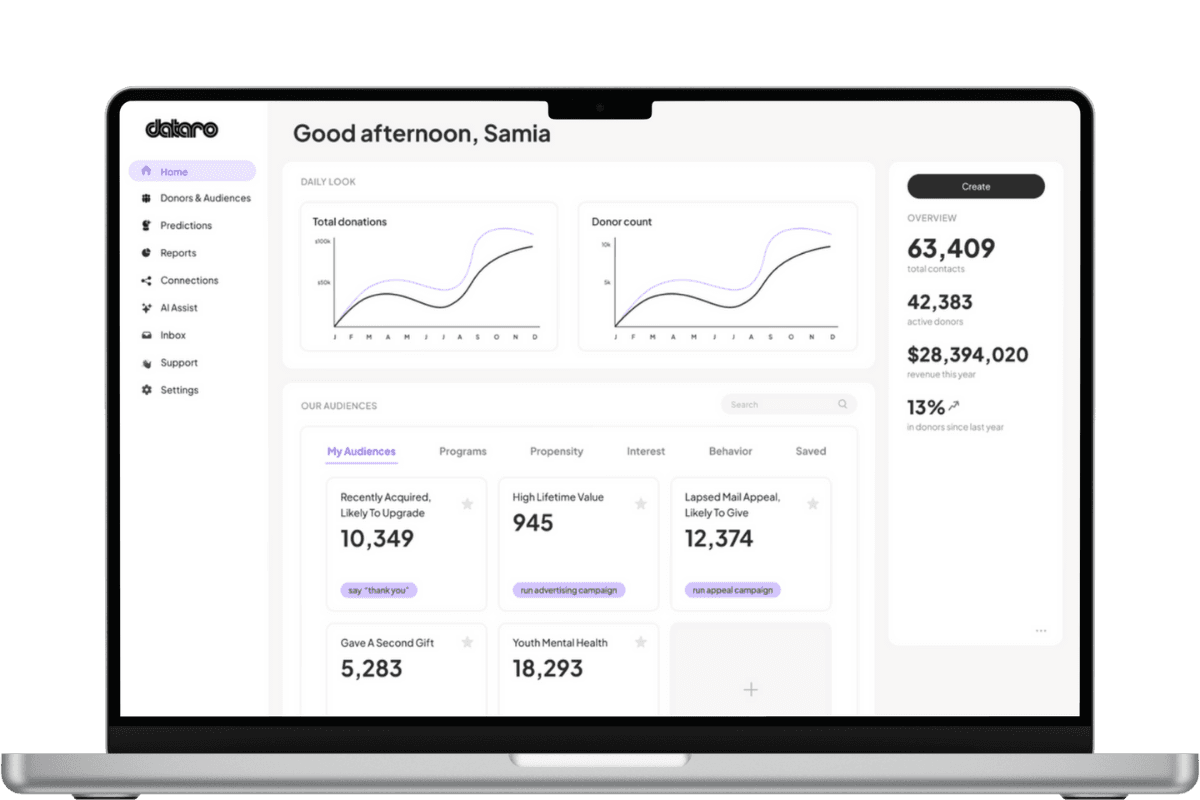
Dataro is a fundraising intelligence platform that sits on top of your CRM. It reads your donor data, scores each supporter on the outcomes that matter, then returns ranked audiences and next actions into the tools your team already uses.
Dataro doesn't replace your CRM, your reporting or your marketing tools. It adds a predictive layer on top. It's CRM-agnostic and works from a standard data export, so most fundraising databases are supported.
The result is a simple loop: predict who to focus on, act on ranked audiences, measure what changed, then repeat. Each cycle gets sharper.Practical takeaways
Use RFM as a baseline, not a strategy. It shows history, not likely behaviour.
Keep personas for messaging and creative, not for deciding who to mail.
Move targeting decisions to predictive scores so you can rank the file and set a defensible cutoff.
Favor live audiences over static exports so campaigns reflect current data.
Judge any AI approach on whether the output is explainable and whether it fits your workflow next week.
Conclusion
Donor segmentation still matters, but the way you build audiences is changing. Rule-based lists group donors by the past. AI-powered audience building ranks donors by what's likely next and keeps that ranking current.
For teams under pressure to do more with less, predictive audience building is the modern standard: fewer touches, clearer cutoffs and decisions you can defend. Dataro makes that operational on top of the CRM you already run.
Related articles
Find more non-profit fundraising and data insights from the Dataro team.