Donor segmentation and audience building: a practical guide for fundraisers
General
The decision behind donor segmentation
Every fundraising campaign starts with one question: who deserves our attention right now, and why?
That's the Focus decision. Before you spend a dollar on print, a minute of staff time, or a slot in the mail calendar, you have to decide who's worth prioritizing. Donor segmentation and audience building are how teams answer that question.
The problem is that most teams still answer it the way they did five years ago. They pull the same segments, set the same recency-frequency-monetary cutoffs, and hope last year's rules still hold. They rarely do.
This post is about building audiences that are defensible, precise and easy to act on, without expanding the list just to feel safe.
What donor segmentation actually solves
Segmentation isn't the goal. It's a means to a decision.
The goal is a short, defensible list that stakeholders can approve and a team can run. Good segmentation gives you fewer, better choices: a clear cutoff, a ranked group of people, and a reason you can explain in one sentence.
The old approach struggles for three reasons:
Capacity is flat while goals rise. You can't mail everyone, so you need a sharper way to choose.
Costs are scrutinized more closely. Over-mailing to feel safe is now visible waste, and it's hard to justify.
Last year's rules don't feel predictive. Coarse segments treat very different donors as if they're the same.
When segments are built on gut feel and habit, getting approvals gets slower. If you can't explain the cutoff, you can't defend it.
From coarse segments to donor-level decisions
The biggest shift in audience building is moving from buckets to individuals.
Traditional segmentation sorts donors into broad groups: high value, mid value, lapsed, new. That's useful for reporting, but it hides a lot. Two donors in the same "lapsed" bucket can have very different odds of giving again. Treating them the same means you over-contact one and ignore the other.
Donor-level prioritization fixes this. Instead of asking "which bucket is this person in," you ask "how likely is this specific person to respond, upgrade or lapse, and what should we do about it."
This is the difference between segmenting people and treating people like people. Segments still have a place for messaging and creative, but the prioritization underneath should be sharper than a label.
How to build an audience you can defend
A strong audience-building process is a sequence a colleague could repeat without translating jargon. Here's a simple version.
Start with the decision, not the data. Name what you're choosing: who to mail for this appeal, who to call, who to suppress. The decision sets the cutoff.
Rank, don't just group. Order donors by likelihood to take the action you care about. Ranking gives you a natural place to draw the line.
Set a defensible cutoff. Choose how many people you can actually serve given budget and capacity, then cut where the expected return drops off.
Assign a next action. Every donor on the list needs an owner and a move: appeal, upgrade, steward, suppress or hand off to another program.
Measure and refine. Track what happened so the next cycle gets sharper. Results become new signals.
This turns audience building from a one-off list pull into a repeatable rhythm. You're not resetting every campaign. You're compounding what you learn.
Precision beats reach
The instinct under pressure is to expand the list. More names feel safer. If goal is at risk, adding 20,000 records to the mail file looks like progress.
It usually isn't. Reach without precision drives donor fatigue, raises cost per dollar raised, and makes results harder to attribute. You end up mailing people who were never going to respond, and you annoy people who would have given anyway.
Precision is the strategy. Winning is doing fewer things with higher confidence:
Mail fewer people, but the right people.
Time the touch better instead of repeating it.
Protect capacity for the donors who need real attention.
The outcome isn't more activity. It's fewer, better decisions that are easier to execute and easier to justify internally.
Audience building across programs, not in silos
Most teams build audiences program by program. The appeals team pulls its list. The retention team pulls another. Mid-value works from a third. Stewardship runs on its own calendar.
That's how the same donor gets three uncoordinated touches in a week, while another gets none. It's also how a lapsing major donor slips through because no one owned the early signal.
Audiences should be built with a shared view of the donor file. The question isn't just "who's in my segment." It's "what's the right next move for this person across every program, and who should make it."
That means a donor flagged as at-risk gets handed to retention before they churn. A reliable mid-value donor gets routed toward an upgrade conversation. A high-frequency giver gets suppressed from a redundant appeal. The programs compound instead of competing.
What good looks like
You'll know your segmentation and audience building are working when a few things change.
Approvals get faster because the cutoff is explainable. Debates shrink because the list is ranked, not argued. Costs come down because you're not over-mailing to feel safe. And your team spends less time pulling lists and more time on judgment and execution.
The test is simple: can a fundraising leader explain the audience to a colleague or a board member in one clear sentence? If yes, you've built something defensible. If not, you're probably still guessing.
Where Dataro fits
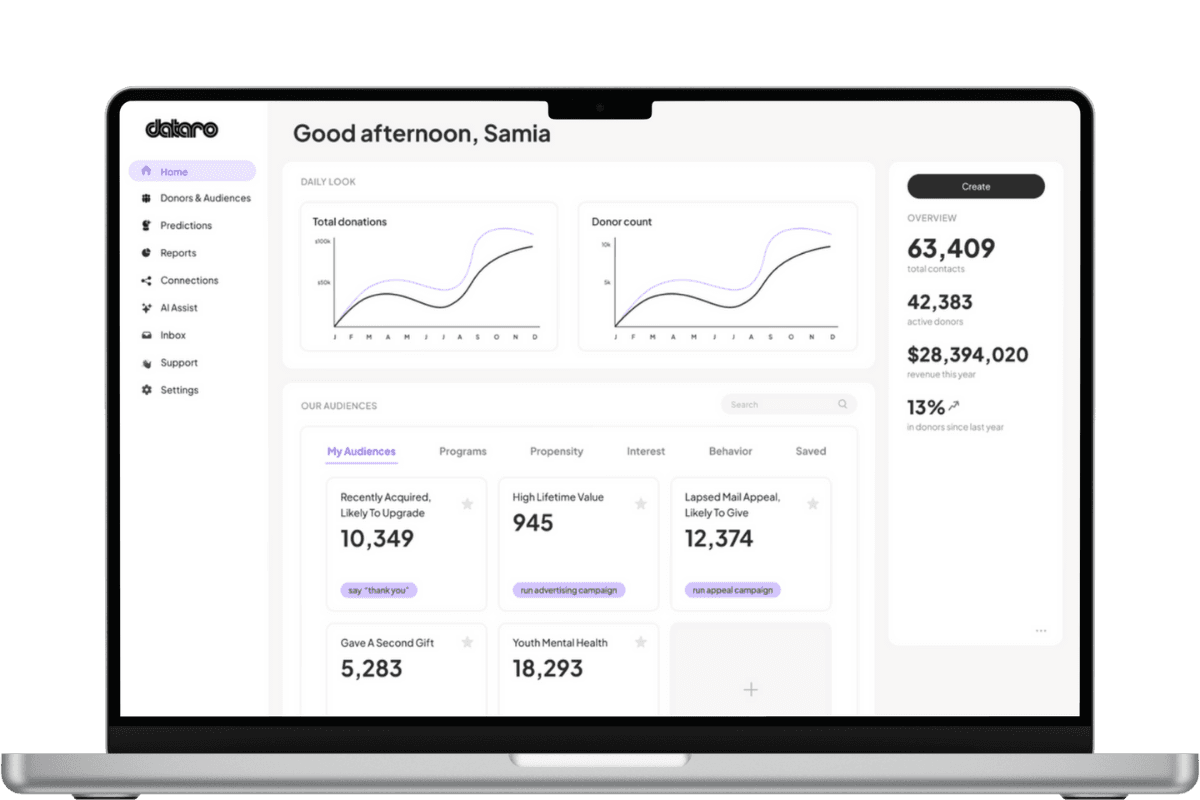
Dataro sits on top of your CRM and turns your data into clear, ranked actions. Instead of rebuilding segments from scratch each campaign, you get prioritized audiences and a next-best action for each donor, delivered back into the tools your team already uses.
That's the Focus decision made operational: who to focus on, with a cutoff you can defend, and what to do for each of them across every program.
Donor segmentation will always matter. The opportunity now is to make it sharper, more individual and easier to act on, so your team can mail fewer people with confidence and protect results.
Related articles
Find more non-profit fundraising and data insights from the Dataro team.