Dataro vs competitors: which fundraising tool tells you what to do next
General
Most fundraising tools answer the wrong question. They tell you what happened last quarter, or they help you send more email faster. Neither helps with the decision you actually face: who deserves your attention right now, and what should you do for each of them.
That gap is where Dataro sits. But it's also where a crowded market of CRMs, wealth screening vendors, AI point solutions and agencies all claim to compete. This post breaks down how Dataro differs and what to look for as you compare options.
The decision tools should help you make
If Dataro didn't exist, your team would still have to make two choices before every campaign:
Who to focus on. Which donors, prospects and segments are worth prioritizing before you spend budget or staff time.
What to do next. The right action for each person, across every program, so activity compounds instead of resetting each send.
Most software helps with neither. It stores data, reports on data or pushes more touches. The work of turning that data into ranked priorities and clear next actions still lands on your team. That's the work Dataro is built to remove.
How the categories actually differ
It helps to sort the market by the job each tool was built to do. Once you do that, the overlap with Dataro mostly disappears.
CRMs (Salesforce, Blackbaud, Bloomerang, Virtuous, Bonterra)
Your CRM is the system of record. It's where constituent data and gift history live, and it should stay there. "AI" in most CRMs is an add-on bolted onto a broad suite.
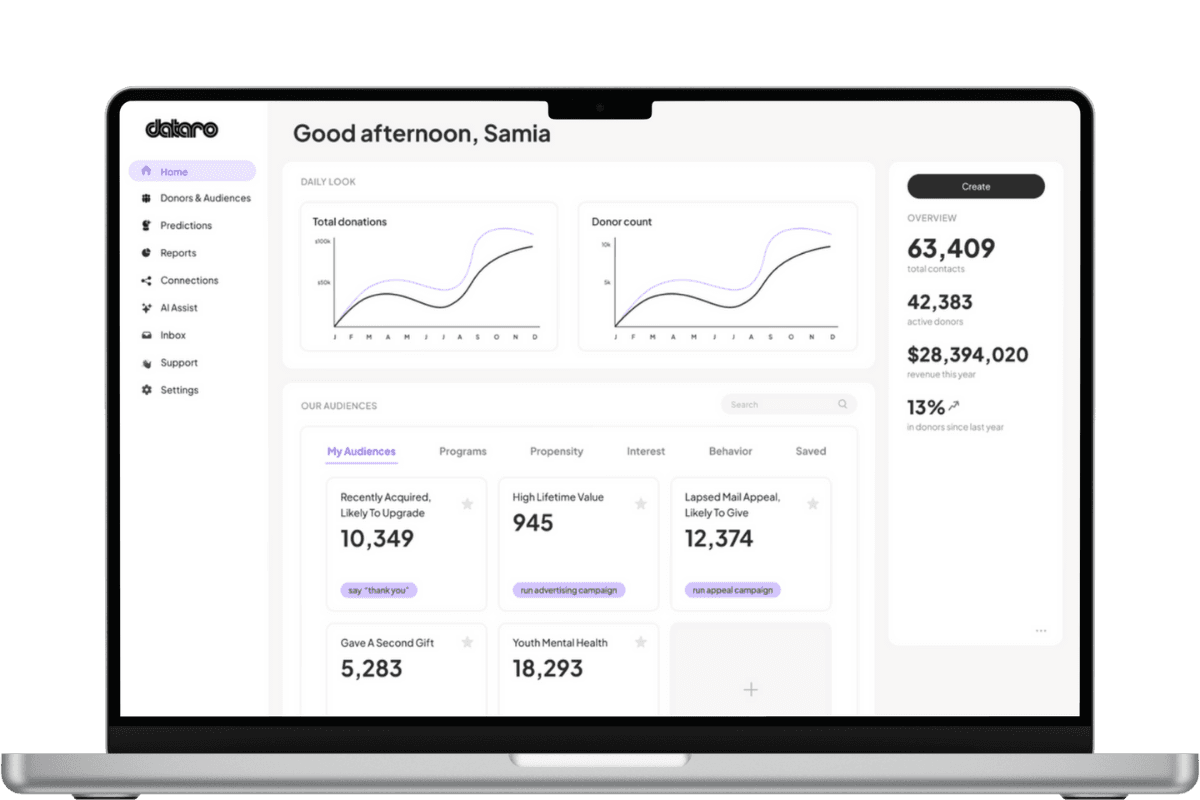
Dataro doesn't replace your CRM. It sits on top of it, reads your data and returns ranked lists, cutoffs and next actions across programs. You don't change systems. You add a predictive layer that turns the data you already have into something your team can act on next week.
Wealth screening and prospect research (iWave, Windfall, DonorSearch, Hatch)
Wealth screening tells you who has capacity to give. That's useful for major gifts, but capacity is only half the story. A high net-worth flag doesn't tell you who's likely to respond now, who's about to lapse or what the right next step is.
Many fundraisers describe traditional wealth scores as feeling random in practice. Dataro is different because it drives cross-program predictive rankings, moving past "who has money" into who to prioritize, when and what to do next. Capacity is one signal. Propensity to act is the one most teams are missing.
AI point solutions (Avid, Squark AI)
These tools position around predictions plus automation. The model output is often the product. The problem is that a model score on its own doesn't fit a real workflow.
Dataro is workflow-real, multi-program and measurable. Outputs land back in your CRM as audiences, tasks, tags or fields, so the team executes in tools they already use. Rankings cover appeals, retention, mid-value, major and legacy. And lift is tied to outcomes, not just model accuracy claims.
Digital fundraising platforms (Fundraise Up, Classy, Engaging Networks, Givebutter)
These optimize a channel: forms, peer-to-peer, email. They make a single touchpoint convert better.
Dataro coordinates the layer above the channel. It decides who to contact and what to do next across the whole donor file and multiple programs, then hands the right audience to whichever channel runs the work.
Agencies (Moore, RKD, Pursuant)
Agencies bring services-led strategy and execution. That's valuable, but it lives outside your team. When the engagement ends, the capability often leaves with it.
Dataro builds in-house capability through a repeatable rhythm: predict, act, measure, repeat. The decisions stay with your team, and they get sharper each cycle.
What this means for the features you're shopping for
If you're evaluating predictive donor scoring, segmentation, prospect research or campaign targeting, here's how to read those features through a decision lens.
Predictive donor scoring. Look for ranked lists with propensity scores you can sort and cut, not a single black-box grade. The point is a clear cutoff your team can explain and approve.
Donor segmentation and audience building. Treat donors as individuals, not coarse buckets. Donor-level rankings let you build audiences off behavior and likelihood, not last year's rules.
Personalized fundraising content. Personalization works when it's tied to the right ask amount and the right next step for each person, not just a merge tag.
Automated prospect research. Wealth screening tells you capacity. Pair it with propensity so you know who to call, not just who's rich.
Next-best-action recommendations. This is the "Act" decision. Every record should carry a recommended next step that an owner can run: upgrade, steward, suppress or hand off.
Recurring giving conversion optimization. The win is finding the one-time donors most likely to convert to monthly, then acting before the moment passes.
Campaign ROI optimization and targeting. The goal isn't a bigger list. It's mailing fewer people with confidence so net revenue holds or grows while costs fall.
Donor data enrichment and profiling. Enrichment matters when it sharpens the ranking and the next action, not when it just adds fields nobody uses.
A simple test for any tool
Ask one question of every vendor on your shortlist: after I use this, do I know who to contact and what to do for each of them?
If the answer is a dashboard, a model score or more email volume, you still have the hard work ahead of you. If the answer is a ranked list with a defensible cutoff and a recommended next action that lands in your CRM, you're looking at a decision tool.
Where Dataro fits
Fundraising teams are being asked to do more with less, but most targeting still runs on manual segmentation and gut feel. So teams over-reach: contacting too many people, at the wrong time, with the wrong next step.
Dataro sits on top of your CRM and turns your data into ranked lists, clear cutoffs and a recommended next action on each record. Every week you can answer the two questions that matter: who to focus on and what to do next.
The result isn't more activity. It's fewer, better choices that protect team capacity and are easier to justify internally.
See it on your own data
The fastest way to compare Dataro with any other tool on your list is to run a small pilot on your own file. Book a working session and see an example output: a ranked appeal audience with a recommended cutoff, built from data you already have.
Related articles
Find more non-profit fundraising and data insights from the Dataro team.