Access isn't adoption

Amy Brese
Strategy & Frameworks

Charity AI adoption stalls for people and process reasons, so start with your team, prove value on real work, then scale what works.
Most charities don't have an AI problem. They have a handful of Copilot licences, a training session in the diary, and a policy sitting on the intranet nobody has finished reading. By most measures, that looks like adoption. It isn't.
That was the starting point for our webinar this week with Ben Cohen (Director and AI Lead at Good Innovation) and Amy Brese (Partnerships Manager at Dataro) alongside Sarah Thorn and Emma Delin, two members of a three-person individual giving team at Sarcoma UK who shared how their own adoption journey played out.
Here's what stuck with us.
Three ways adoption stalls
The same three patterns show up again and again in charity AI pilots, and none of them have much to do with the technology itself.
Tech-first rollout. Everyone gets a licence, a training session on the tool's features, and a policy. Access goes up. How the team works doesn't change. You just get faster versions of the same work.
Efficiency obsession. AI gets framed purely as a cost-cutting play borrowed from the private sector. Charities are stretched, so efficiency isn't a bad word, but if it's the only goal, staff won't get behind it, and stripping out the judgement and relationships a mission depends on makes the work worse, not just faster.
Policy masterpiece. The AI policy becomes the whole strategy: 100-plus cautious pages nobody reads. Governance matters, but a checklist of what people can't do isn't adoption.
None of these blockers are actually about AI. They're organisational and human. So what does fixing it actually look like?
Adoption is a system, not a switch
Good adoption runs on three connected parts: miss one, and the other two stop delivering.
Leadership and governance sets the direction: ownership, priorities, safeguards, and permission to experiment.
Going wide raises the floor across the organisation: training, trust, shared practice, access to decent tools. Skip it and value stays trapped with a few early adopters.
Going deep is where the work itself changes: real workflows redesigned around AI, not just done faster. Harder than turning on a licence, but where the value sits.
Miss governance and pilots don't scale. Skip going wide and value stays siloed. Skip going deep and teams just get faster drafts on the same broken process. All three, moving together, is what makes adoption stick.
What a pilot needs before it earns the right to scale
A pilot is worth scaling once it clears three bars:
Value. Does it create measurable mission value: time returned, better quality, greater reach?
Trust. Are there clear safeguards, and can colleagues and supporters trust how it's used?
People. Does it make more room for judgement and relationships, or does it just increase pace and output? If it's only the latter, don't scale it yet.
Clearing those three bars is one challenge. Deciding what part of building your AI system should stay with your team versus what should be outsourced is another.
Where does outsourcing fit?
One of the most-upvoted audience questions was exactly that: what should stay in-house, and where do external consultants fit?
The honest answer is it depends. Charities need someone internal with the time and capability to own adoption, increasingly a defined role rather than a side project. For complex or technical pilots, outside support makes sense. For broad capability training, most teams have more in-house skill than they think, and there's strong free training available. Save the budget for running good pilots, and bring in as much of the rest as you can internally.
What this looked like in practice
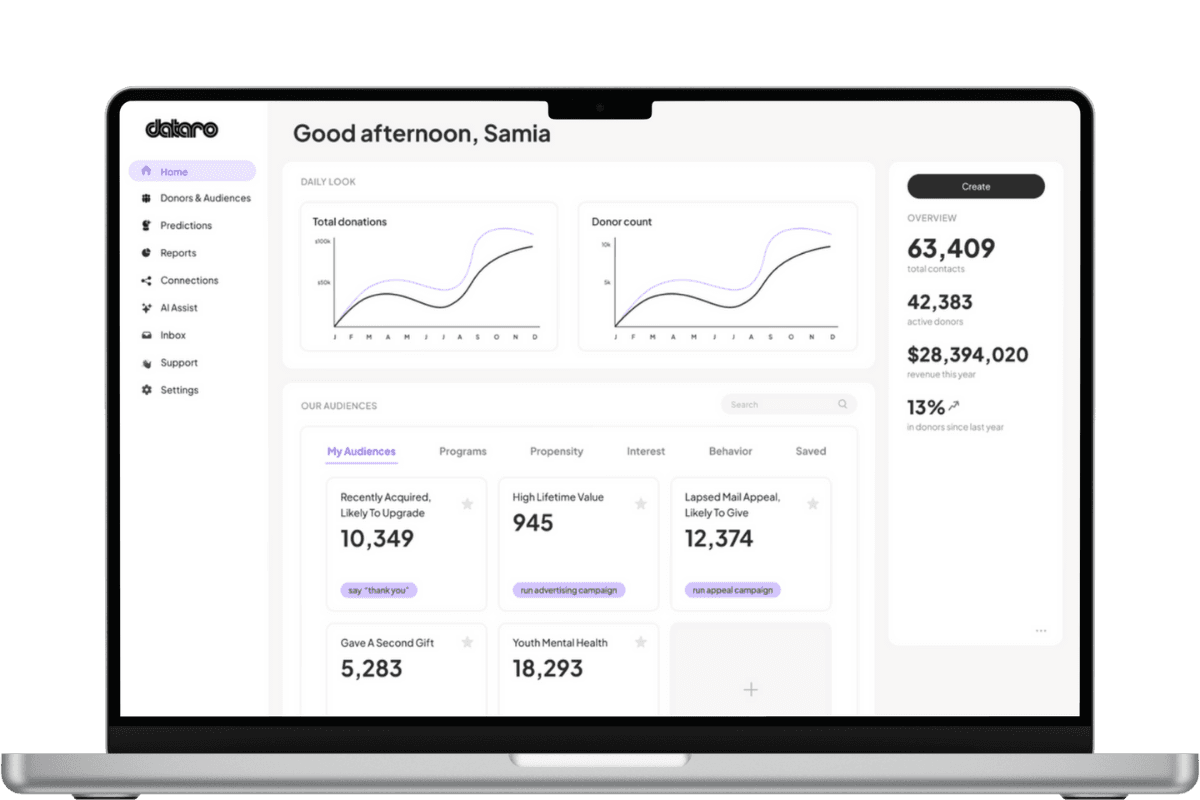
Want to see it on the ground? Watch the full recording to hear directly from Emma Delin and Sarah Thorn at Sarcoma UK on how their three-person individual giving team moved from manual, self-taught segmentation to running appeals with Dataro. It covers their first appeal's results, how that confidence carried into legacy and major donor work, and how it changed the way they work with their database team.
Related articles
Find more not-for-profit fundraising and data insights from the Dataro team.