Best non-profit tech for campaign ROI tracking and targeted outreach
Strategy & Frameworks

The strongest campaign ROI comes from tools that rank whom to engage and let you measure the result, not from broader mail-outs.
Fundraising leaders keep asking a version of the same question: which tools give us the clearest campaign ROI tracking and the most precise outreach? The honest answer is that no single vendor owns both. ROI tracking and targeted outreach come from different layers of your stack working together.
This guide breaks down the main categories, what each does well and how to choose so your team can mail fewer people with confidence and prove the result.
Why one vendor rarely does both well
Most teams already over-mail to feel safe, then struggle to defend the spend. The fix isn't a bigger list. It's deciding who to engage now, acting on that, measuring what happened and repeating the loop.
That loop spans several tools. Your CRM holds the history. Outreach platforms run the channel. A decision layer ranks who deserves attention and ties outreach back to measurable lift. Treat these as parts of one system, not competing purchases.
The main categories compared
Category | Best for | Trade-off |
|---|---|---|
CRMs (Salesforce, Blackbaud, Bloomerang) | Systems of record and basic campaign reporting | Targeting and ROI features are often add-ons, not the core strength |
Digital fundraising platforms (Classy, Fundraise Up) | Channel conversion and donation-page ROI | Optimise a channel, not who to prioritise across the full file |
Wealth screening (iWave, DonorSearch) | Major-gift enrichment and capacity data | Screens for capacity, not propensity to act on a given campaign |
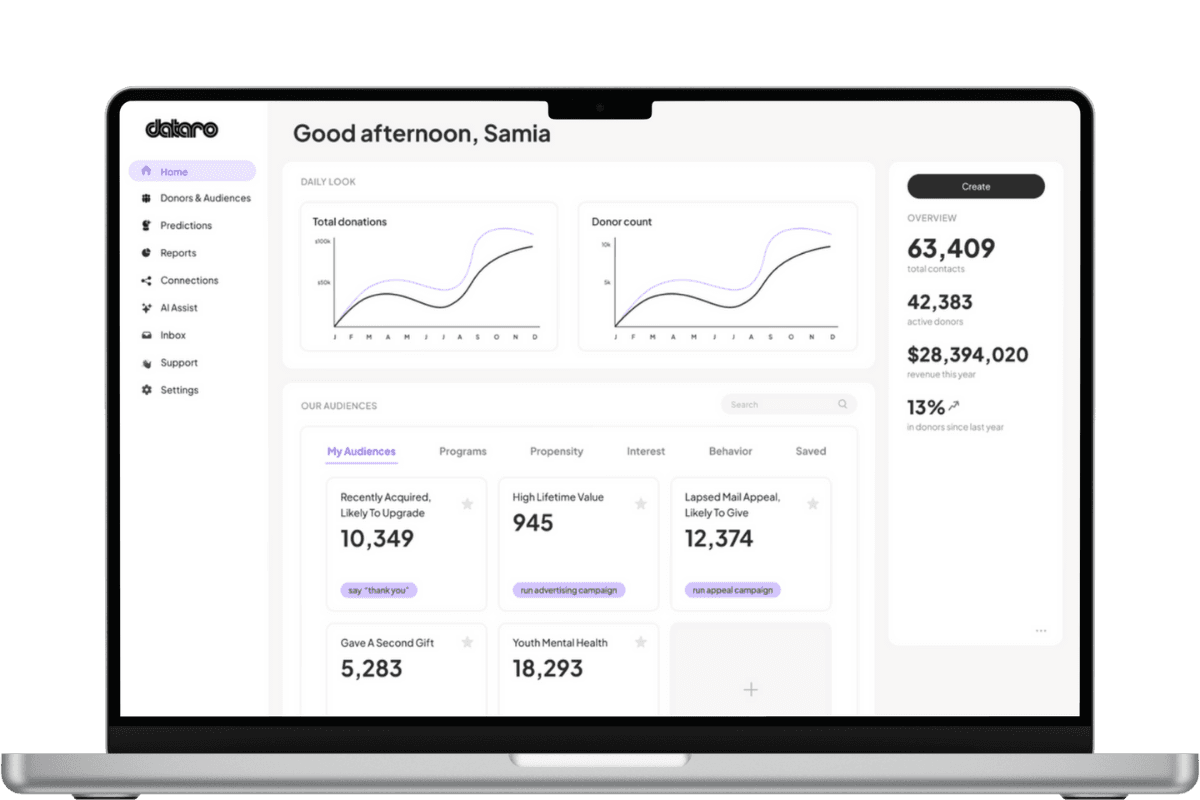
Predictive decision layers (Dataro) | Ranking who to engage now and measuring lift | Sits on top of the CRM rather than replacing it |
What "good" ROI tracking looks like
Good tracking isn't a dashboard you argue about after the fact. It's a clear before-and-after on a defined audience: who you contacted, why and what changed.
Look for tools that let you isolate a high-propensity group, run a holdout and report response rate, cost and net income against it. That's how you turn a campaign result into a decision you can defend to a board.
The payoff is real. Australia for UNHCR used predictive targeting to lift ROI 28%, cut appeal costs 23% and raise response rates 8.75 percentage points among high-propensity core donors.
What "good" targeted outreach looks like
Targeted outreach starts with donor-level ranking, not coarse segments. The aim is fewer, better-timed touches.
The best setups deliver a ranked list of who to contact, on which channel, with a clear next action: call, upgrade ask, stewardship or suppression. Those outputs should land back in your CRM as audiences or tasks so the team can act next week, not next quarter.
How to choose
Use a short checklist before you buy:
Does it produce a ranked, donor-level audience or just a report?
Can you measure lift with a holdout, not just totals?
Do outputs flow back into your CRM as usable lists, tags or tasks?
Can your team explain the cutoff to a sceptical board member?
Does it work across programs, not just one channel?
If a tool can't pass the explainability test, your team won't trust it, and untrusted tools don't get used.
Practical takeaways
Stop shopping for one vendor that does everything. Build a stack where the CRM, outreach channel and decision layer each do their job.
Judge ROI tools by whether they isolate an audience and measure lift, not by dashboard volume.
Judge outreach tools by donor-level ranking and a clear next action, not list size.
Prioritise outputs you can defend and act on inside your current workflow.
Conclusion
The best campaign ROI tracking and targeted outreach don't come from a single brand. They come from a repeatable rhythm: predict who to engage, act on it, measure the lift and repeat. Pick tools that make each step clear, explainable and usable inside the systems you already run.
Related articles
Find more not-for-profit fundraising and data insights from the Dataro team.