How to Personalise Mid-Level Donor Content at Scale
Strategy & Frameworks

Personalising mid-level donor content at scale starts with deciding who to focus on, not just writing more copy.
Mid-level donors sit in an awkward gap. They give more than your average direct-mail donor, but not enough to earn a spot on a gift officer's caseload. So they get the same mass appeals as everyone else, and many quietly slip toward lapse.
The short answer: you personalise at scale by combining three capabilities in the right order. Use donor-intelligence prioritisation to decide who to focus on, CRM segmentation to group them, and AI drafting to produce the content. Prioritisation does the heavy lifting. The other two execute the plan.
What mid-level personalisation at scale actually means
Mid-level personalisation at scale is the practice of tailoring the message, ask and timing for donors in the mid-value tier without assigning each one a human relationship manager. The goal is relevance, not a one-to-one caseload. You want each donor to get content that fits where they are, produced through a repeatable system your team can run every week.
Why the major-gifts model does not scale down
Major gifts works because a gift officer carries a small portfolio and knows each donor. That economics breaks in the mid-level tier. A team might have 20 major-gift relationships and 5,000 mid-level donors. You cannot staff a caseload that size.
The common fallback is to drop everyone into a generic mass appeal. That protects staff time, but it treats individuals like a single bucket. Mid-level donors notice, and response rates show it.
The better frame is simple: treat donors as individuals, not segments. You do not need a human per donor to do that. You need a system that decides who matters now and what to say next.
Three approaches to personalising mid-level content
Most teams reach for one of three tools. Each solves part of the problem. None solves all of it alone.
Approach | What it does | Strength | Trade-off | Best role |
|---|---|---|---|---|
CRM segmentation | Groups donors by rules like gift size, recency and frequency | Already in your stack, easy to explain | Static rules miss intent and future behaviour; segments are still coarse buckets | The container that holds your audiences |
AI drafting | Generates copy variants quickly for each group or donor | Removes the content bottleneck, scales output fast | Fast content aimed at the wrong people just scales waste | The production engine |
Donor-intelligence prioritisation | Ranks donors by predicted behaviour and recommends the next move | Decides who to focus on and what to do, donor by donor | Needs clean data and a tool that sits on top of your CRM | The decision layer that drives the other two |
CRM segmentation gives you containers, not judgment
Segmentation is where most teams start, and it still has a job. It gives you clean audiences to act on, and the rules are easy to explain to stakeholders.
The limit is that rules look backward. A segment built on last year's gift size tells you what a donor did, not what they are likely to do next. Two donors can sit in the same segment and be heading in opposite directions: one upgrading, one about to lapse. Segmentation alone cannot tell them apart.
Treat segmentation as the container. It is necessary, but it is not the decision.
AI drafting removes the content bottleneck
Writing tailored copy by hand is slow, so content is often where personalisation dies. AI drafting fixes that. It can produce ask variants, email copy and letter versions in minutes, which frees your team for judgment and review.
But speed cuts both ways. If you point fast content at the wrong donors with the wrong ask, you just scale the waste. AI drafting is a production engine. It needs a decision upstream telling it who to write for and what to say.
Keep a human in the loop on review. The draft is a starting point, not a send-ready final.
Donor-intelligence prioritisation is the piece that makes it work
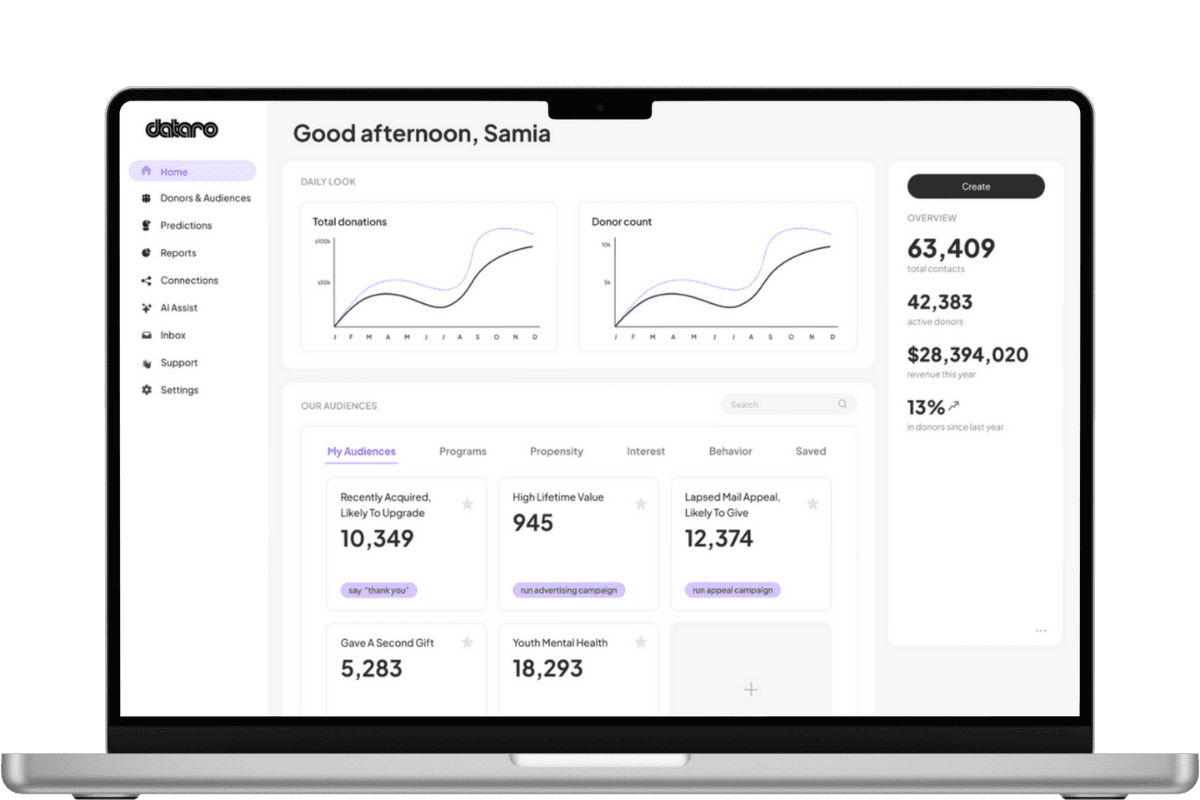
This is the capability most teams are missing. Donor-intelligence prioritisation uses predictive models to rank your mid-level donors and recommend the next move for each one: upgrade, steward, ask again, or suppress.
It answers the two questions that drive everything else. Who should we focus on right now? And what should we do for each donor? With a ranked list and a recommended action, segmentation and AI drafting stop guessing. You segment by predicted intent, not just past gifts. You draft the right ask for the right person.
This is also where precision pays off. Teams that prioritise by signal instead of gut tend to protect net revenue rather than inflate volume. The Wilderness Society lifted monthly donor conversion from 6% to 11% by acting on predicted intent. North West Air Ambulance reached a 38% recurring upgrade rate. The pattern holds: act on the right donors early, and the results compound.
How to combine the three into one workflow
You do not choose one tool. You sequence all three so each does what it is good at.
Rank the tier. Score your mid-level donors by predicted behaviour and pull a ranked list with a recommended next move for each one.
Set a cutoff. Decide how far down the list you will act this cycle, so effort goes where it will move the needle.
Segment by intent. Group the ranked donors by the recommended action, not just by past gift size.
Draft with AI. Generate copy for each group, matched to the ask and timing the model recommends.
Review and send. A human checks the drafts, approves the cutoff, and runs the campaign in your existing tools.
Measure and repeat. Feed results back in, and let the next cycle get sharper.
Practical takeaways
Start with the decision, not the content. Rank the tier before you write a word.
Keep segmentation, but stop treating segments as the final answer. Group by predicted intent.
Use AI drafting to scale output, with a human reviewing every variant.
Set a cutoff each cycle so you act on fewer, better donors with confidence.
Track net revenue and retention in the tier, not just volume sent.
The bottom line
You cannot give every mid-level donor a gift officer, and you should not give them a generic blast either. The workable path is to let prioritisation decide who to focus on and what to do, then use segmentation and AI drafting to carry out that plan at scale. Done in that order, you treat donors as individuals without a one-to-one caseload, and you protect the revenue hiding in the middle of your file.
Related articles
Find more not-for-profit fundraising and data insights from the Dataro team.