AI fundraising scenario planning vs three-case budget forecasting
Strategy & Frameworks

AI scenario planning forecasts the donors, grants and gift timing behind revenue, while three-case budgets only guess at the total.
Most fundraising budgets still rest on three guesses: best case, base case and worst case. AI-powered scenario planning replaces those guesses with models that predict the drivers behind revenue, so you can see who to focus on and what to do next before you commit the budget.
This guide explains how the two methods differ, what AI actually models, where the data comes from, how accuracy is checked and how the outputs shape real budget and program choices.
AI scenario planning models the drivers, not three fixed outcomes
Traditional forecasting asks a simple question: if things go well, stay flat or go poorly, what is the number? A planner sets a few broad assumptions and then writes three columns.
AI scenario planning asks a different question. It predicts the underlying drivers that move the number: which donors are likely to give, when a grant is likely to renew and when a major gift is likely to land. Each scenario is then built from those predictions, not from a round percentage adjusted up or down.
The result is a forecast you can trace back to real donors and real signals, not a spreadsheet mood.
Three-case budgets hide the assumptions that matter
Best, base and worst-case budgets are quick to build and easy to explain. That is their appeal. But they carry real costs.
The three cases often come from gut feel, where "worst case" might just be last year minus 10%. The method also treats your whole file as one block, so it misses the donor-level timing that drives cash flow. And when the actual result lands between two cases, the budget gives little practical guidance on what to do next.
Here is how the two approaches compare.
Factor | Three-case budget forecasting | AI scenario planning |
|---|---|---|
Unit of analysis | The whole file or program | Each donor, grant and gift |
Inputs | A few manual assumptions | CRM history plus predictive signals |
Scenarios | Three fixed columns | A range built from modelled drivers |
Timing | Annual or quarterly totals | Month-by-month, including cash flow |
Validation | Rarely checked against past forecasts | Scored against history and staff forecasts |
Output | A target number | Ranked actions tied to budget and programs |
Main risk | Confident but wrong | Needs clean data and clear governance |
Three-case budgets are not wrong. They are just coarse. AI scenario planning adds the detail that coarse methods leave out.
What AI models: campaign revenue, grant renewals, gift timing and cash flow
AI scenario planning works at the level of each donor, grant and gift. It then rolls those predictions up into a view of the whole organisation.
Campaign revenue. The model scores each donor on their likelihood to give and a recommended ask. Add those up across a segment and you get a campaign forecast built from people, not averages.
Grant renewals. The model weighs each grant by its renewal likelihood and expected timing. A grant with a strong history and an early signal counts differently from one at risk.
Major-gift timing. Major gifts are lumpy and hard to time. The model estimates when a gift is likely to close, so a single large gift does not swing a whole quarter by surprise.
Cash flow. Because the model works month by month, it shows not just how much is likely to come in but when. That turns a yearly target into a cash-flow plan the finance team can use.
Better data produces better forecasts
A forecast is only as good as its inputs. AI scenario planning draws on more of them than a manual budget does.
The core input is your own CRM: gift history, recency, frequency, channel and program. On top of that sit predictive signals such as next-gift likelihood, lifetime value and churn risk. Grant and pledge records add renewal dates and funder history. Campaign calendars add the timing of asks across the year.
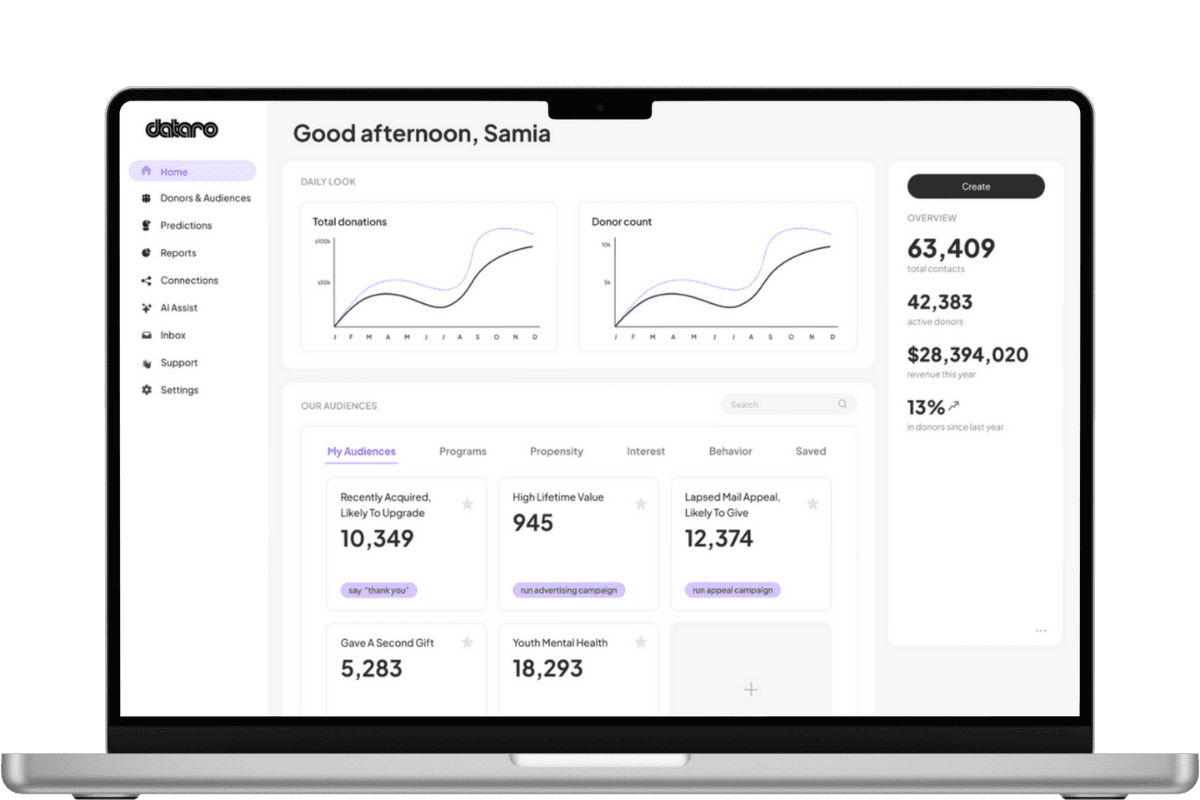
Dataro sits on top of your CRM, reads this data and returns ranked actions. The models run on your history, so the forecast reflects your donors, not an industry average.
Clean data matters here. If gift dates or program codes are messy, the forecast inherits that mess. Good scenario planning starts with a quick data check.
Accuracy is checked against your team's past forecasts
A forecast you cannot trust is just another opinion. The honest test is simple: how well would the model have predicted results you already know?
This is called backtesting: you run the model on past periods and compare its predictions to what really happened. You can then compare the model's error against your team's own past forecasts for the same periods. If the model is not more accurate than your planners, it has not earned a place in the budget.
Good practice is to report the gap in plain terms. For example: over the last eight quarters, the model's forecast was within a stated range of actual revenue, and it beat the manual forecast in most of them. Trust comes from that track record, not from the technology.
Keep the outputs inspectable. A finance lead should be able to see which donors and assumptions drive each scenario, so the forecast is clear, explainable and easy to justify.
Outputs drive budget and program choices, not just donor scores
A donor score on its own does not change anything. The point of scenario planning is to connect the forecast to the choices a team actually makes.
Good outputs answer real questions. Which campaigns should get more budget, and which should get less? Which at-risk grants need attention now? When should major-gift officers focus their time to protect this quarter's cash flow? Which segment can you mail fewer people in without hurting net revenue?
This is where Focus and Act meet. The model helps you focus on the donors, grants and gifts that move the forecast. Then it points to the next action for each one, delivered as ranked lists your team can run. The forecast stops being a report and becomes a plan.
How to start: run one program through both methods
You do not need to replace your budget process overnight. Start small and prove it.
Pick one program with clean data, such as a recurring or direct-mail appeal.
Build your usual best, base and worst-case budget for it.
Run an AI scenario forecast on the same program and period.
Backtest both against the last several periods to compare accuracy.
Review the gap with finance, then expand to more programs if the model earns it.
This keeps the risk low and makes the decision evidence-based, not a leap of faith.
Conclusion
Three-case budgets answer one question: what might the total be? AI scenario planning answers a sharper set: which donors, grants and gifts drive that total, when the cash will land and what to do about it.
The shift is from static guesses to modelled drivers you can trace, test and act on. Start with one program, check the accuracy against your own forecasts, and let the results decide how far to take it.
Related articles
Find more not-for-profit fundraising and data insights from the Dataro team.