How to choose a fundraising platform for donor segmentation and targeted outreach

Nic Miller
Strategy & Frameworks

The best platform for segmentation tells you who to contact and what to do next, not just how to slice your list.
If you're searching for the best fundraising platform for donor segmentation and targeted outreach, start with the promise you actually want: a tool that tells you what to do for every donor, right now. The best platform doesn't just slice your list into more groups. It tells you who to contact and what to do next.
This guide is for fundraising leaders and database managers who run multi-channel programs and are tired of guessing where to draw the line. It covers what to look for, where the main categories of tools differ and how to choose one that fits the CRM you already use.
Why segmentation alone isn't enough
Most teams already segment. They group donors by recency, frequency and value, then build appeals around those buckets. The problem is that last year's segments don't feel predictive now. Costs are up, teams are flat and the safe default becomes "mail more people" or "reuse the segments we used last year."
That guesswork is expensive. Fundraisers spend hours pulling lists, negotiating exclusions and defending where to draw the cutoff. Approvals slow down because no one can explain the line.
The shift worth paying for is from coarse segments to donor-level prioritisation. Instead of asking "which bucket is this donor in," you ask two questions every week: who to focus on, and what to do for each of them.
What to look for in a platform
Before you compare vendors, write down the capabilities that map to better targeting. Strong options share a few traits:
Ranked lists, not just filters. Look for predictive propensity scores that rank donors by likelihood to give, upgrade or lapse, so you can mail fewer people with confidence.
Clear cutoffs. The tool should help you draw a line you can explain to a board or a director, not just hand you a dashboard to argue about.
A recommended next action per record. Segmentation is the start. The value is knowing whether to upgrade, steward, suppress or hand a donor to another program.
CRM fit. Outputs should land back in your CRM as audiences, tasks, tags or fields so the team executes in the tools they already use.
Explainable outputs. Trust is a buying criterion. You should be able to inspect why a donor ranks where they do and justify it internally.
Multi-channel reach. Rankings should activate across mail, email, phone and digital ads, not sit in one channel.
How the main categories compare
Most tools marketed for segmentation fall into a few categories. Each does something well, but they solve different problems. The table below shows the trade-offs for donor segmentation and targeted outreach specifically.
Category | Strong for | Trade-off for targeted outreach |
|---|---|---|
CRMs (Salesforce, Blackbaud, Bloomerang, Virtuous) | System of record, manual segments and reporting | Segments rely on rules and gut feel; AI is often an add-on |
Wealth screening (iWave, DonorSearch, Windfall) | Major-gift capacity and affinity research | Tells you who has money, not who to prioritise this week or what to do next |
Digital fundraising tools (Classy, Fundraise Up, Givebutter) | Forms, donation pages and channel conversion | Optimises one channel rather than coordinating who and what next across the file |
Marketing automation | Sending more touches at scale | Built for volume, not for choosing fewer, better touches |
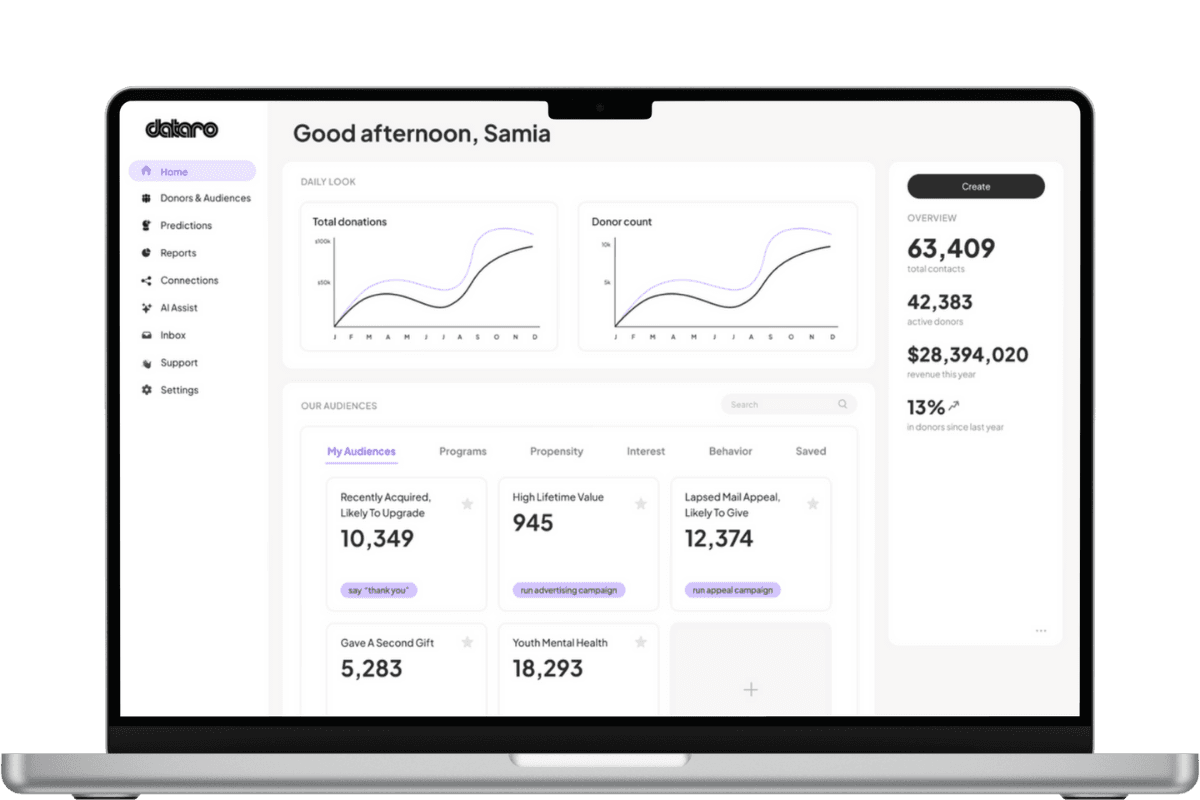
Predictive layer (Dataro) | Ranking donors and recommending next actions across programs | Sits on top of your CRM rather than replacing it |
The pattern is clear. CRMs, screening tools and digital platforms each cover part of the job. None is built to rank every donor and tell you what to do next across appeals, retention, mid-value and stewardship.
Where a predictive layer fits
A predictive layer sits on top of your CRM, reads your data and returns ranked actions. You don't change systems. You add the missing step between data and outreach.
The operating rhythm is simple: predict, act, measure, repeat. The platform produces a ranked list and a recommended action, the team runs the work and results flow back as new signals that sharpen the next cycle.
For segmentation and outreach, that means core models like next gift likelihood, recommended ask and lifetime value forecast, plus specialist models for best channel, lapsed donor reactivation and recurring donor churn risk. You stop sorting donors into static buckets and start prioritising individuals.
Pricing for this kind of platform usually combines an annual platform fee with a per-active-donor rate, so cost scales with the size of your file rather than a flat license. Plans typically start around $15,000 a year, and right-sizing matters more than buying the biggest tier.
Practical takeaways
Don't buy more segmentation. Buy prioritisation that tells you who to contact and what to do next.
Insist on ranked lists and clear cutoffs you can explain, not another dashboard.
Choose a tool that writes back to your CRM so outreach happens in your existing workflow.
Favor explainable outputs. If you can't justify a cutoff, you can't get it approved.
Match the platform to your programs. Look for cross-program coverage, not a single-channel optimiser.
Run a small pilot on real data before you commit. Ask to see example outputs on your own donors.
The bottom line
The best fundraising platform for donor segmentation and targeted outreach is the one that turns your CRM data into ranked lists, clear cutoffs and a recommended next action on each record. Segmentation tells you how donors differ. A predictive layer tells you what to do about it, so you can mail fewer people with confidence and protect results.
Start by mapping your two weekly decisions, who to focus on and what to do next, then test each option against how well it answers them on your own data.
Related articles
Find more not-for-profit fundraising and data insights from the Dataro team.