Donor data enrichment and profiling: a practical guide for fundraisers
General
Most fundraising teams already hold the data they need to make better decisions. The problem is the data sits in fragments: a gift here, an email open there, an old phone number nobody has checked in two years. When it's time to plan an appeal or build a major gifts list, that scattered picture turns into guesswork.
Donor data enrichment and profiling is how you turn that raw history into something you can actually act on. Done well, it answers the two questions every fundraiser has to answer: who should we focus on, and what should we do for each of them?
What donor data enrichment and profiling actually means
These two terms get used interchangeably, but they do different jobs.
Enrichment fills the gaps in your records. It validates contact details, appends missing fields and adds context your CRM didn't capture on its own. The goal is a cleaner, more complete file.
Profiling builds on that file to understand each donor as an individual. It looks at giving history, engagement patterns and signals over time to describe who someone is and how they're likely to behave next.
Put simply: enrichment improves the inputs. Profiling turns those inputs into a decision.
Why this matters more than it used to
Fundraising has changed faster than most operating habits. Costs are up, teams are flat and donor behaviour is harder to predict than it was a few years ago. So the safe default becomes "mail more people" or "use last year's segments," even when everyone suspects those rules no longer hold.
That's decision debt. It shows up as hours spent pulling lists, debating exclusions and guessing at cutoffs nobody can defend in a budget meeting.
Enrichment and profiling attack that debt at the source. When your file is complete and each donor is understood at an individual level, you stop guessing and start prioritising. You can mail fewer people with more confidence and protect results in the process.
What good donor profiling looks like
A strong donor profile isn't a wall of demographic trivia. It's a short, useful summary of what a donor is likely to do and what you should do about it. The best profiles share a few traits:
Behaviour-led, not just demographic. Giving recency, frequency and amount tell you more than a postcode ever will.
Predictive, not historical. A profile should point forward — likelihood to give, upgrade or lapse — not just describe the past.
Donor-level, not segment-level. People aren't averages. Coarse segments hide the individuals who deserve a different action.
Explainable. If you can't say why a donor was prioritised, you can't defend the decision to a board or a finance lead.
Workflow-ready. A profile is only useful if it lands as an audience, task or tag your team can act on next week.
The data that powers a useful profile
You don't need exotic third-party data to build something valuable. Most of what matters is already in your CRM. Enrichment and profiling work best when you combine:
Transactional history: gift amounts, dates, frequency, campaigns and channels.
Engagement signals: email opens, event attendance, website visits and survey responses.
Contact quality: validated addresses, emails and phone numbers so the right message reaches the right person.
Relationship context: household links, soft credits and how a donor first came in.
The aim isn't to collect everything. It's to assemble enough signal to make the next decision with confidence.
From profile to action
A profile that sits in a dashboard doesn't change anything. The value comes when profiling feeds a simple, repeatable rhythm:
Focus. Use enriched profiles to rank donors and set a defensible cutoff. Decide who's worth a touch before you spend budget or staff time.
Act. For each donor, choose the right next move: upgrade, steward, retain, suppress or hand off to another program. The action should be assigned to an owner and fit a workflow your team already runs.
Measure. Track what changed so the next cycle gets sharper. Results flow back as new signals that improve the next round of profiling.
This is the difference between activity and progress. The goal isn't more appeals. It's fewer, better decisions that compound across programs instead of resetting every time you hit send.
Common mistakes to avoid
Teams new to enrichment and profiling tend to trip on the same things:
Chasing data for its own sake. More fields don't help if they don't change a decision. Start with the decision, then collect what it needs.
Treating profiling as a one-time project. Donor behaviour shifts. Profiles need to refresh as new gifts and engagement come in.
Hiding the logic. If a model or rule can't be explained, stakeholders won't trust it and won't approve it.
Stopping at the insight. A score is not an outcome. Without an assigned action and owner, nothing happens.
How Dataro fits
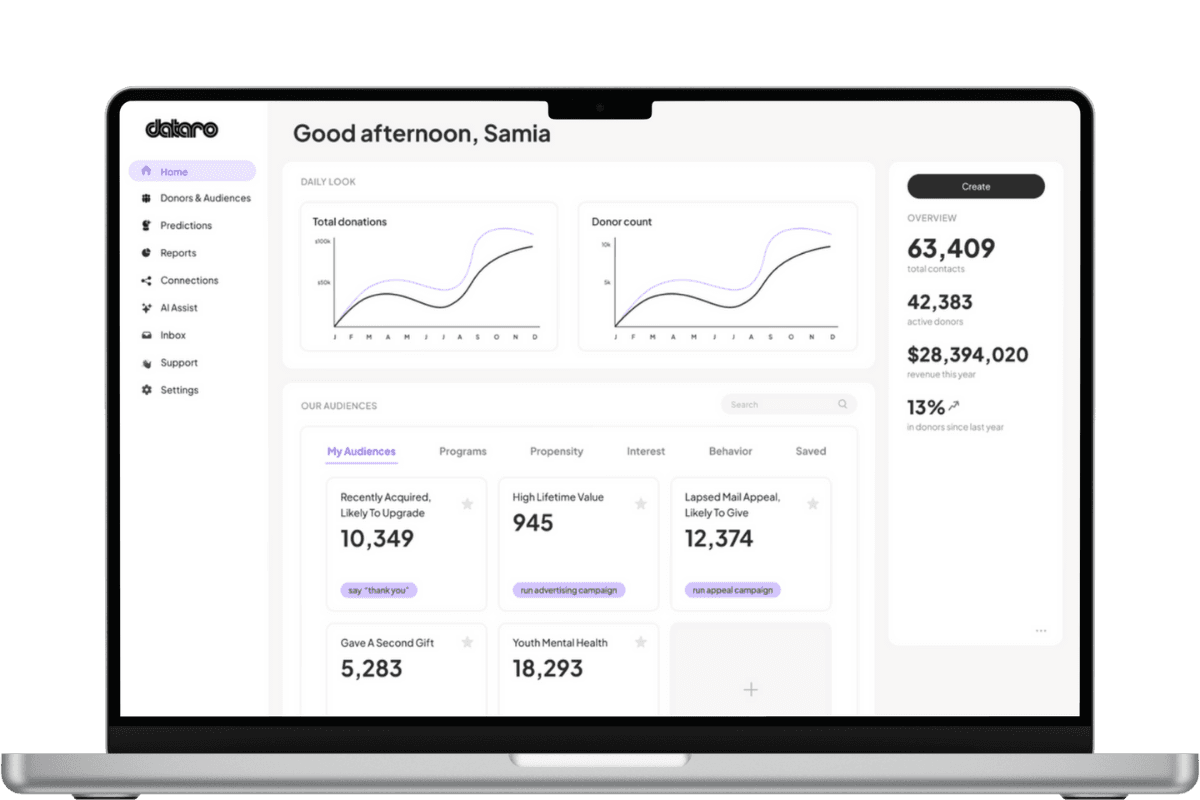
Dataro sits on top of your CRM and turns your donor data into clear, ranked actions. Rather than asking you to change systems or run another reporting project, it reads what you already have and returns priorities, cutoffs and next-best actions into the tools your team uses every day.
That means enrichment and profiling aren't separate exercises. They feed the same decision rhythm: predict, act, measure, repeat. You get a short list you can defend, an action for each donor across every program, and a way to see what worked so the next cycle improves.
Trust matters here, so the decisions are inspectable and explainable. If you're going to prioritise one donor over another, you should be able to say why — to your team, your board and your finance lead.
The bottom line
Donor data enrichment and profiling aren't about collecting more information. They're about turning the information you already hold into decisions you can act on and defend.
When your file is complete and each donor is understood as an individual, the hard questions get easier. You know who to focus on. You know what to do for each of them. And you can spend less time pulling lists and more time doing the work that actually grows revenue.
If your team is still building appeal lists from last year's rules and gut feel, that's the place to start. Clean the inputs, profile at the donor level and let those profiles drive a rhythm your team can run every week.
Related articles
Find more not-for-profit fundraising and data insights from the Dataro team.