Dataro vs competitors: how predictive fundraising tools really compare
General
The two questions every fundraising team has to answer
Fundraising teams are being asked to do more with less. Costs are up. Teams are flat. Donors are harder to predict. But most targeting still runs on manual segmentation and last year's rules.
That leaves you with two questions you have to answer every week, no matter what software you use:
Who should we focus on right now?
What should we do next for each of them?
When you compare Dataro to other tools, the real question isn't "which has more features." It's "which one actually helps me answer those two questions in a way I can run and justify?"
This post walks through how Dataro approaches that work and where it sits next to the tools you may already know.
What Dataro is, in plain terms
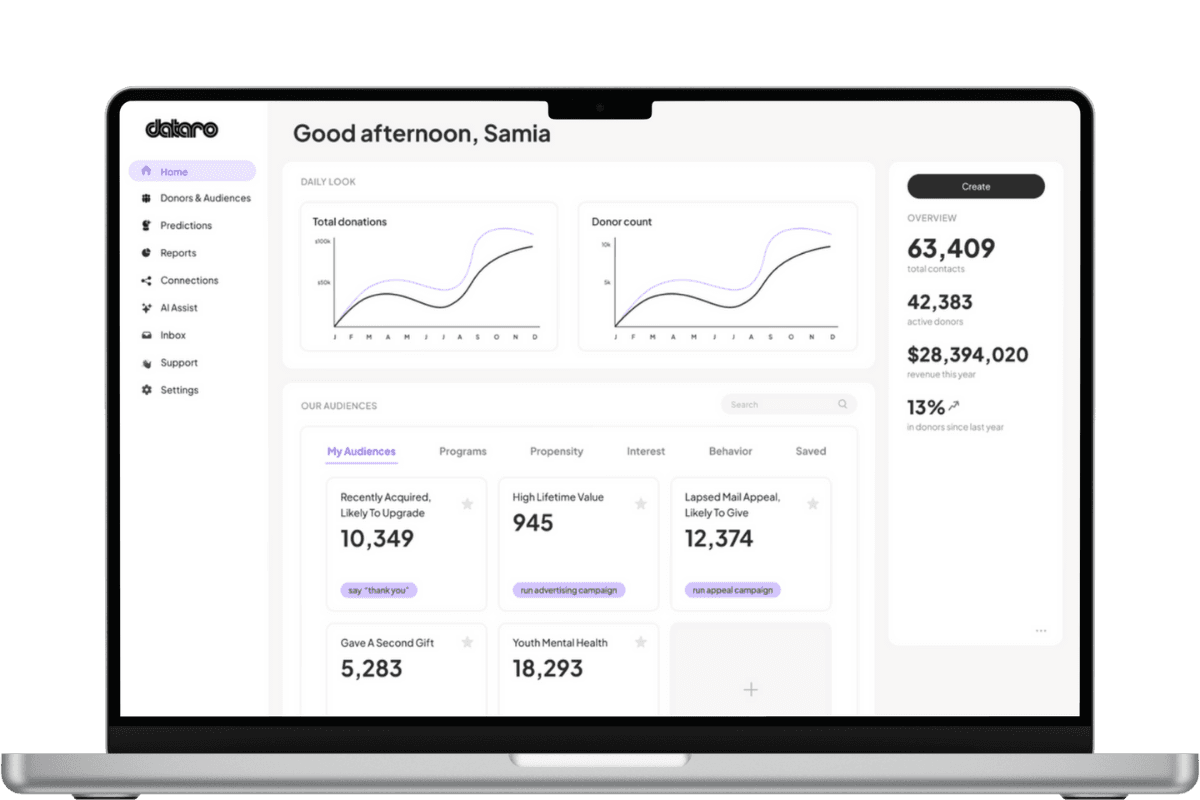
Dataro is a fundraising intelligence platform. It sits on top of your CRM, reads your data and returns ranked lists, clear cutoffs and a recommended next action on each record.
That covers the work many teams stitch together from separate tools:
Predictive donor scoring: propensity scores that rank who is most likely to give, upgrade or lapse
Donor segmentation and audience building: ranked audiences you can push back to your CRM as lists or tags
Personalized fundraising content: ask amounts and content matched to where a donor sits
Automated prospect research: surface who's worth a closer look without manual screening
Next-best-action recommendations: a clear action on each record, not just a score
Recurring giving conversion: find single donors most likely to convert to regular giving
Campaign ROI and targeting: mail fewer people with confidence and protect results
Donor data enrichment and profiling: richer records to sharpen prioritised efforts
The point isn't the feature list. It's the loop: predict, act, measure, repeat.
How Dataro compares to the tools you already know
Most categories solve part of the job. Here's where they typically land and where Dataro differs.
CRMs (Salesforce, Blackbaud, Bloomerang, Virtuous, Bonterra)
Your CRM is the system of record. It's where constituent data and history live. "AI" is often an add-on.
Dataro doesn't replace your CRM. It sits on top of it and turns that data into ranked priorities and next actions across programs, so you don't change systems to get better targeting.
Wealth screening and prospect research (iWave, Windfall, DonorSearch, Hatch)
These tools enrich and screen for major gifts. They tell you who has capacity.
Capacity is one signal. Dataro goes further: it predicts who to prioritise, when and what to do next across every program, not just who looks wealthy on paper. Many fundraisers say wealth scores alone can feel random. Dataro pairs likelihood to give with capacity so the ranked list reflects real behaviour.
Predictive point solutions and "AI operating systems" (Avid, Squark AI)
These position themselves as predictions plus automation.
Dataro is built to be workflow-real. Outputs land in your CRM as audiences, tasks and fields your team can use next week. It works across appeals, retention, mid-value, major and legacy. And it ties lift to outcomes, not just model claims.
Digital fundraising platforms (Fundraise Up, Classy, Engaging Networks, Givebutter)
These optimize a channel: forms, peer-to-peer, email.
Dataro coordinates who to contact and what to do next across your whole donor file and multiple programs, not inside a single channel.
Agencies (Moore, RKD, AGP/Pursuant)
Agencies bring services-led strategy and execution.
Dataro builds in-house capability with a repeatable decision rhythm you own. It compounds rather than resetting each campaign.
The shorthand
Most tools market AI, data, automation or "all-in-one."
Dataro leads with the operating loop: predict, act, measure, repeat. The output is a ranked action a fundraiser can run and explain.
A plan you can run
You don't need a system overhaul to get value. The rhythm is simple:
Connect Dataro to your CRM. It reads your data where it already lives.
Get ranked lists and cutoffs. See who to focus on and where to draw the line.
Act on the next-best action. Push audiences, tasks and tags back into your tools and run the work.
Measure what changed. Results flow back as new signals, so the next cycle gets sharper.
Each output is clear, explainable and easy to justify when leadership asks why a name is on or off the list.
What happens if nothing changes
Without a reliable way to rank and prioritise, the safe default becomes "send more people" or "use last year's segments." That guesswork is expensive.
Fundraisers spend hours pulling lists, negotiating exclusions and defending where to draw the line. Technical teams get pulled into ad hoc requests. And because the cutoffs aren't clear, approvals slow down. You over-mail to feel safe or under-mail out of fear. Either way, budget and donor goodwill leak out.
What changes when you act
The result isn't more activity. It's fewer, better choices.
You mail fewer people with confidence and protect results
You spot donors at risk of lapsing early enough to do something
You find single donors ready to convert to recurring giving
You give major-gift officers a ranked list, not a hunch
You run programs that are easier to execute and easier to justify
Fewer touches, better timing, higher impact. That's the shift from reactive, wasteful fundraising to work that's predictive, focused and respectful of both donors and staff.
How to choose
When you compare Dataro to competitors, anchor on the job, not the brochure. Ask three questions of any tool:
Does it tell me who to focus on with a clear cutoff?
Does it tell me what to do next on each record, in a form my team can run?
Can I explain and measure the result to stakeholders?
A CRM stores the data. BI tools explain what already happened. Marketing automation sends more touches. Dataro adds the predictive layer that turns your data into ranked actions, so every week you can answer who to focus on and what to do next.
If you want to see what that looks like on your own file, the best next step is to run a small pilot and review an example output. That's the fastest way to judge the fit for your team.
Related articles
Find more not-for-profit fundraising and data insights from the Dataro team.