When to add a predictive donor insights layer to your CRM
Strategy & Frameworks
A non-profit is ready for a predictive layer when manual list-pulling stops scaling and cut-offs become hard to defend, not at a fixed donor count.
The short answer
Add a predictive donor insights layer when your team can no longer defend its targeting decisions by hand. That point is triggered by readiness signals, not a fixed donor count or budget line.
Most shops hit it once manual list-pulling stops scaling, cutoffs get harder to justify and program silos start costing you revenue. For many organisations that lands somewhere around 10,000 active donors, but the signals matter more than the number.
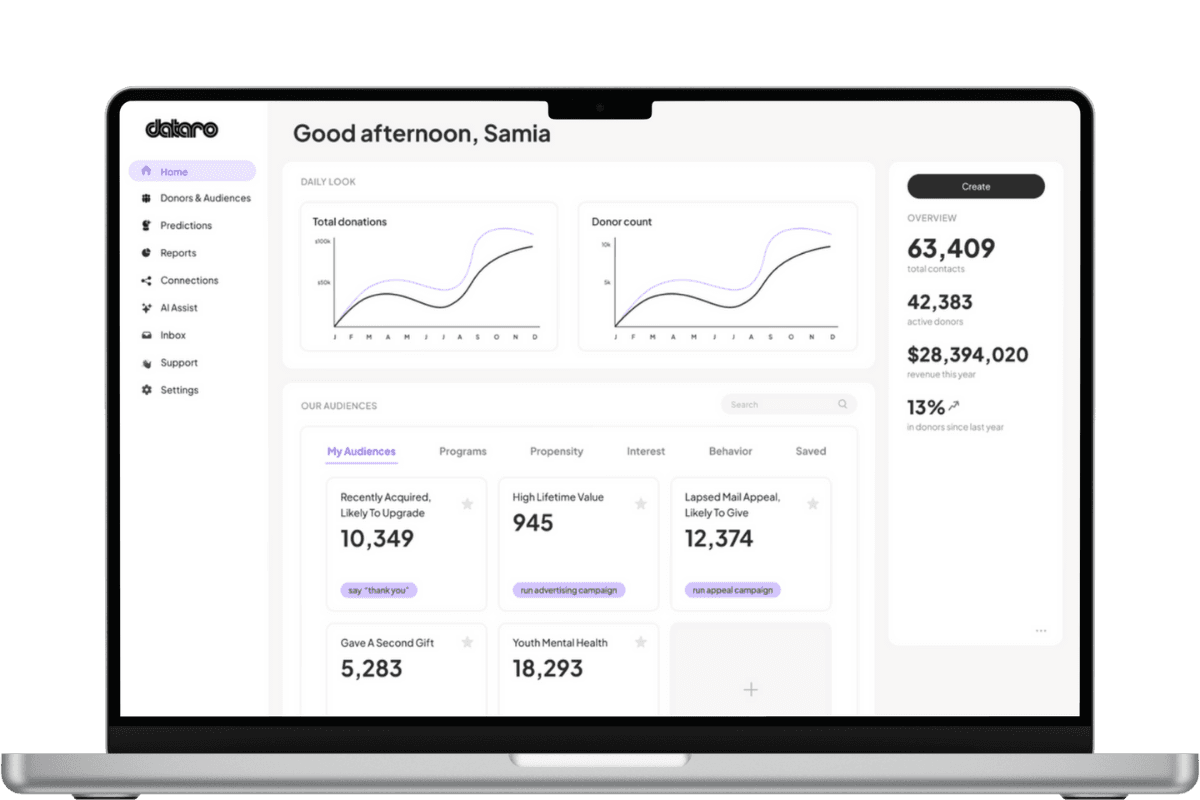
Definition: A CRM is your system of record. It stores constituent data and gift history. A predictive layer sits on top of that data and turns it into ranked lists, clear cutoffs and a next action for each donor. The CRM tells you what happened. The predictive layer helps you decide who to focus on and what to do next.
System of record vs. predictive layer
These are two different jobs, and one can't do the other's work.
Question | CRM (system of record) | Predictive layer |
|---|---|---|
Core job | Store and report data | Rank donors and recommend actions |
Answers | What happened | Who to focus on and what to do next |
Output | Records, reports, dashboards | Ranked lists, cutoffs, next actions |
Targeting method | Manual segments and RFM rules | Propensity scores across programs |
Best when | You need one source of truth | Manual targeting stops scaling |
A CRM can hold every gift a donor has ever made and still leave you guessing about who to mail next week. That gap is what the predictive layer closes.
What are the readiness signals?
Watch for these signs, regardless of size:
List-building eats hours of staff time every campaign
Your cutoffs are hard to explain to leadership, so approvals slow down
RFM and wealth scores feel like guesswork and don't predict who gives
Appeals, retention and stewardship run in silos with no shared handoff
Mail and media costs are up, and over-mailing is getting expensive
You have enough gift history to learn from, usually a few years of transactions
One signal is a nudge. Three or more mean you're ready.
When is a small shop ready?
Small development shops, often under 10,000 active donors, usually run on one or two people and heavy manual work.
You're ready when list-pulling crowds out donor-facing time and you're mailing your whole file because segmenting by hand is too slow. At this stage the predictive layer buys back capacity. It tells a stretched team who to contact first so fewer touches protect results.
You're not ready if you have less than a year of clean gift data. Fix data hygiene first.
When is a mid-size shop ready?
Mid-size shops, roughly 10,000 to 100,000 donors, feel the pressure most. Goals rise, the team stays flat and programs multiply.
You're ready when RFM segments no longer feel predictive, cutoff debates slow your approvals and you're running separate appeals, mid-value and retention programs that don't talk to each other. This is the most common entry point. The predictive layer replaces guesswork with ranked lists and defensible cutoffs, and it coordinates who to prioritise across programs.
When is a large shop ready?
Large development shops, above 100,000 donors, often have analysts and a data warehouse already.
Here the question isn't whether to predict. It's whether prediction reaches the frontline. You're ready when models live in reports that fundraisers never act on, when scoring can't keep pace across appeals, mid, major and legacy, and when governance requires outputs you can inspect and explain.
At this scale the predictive layer turns analysis into execution-ready actions that land back in the CRM as audiences, tasks and fields the team already uses.
How the two layers work together
The pattern is simple: CRM to predictive layer to CRM to action.
Your CRM holds the data and history.
The predictive layer reads it and returns ranked priorities, cutoffs and next actions.
Those outputs land back in the CRM as lists, tags and tasks.
Your team runs the work, and results flow back as new signals.
You don't replace your CRM. You add a layer that turns its data into decisions, then measure what changed so the next cycle gets sharper.
Practical takeaways
Judge readiness by signals, not donor count. Manual work that no longer scales is the clearest trigger.
Keep your CRM as the system of record. The predictive layer sits on top and returns ranked actions.
Small shops gain capacity, mid-size shops gain defensible cutoffs, large shops gain frontline execution.
Clean gift data comes first. Without a track record to learn from, hold off.
Start small. Run a pilot on one program, measure the lift, then expand.
Conclusion
There's no universal donor count that says "add predictive insights now." The right moment is when your team spends more time defending targeting decisions than making them. When that happens, a predictive layer on top of your CRM helps you mail fewer people with confidence and answer two questions every week: who to focus on and what to do next.
Related articles
Find more not-for-profit fundraising and data insights from the Dataro team.