Predictive donor scoring vs competitors: how to focus and act
General
Fundraising teams are being asked to do more with less. Goals rise, teams stay flat and the cost of every mail piece, email and staff hour gets scrutinised harder than ever. When it's time to plan a campaign, the safe default becomes "send to more people" or "reuse last year's segments," even when no one is confident those choices still hold.
That's the gap predictive donor scoring is built to close. Done well, it answers the first decision every fundraiser owns: who deserves our attention right now, and why.
What predictive donor scoring actually does
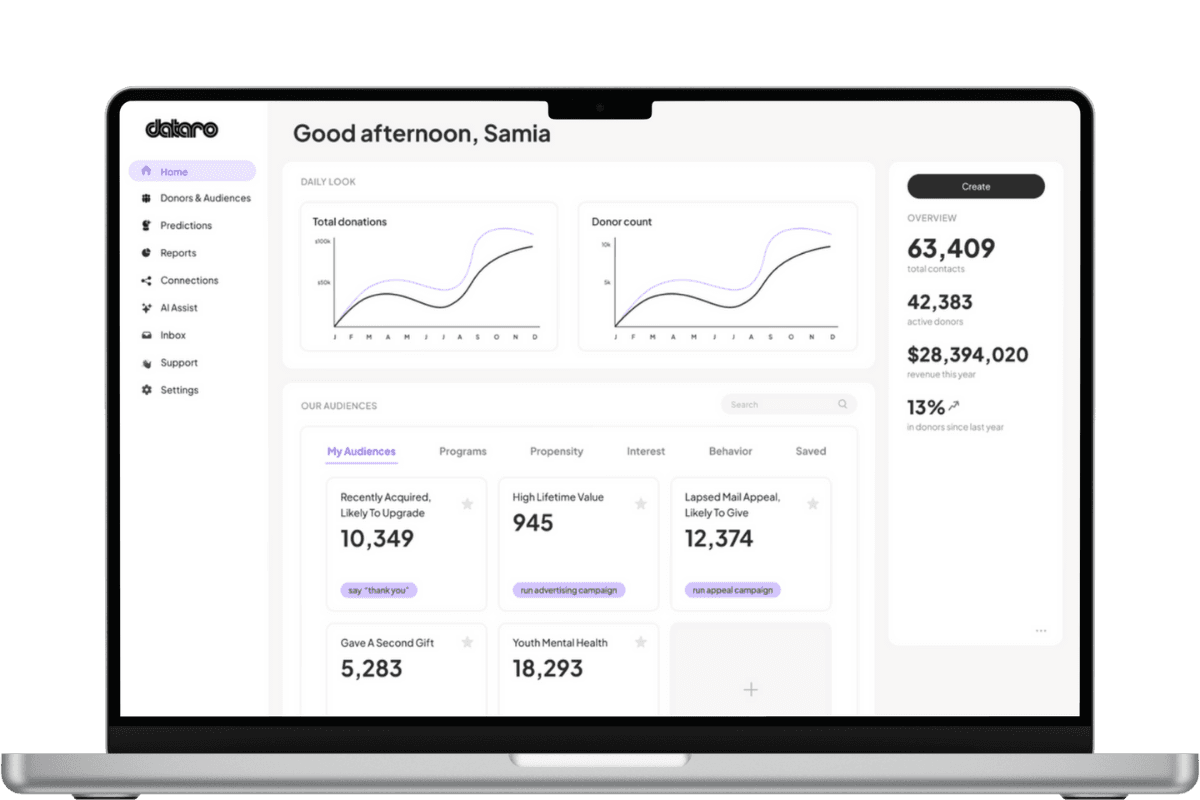
Predictive donor scoring reads your CRM history and returns a ranked view of your donors based on the likelihood of a future action. That action might be giving to the next appeal, upgrading, lapsing or converting to a recurring gift.
The output isn't a dashboard to interpret. It's a defensible cutoff and a short list your team can approve. Instead of debating who to include, you start from a ranked order and decide how far down the list your budget reaches.
That shift matters because most targeting today still runs on manual segmentation and gut feel. Teams contact too many people, at the wrong time, with the wrong next step. Scoring replaces that guesswork with signals you can act on.
Focus first: who to prioritise
Before you spend a dollar, you face a focus decision. Limited capacity and pressure to hit goal make it hard, and last year's rules rarely feel predictive now.
Good scoring gives you three things:
Fewer, better choices so you're not mailing to feel safe
A clear cutoff you can point to and defend
A decision the team can explain to a board or finance lead
This is where related capabilities connect. Donor segmentation and audience building turn scores into usable groups. Donor data enrichment and profiling fill gaps in your records so the scores are grounded in a fuller picture. Automated prospect research, often called wealth screening, layers in capacity signals for major-gift work. Each supports the same job: knowing where to focus before you act.
Then act: what to do for each donor
Focus alone isn't enough. The harder, more valuable decision is what to do next for each person across every program.
Appeals, retention, mid-value and stewardship often run in silos. A donor flagged as at-risk in one program may be a perfect upgrade candidate in another, and without a shared rhythm that signal gets lost. The work resets every cycle.
This is the act decision. Next-best-action recommendations assign a move to each donor: upgrade, steward, suppress or hand off to another program. The goal is execution-ready actions, not more analysis. A plan the team will actually run, delivered into the tools they already use.
How scoring powers the wider toolkit
Predictive scores rarely work alone. They feed a connected set of decisions:
Donor segmentation and audience building: Scores become approved audiences ready to push into your CRM or email tool.
Personalised fundraising content: Knowing who's likely to give, and why, lets you match message to motivation instead of blasting one appeal to everyone.
Automated prospect research: Capacity and wealth signals sharpen major-gift focus so officers spend time on the right relationships.
Recurring giving conversion optimisation: Scoring surfaces single-gift donors most likely to convert, so you target the ask rather than hope.
Campaign ROI optimisation and targeting: A defensible cutoff protects budget by trimming low-probability contacts without sacrificing revenue.
Donor data enrichment and profiling: Cleaner, fuller records make every prediction more reliable.
The through-line is precision. Winning isn't expanding the list to reduce anxiety. It's doing fewer things with higher confidence.
Dataro vs competitors: where the lines fall
If you're comparing options, it helps to know what each category is built to do.
CRMs like Salesforce, Blackbaud and Bloomerang are systems of record. They store the data. AI is usually an add-on, not the core job.
Wealth screening and prospect research tools such as iWave and DonorSearch answer one question well: who has capacity. That's valuable for major gifts but narrow. It doesn't tell you who to prioritise across appeals, retention and recurring giving, or what to do next.
Digital fundraising platforms like Classy and Fundraise Up optimise a channel: forms, email, peer-to-peer. They don't coordinate who and what next across your whole donor file.
Agencies bring strategy and execution as a service, but the capability lives with them, not your team.
Dataro is a fundraising intelligence platform. It sits on top of your CRM, reads your data and returns ranked actions back into your workflow. The difference is the predictive layer: outputs that are workflow-real, span multiple programs and tie lift to outcomes you can measure. We don't replace your systems. We add a decision layer on top of them.
What good looks like in practice
The operating loop is simple: predict, act, measure, repeat.
Predict: Produce a ranked list and a cutoff the team can approve.
Act: Make the next step easy to run, assigned to an owner and a workflow.
Measure: Show what changed so the next cycle gets sharper.
Results flow back as new signals, and the next round of scoring improves. That's how programs compound instead of starting from zero each campaign.
The cost of guessing
Without reliable scoring, the failure mode is familiar. You over-mail to feel safe or under-mail out of fear. Budget gets wasted on donors who were never likely to give. Donor fatigue creeps in. Approvals slow down because no one can defend the cutoff. And your team burns hours pulling lists instead of building relationships.
The alternative is a steadier operating reality: fewer debates, clearer cutoffs, faster approvals and next actions your team can execute. You target with more precision, protect capacity and run programs that are easier to justify internally.
Predictive donor scoring isn't about more activity. It's about fewer, better decisions, made with confidence and grounded in your own data.
Where to start
You don't need a full transformation to see whether scoring works for you. The smallest useful step is a single campaign. Score your file, set a defensible cutoff and compare the outcome against your usual approach.
If you'd like to see what a ranked list and next-best actions look like on your own data, book a working session or run a small pilot. The goal is one thing: a decision you can explain and a plan your team can run.
Related articles
Find more not-for-profit fundraising and data insights from the Dataro team.