What is personalised fundraising content?
Strategy & Frameworks

Personalised fundraising content pairs donor-level signals with the right message, ask and next action for each supporter.
What is personalised fundraising content?
Definition: Personalised fundraising content is messaging shaped by what you know about each supporter, so the story, the ask and the next step fit that person rather than a generic list. It ranges from a name in a greeting to a full system that pairs donor-level signals with the right message, channel and follow-up.
Most teams call any mail-merge a personalised appeal. That is the shallow end. The deeper end treats donors as individuals, not segments, and uses data to decide who to contact, what to say and what to do next.
This guide maps the full stack, from basic merge fields to next-best-action workflows, and shows where each layer adds value.
Merge fields vs. the full personalisation stack
Basic personalisation swaps a token into a fixed template. It scales well but says little. Real personalisation changes the substance of the message based on a donor's history, interests and likelihood to give.
The table below contrasts the two ends of the spectrum.
Element | Merge-field personalisation | Full personalisation stack |
|---|---|---|
Data used | Name, city, last gift | Giving history, propensity scores, channel and content signals |
What changes | A few tokens in a set template | The story, ask amount, channel and timing |
Targeting | Broad segments or the whole file | Ranked lists and clear cutoffs |
Copy | One version for many | Variants matched to donor interests |
Follow-up | Manual and inconsistent | A next-best action on each record |
Effort to scale | Low effort, low relevance | Higher relevance with less manual list work |
Takeaway: Merge fields make a message look personal. The full stack makes it relevant, and relevance is what protects results.
What are the layers of personalised fundraising content?
Think of personalisation as five layers that build on each other. Each one sharpens who you reach and what you say.
1. Donor intelligence
Definition: Donor intelligence is the practice of turning raw CRM data into usable signals about each supporter, such as likelihood to give again, forecast lifetime value and a recommended ask.
This is the base layer. Without reliable signals, personalisation is just formatting. With them, you can rank donors and set a cutoff you can explain to stakeholders.
2. Segmentation and prioritisation
Segmentation groups donors so you can tailor content. Prioritisation goes further: it ranks people so you spend budget and staff time on those most likely to respond.
The shift here is from coarse buckets to donor-level ranking. That lets you mail fewer people with confidence rather than over-mailing to feel safe.
3. AI-assisted copy and dynamic content
Definition: Dynamic content is copy, imagery or asks that change automatically based on donor data, so a single template can render many relevant versions.
AI-assisted copy speeds up drafting variants for different audiences: a recurring donor, a lapsed supporter, a first-time giver. The goal is not more content. It is the right version reaching the right person.
4. Channel orchestration
Channel orchestration decides not just what to say, but where and when to say it: mail, email, phone or SMS. A best-channel signal points each donor toward the format they respond to, so touches compound instead of clashing.
5. Next-best-action workflows
Definition: A next-best action is the single recommended step for a given donor right now, such as upgrade, steward, win back or suppress, assigned to an owner and a workflow.
This is where personalisation becomes operational. Instead of a report, the team gets a clear next step on each record that lands back in the CRM as a task, tag or list.
What is hyper-personalisation in fundraising?
Definition: Hyper-personalisation is personalisation at the individual level across every layer at once, combining donor intelligence, dynamic content, channel choice and a next-best action for each supporter.
Basic personalisation asks, "What is this donor's name?" Hyper-personalisation asks, "Who should we focus on, what should we say and what should we do next?" It treats each of those as a ranked, explainable choice rather than a guess.
This only works when the underlying signals are trustworthy. If a team cannot explain why a donor was ranked or contacted, the personalisation is hard to justify internally.
How does fundraising intelligence support personalised content?
Fundraising intelligence is the category of software that sits on top of your CRM and turns donor data into ranked actions: who to focus on and what to do next.
Personalised content needs that engine underneath it. The signals decide who makes the list and what ask fits. The content layer then dresses that decision in the right words and channel.
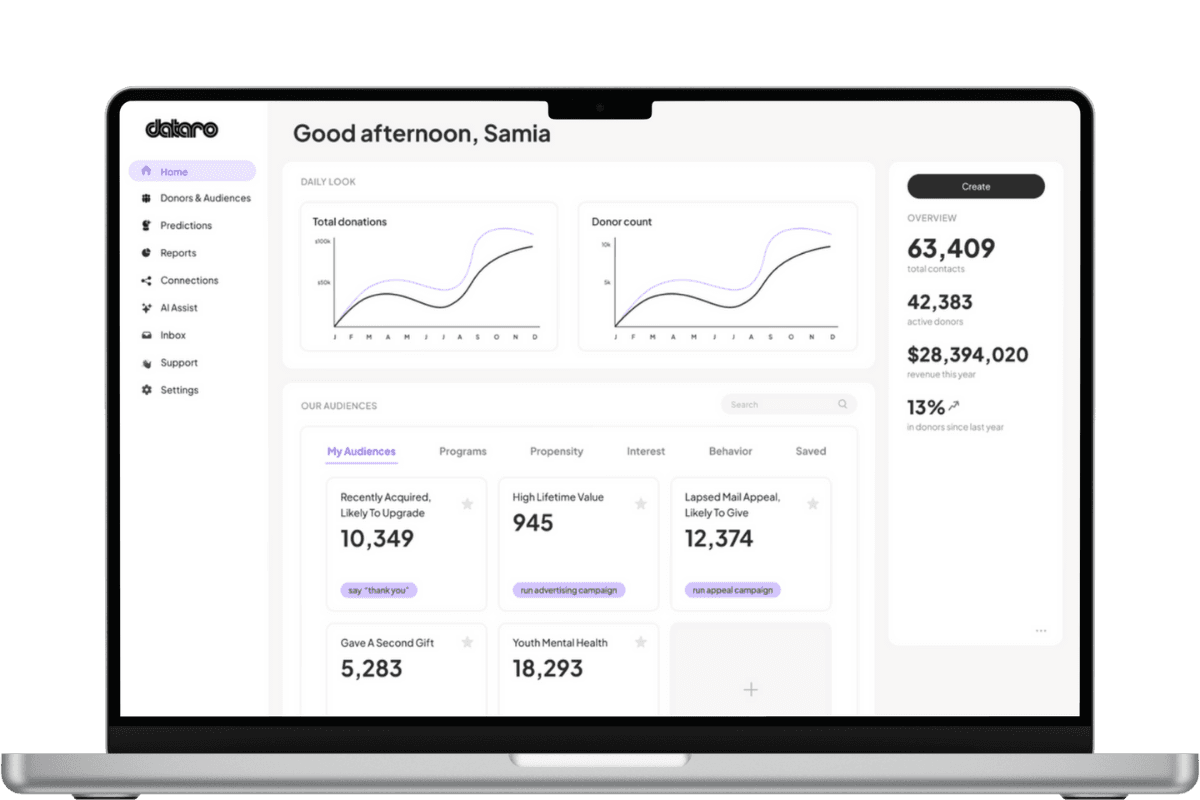
Dataro works as a predictive layer on top of your existing CRM. It reads your data and returns ranked lists, clear cutoffs and a recommended next action on each record, then those outputs flow back into the tools your team already uses.
Practical recommendations
Start where the payoff is highest and build outward.
Fix the data layer first. Reliable propensity scores and lifetime value forecasts make every later layer more accurate.
Rank before you personalise. Decide who to contact and set a cutoff, then tailor content for that list.
Match the ask to the donor. Use a recommended ask rather than one blanket amount.
Draft variants with AI, then edit. Speed up copy for each audience, but keep a human check on tone and accuracy.
Assign a next-best action. Give each donor a clear step with an owner, so activity compounds across appeals, retention and stewardship.
Keep it explainable. Only run personalisation you can justify to leadership and to donors.
Conclusion
Personalised fundraising content is a spectrum. At one end sits a name dropped into a template. At the other sits a stack that uses donor intelligence, ranked segmentation, dynamic content, channel orchestration and next-best-action workflows to treat each supporter as an individual.
The teams that win are not the ones sending more mail. They are the ones sending fewer, better touches grounded in reliable signals. Personalisation is the message. Ranked actions are the engine that makes it land.
Related articles
Find more not-for-profit fundraising and data insights from the Dataro team.