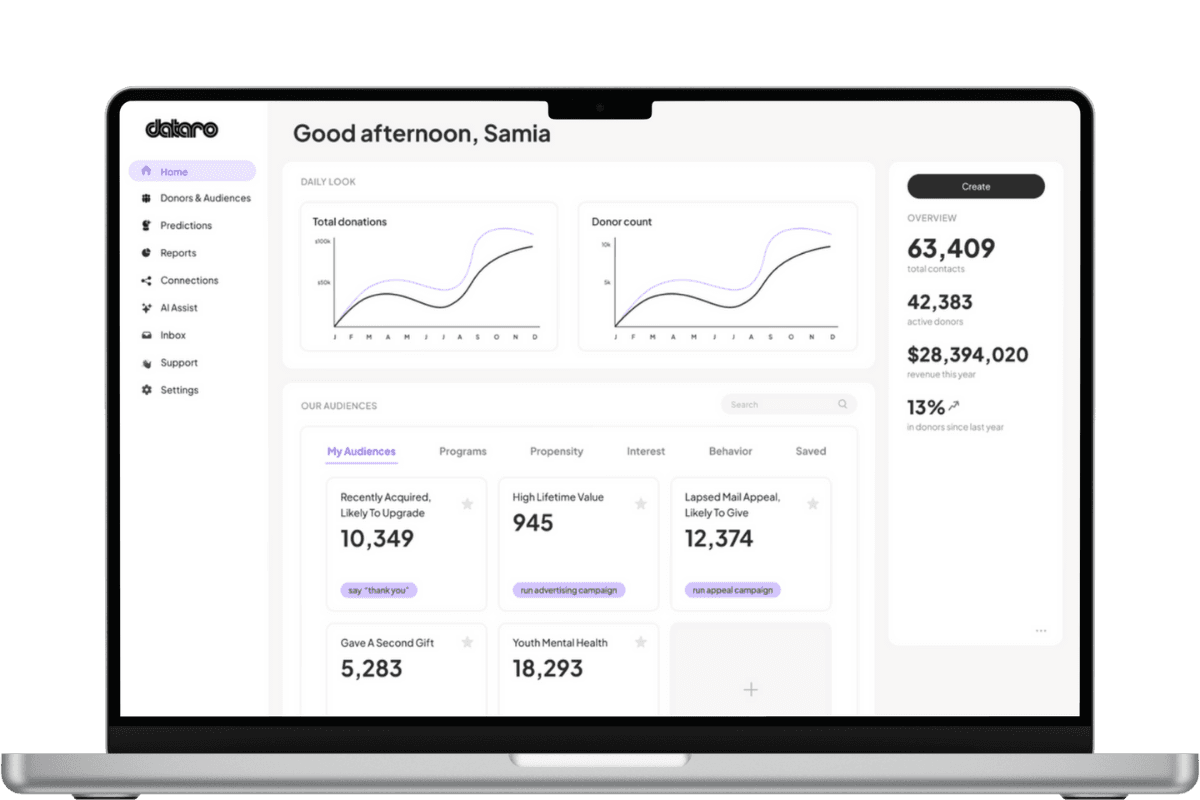
Explainable AI in donor scoring: how to trust the 'why' behind a score
Research & Data

Fundraisers should trust a donor score only when the vendor can show the specific signals behind it.
Donor scores are only as useful as the reasons behind them. If a score tells you to call a donor but can't tell you why, you're back to gut feel with a number attached.
This guide explains explainable AI in CRM-integrated donor scoring, contrasts transparent propensity models with black-box wealth scores and gives you a checklist for pressing vendors to show their work before you trust a score for outreach.
What is explainable AI in donor scoring?
Explainable AI in donor scoring means the model can show the specific signals behind each score in plain terms a fundraiser can read and question. Instead of a lone number, you see the inputs that moved it: recent gifts, frequency, channel history, tenure and engagement.
The test is simple. If you can't answer "why did this donor score high?" without calling the vendor, the score isn't explainable.
Transparent propensity models vs. black-box wealth scores
A propensity model predicts a specific behaviour, such as the likelihood of a next gift, an upgrade or a lapse. A transparent one exposes the data and the drivers behind each prediction.
A wealth score estimates capacity to give from external markers like property, stock and business records. Many arrive as a single figure with no visible path from data to number.
The difference matters most at the moment you decide who to contact and what to say.
Factor | Transparent propensity model | Black-box wealth score |
|---|---|---|
What it predicts | A specific action, like next gift or churn | Estimated capacity to give |
Data sources | Your CRM giving and engagement history | External wealth and asset markers |
Source visibility | Drivers shown per donor | Often hidden or aggregated |
Can a fundraiser explain it | Yes, from the listed signals | Rarely without the vendor |
Bias and audit | Inspectable and testable | Hard to check |
Best use | Prioritising outreach across programs | A rough capacity signal, not a targeting decision |
The trade-off is real. Wealth scores can surface prospects your file wouldn't flag on giving history alone. But used on their own, they push teams toward capacity over intent, and they resist the audit that trust and governance now demand.
Why the 'why' matters for outreach decisions
Three reasons a visible explanation changes outcomes:
First, it protects results. When you can see that a score rests on recent, relevant giving, you can mail fewer people with confidence instead of padding the list to feel safe.
Second, it speeds approvals. A cutoff you can explain is easy to justify to a director or board. A number no one can trace invites debate.
Third, it manages risk. Scores built on opaque external data can encode bias or stale records. If you can't inspect the inputs, you can't catch the errors before they reach a donor.
Checklist: how to ask a vendor to show the 'why'
Use these questions in any demo or procurement review. Strong vendors will answer them directly.
Can you show the top signals behind an individual donor's score, not just a model-level summary?
Which data comes from our CRM and which comes from external sources?
How current is the data behind each score, and how often is it refreshed?
What exactly does the score predict, and over what time frame?
How was the model validated, and can you show lift against a holdout or control?
How do you test for bias, and what happens when a source is wrong or missing?
Can a fundraiser read the explanation without a data analyst translating it?
Do the scores and reasons write back into our CRM so the team can act in the tools they already use?
Can we override or exclude a score, and is that change tracked?
What are the documented limits of the model, and when should we not rely on it?
If a vendor deflects on source visibility or validation, treat that as your answer.
Practical takeaways
Prefer models that predict a specific action and show the drivers per donor.
Treat wealth scores as one input for capacity, not a standalone targeting decision.
Require source visibility, refresh dates and validation evidence before you act.
Make sure scores and reasons land back in your CRM so outreach stays in workflow.
Keep an override path, and log it, so human judgement stays in the loop.
Conclusion
Explainability isn't a nice-to-have on a donor score. It's the difference between a defensible outreach plan and a confident-looking guess.
A transparent propensity model tells you who to focus on and why, in language your team can act on and your leaders can approve. Before you trust any score, ask the vendor to show the why. If they can't, don't build your outreach on it.
Related articles
Find more not-for-profit fundraising and data insights from the Dataro team.