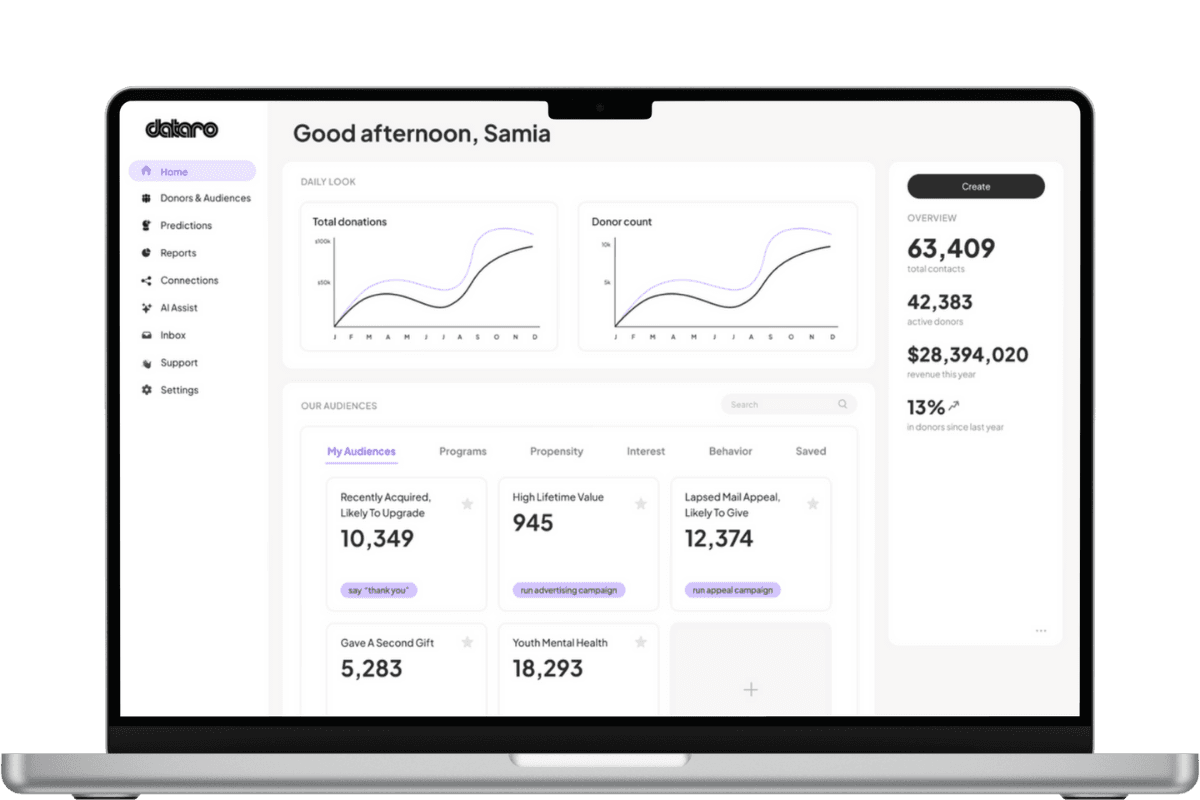
Donor segmentation and audience building: a practical guide
Strategy & Frameworks

Predictive, donor-level rankings help fundraising teams prioritise the right people and choose the right next action.
Donor segmentation and audience building decide who gets your team's attention and budget. Done well, they help you contact fewer people with more confidence. Done poorly, they waste mail, tire donors and make campaigns hard to justify.
This guide explains what donor segmentation is, why traditional methods fall short and how predictive rankings sharpen the two decisions every fundraiser makes: who to focus on, and what to do next.
What is donor segmentation?
Donor segmentation is the practice of grouping supporters by shared traits, such as giving history, recency, channel or gift size, so you can tailor how you contact each group. Audience building is the next step: turning those groups into the specific lists you activate in a campaign.
Both answer a single question: out of everyone in your database, who should you contact and how?
Why traditional segmentation falls short
Most teams still build audiences with recency, frequency and monetary value, known as RFM, or with wealth scores and manual rules. These methods are familiar, but they have clear limits.
They look backward. RFM tells you what a donor did last year, not what they are likely to do next. Rules and cutoffs from a past campaign rarely stay predictive.
They are coarse. A single segment can hold donors with very different intentions. Treating them the same means over-contacting some and missing others.
They are hard to defend. When a cutoff is based on gut feel, approvals slow down and the team debates the list instead of running the campaign.
The result is a familiar pattern: teams over-mail to feel safe, or under-mail out of fear.
From segments to donor-level rankings
The shift now underway is from coarse segments to donor-level prioritisation. Instead of sorting everyone into a handful of buckets, you rank each individual by how likely they are to take a specific action, then draw a clear cutoff.
Definition: predictive ranking A predictive ranking scores every donor by their likelihood to take a given action, such as giving to an appeal, upgrading or lapsing. You use the ranking to prioritise contacts and set a cutoff you can explain.
This treats donors as individuals rather than members of a fixed group. Two donors who look similar on paper can rank very differently once their full history is scored.
RFM and rules vs. predictive rankings
The table below compares the two approaches and their trade-offs.
Factor | RFM and manual rules | Predictive rankings |
|---|---|---|
Basis | Past behaviour and static rules | Likelihood of a future action |
Granularity | Broad segments | Donor-level score |
Setup effort | High, done by hand each campaign | Low once connected to your CRM |
Cutoffs | Judgement calls, harder to justify | Clear and easy to explain |
Best for | Simple, stable programmes | Multi-channel programmes that change often |
RFM still has a place for quick, simple splits. But as programmes get more complex, donor-level rankings give you sharper targeting with less manual work.
How to build a donor audience: 5 steps
Name the decision. Define the action this audience supports, such as an appeal, an upgrade ask or a win-back. One audience, one job.
Rank the file. Score every donor by their likelihood to take that action rather than sorting them into broad buckets.
Set a cutoff. Draw a line you can explain to a colleague or a board. Contact the highly ranked, hold or suppress the lowly ranked.
Assign the next action. Attach a clear next step to each record: mail, call, upgrade, steward or suppress.
Measure and repeat. Track what changed, then feed the results back into the next round so targeting gets sharper.
How does this reduce mail volume without losing revenue?
Because a ranking orders your whole file, you can see where response drops off and stop there. Many teams cut a mail file substantially, for example from 40,000 to 16,000, while protecting revenue, because the people removed were unlikely to give anyway.
The goal is not more activity. It is fewer, better touches: mail fewer people with confidence and protect results.
Practical takeaways
Build each audience around one decision and one next action.
Rank donors as individuals instead of relying on broad segments alone.
Use a clear cutoff so approvals are fast and easy to justify.
Treat retention as a targeting problem: rank who is at risk early enough to act.
Measure every cycle so the next audience is sharper than the last.
Conclusion
Segmentation is no longer about sorting donors into a few fixed groups. It is about ranking individuals, drawing clear cutoffs and pairing each contact with the right next action. That shift lets teams contact fewer people, protect revenue and run campaigns they can explain.
Dataro sits on top of your CRM and turns your data into ranked lists, clear cutoffs and a recommended next action for each donor, so you can decide who to focus on and what to do next.
Related articles
Find more not-for-profit fundraising and data insights from the Dataro team.