Donor data enrichment vs. donor intelligence: what's the difference and which do you need
Strategy & Frameworks

Enrichment adds facts to donor records, while donor intelligence turns those records into ranked actions your team can run.
Fundraising teams often use "donor data enrichment" and "donor intelligence" as if they mean the same thing. They don't. One fills gaps in your records. The other tells you what to do with them. Confusing the two leads to buying the wrong tool, or paying for two tools when you needed one.
This guide draws a clear line between the categories, compares the main vendor types and helps you decide which you need.
Quick answer: what's the difference?
Donor data enrichment adds missing facts to your donor records: contact details, demographics, wealth markers, giving history from external sources. The output is a more complete database.
Donor intelligence interprets your data to answer two decisions: who to focus on and what to do next for each person. The output is a ranked action, not just a richer record.
Put simply: enrichment gives you more data. Intelligence gives you a decision you can act on this week.
What is donor data enrichment?
Donor data enrichment appends third-party information to the records you already hold. It corrects and completes fields so your CRM reflects reality.
Common enrichment outputs include:
Updated addresses, emails and phone numbers
Age, household and geographic data
Wealth and asset markers, such as property or business ownership
Deceased and gone-away flags
Enrichment answers a narrow question: is this record accurate and complete? It does not tell you who to contact or what to ask for. That work still sits with your team.
What is donor intelligence and profiling?
Donor intelligence turns data into prioritisation and next actions. It ranks donors by a likely outcome, then recommends what to do for each one across your programs.
Within this category, it helps to separate two things people lump together:
Prospect research and wealth screening profiles individuals to estimate capacity and affinity, usually for major gifts. It answers "who could give a large gift?"
Predictive donor intelligence ranks your whole file by propensity for a specific action, such as an appeal response, a recurring cancellation or a reactivation. It answers "who should we focus on right now, and what should we do next?"
Both go beyond enrichment because both produce judgement, not just fields. The difference is scope: wealth screening concentrates on major-gift capacity, while predictive intelligence works across appeals, retention, mid-value, major and legacy programs.
The three vendor types, compared
Most tools in this market fall into three groups. Each solves a different job, and the trade-offs matter.
Vendor type | Core job | Main output | Best for | Trade-off |
|---|---|---|---|---|
Enrichment providers | Complete and correct records | Appended fields | Data hygiene, contactability | Doesn't tell you who to prioritise or what to do |
Wealth screening and prospect research (iWave, Altrata, DonorSearch) | Estimate capacity and affinity | Wealth ratings, donor profiles | Major-gift prospecting and qualification | Capacity is not the same as intent to give now, and coverage skews to major donors |
AI donor intelligence (Dataro) | Prioritise the whole file and recommend next actions | Ranked lists, propensity scores, next-best actions | Running appeals, retention and cross-program decisions at scale | Needs your CRM data to model; not a replacement for a system of record |
Where iWave, Altrata and DonorSearch fit
iWave, Altrata and DonorSearch are strongest for major-gift work. They screen individuals, estimate giving capacity and assemble profiles that help gift officers qualify prospects and prepare for conversations.
The limit is scope and signal. A wealth score tells you who could give, not who is likely to give in your next campaign. Coverage also concentrates on higher-net-worth records, so most of your file stays untouched.
Where AI donor intelligence fits
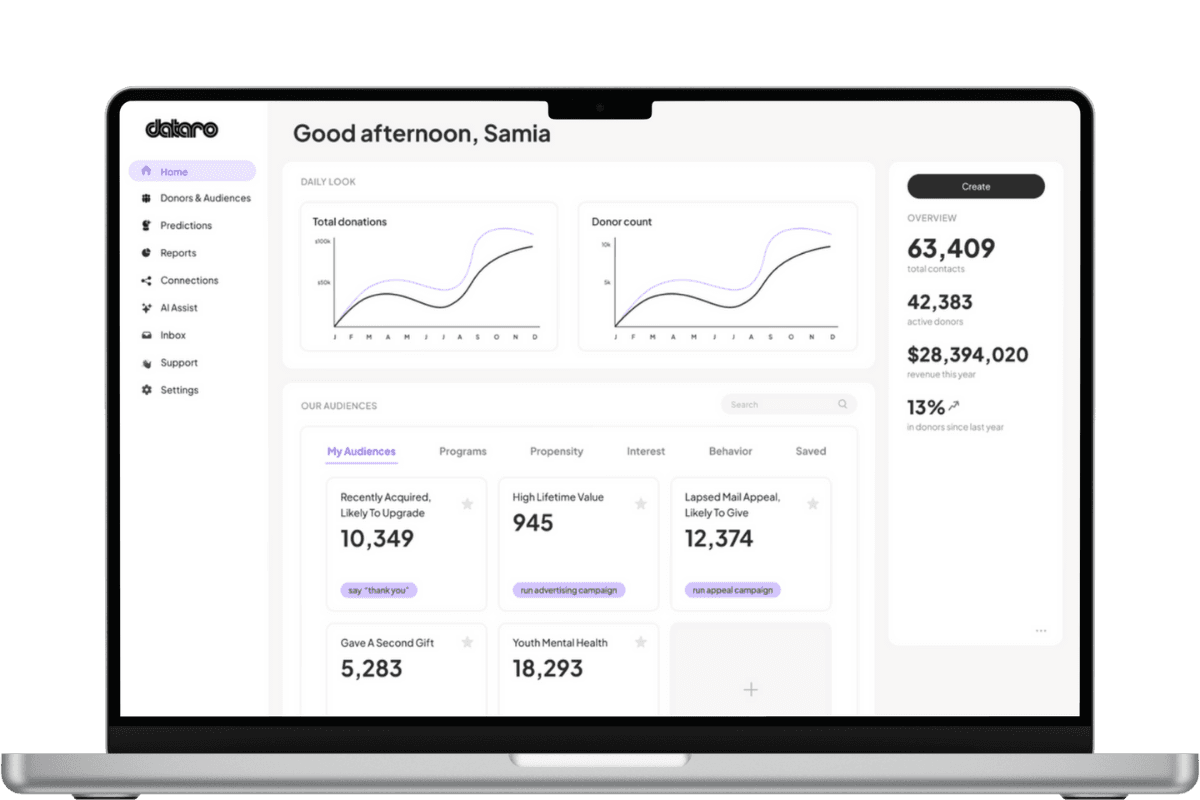
AI donor intelligence, the category Dataro works in, ranks every active donor by propensity for a specific action, then returns a recommended next step. It sits on top of your CRM, reads your data and sends ranked lists and next actions back into the tools your team already uses.
The practical difference: instead of a richer record or a capacity rating, you get a defensible cutoff and a short list you can approve and run. That covers appeals, recurring churn, reactivation and mid-value moves, not just major gifts.
Do these tools overlap?
Yes, and that's where buyers get confused. Some enrichment providers add light scoring. Some wealth-screening platforms bundle basic profiling. Some intelligence tools include prospect research features.
Dataro, for example, includes prospect research alongside its predictive models, so a team can profile major-gift candidates and rank the wider file in one place. The point is not that categories never touch. It's that each tool has a centre of gravity. Buy for that centre, not the edge features.
Which do you need?
Use this as a starting filter.
Choose enrichment if your core problem is dirty or incomplete data: bad addresses, missing emails, unknown ages. Fix the foundation first. Poor data undermines every tool downstream.
Choose wealth screening or prospect research if your priority is major gifts and your team needs to qualify and prepare for high-value conversations. iWave, Altrata and DonorSearch are built for this.
Choose AI donor intelligence if your problem is capacity and focus across the whole program: too many donors to triage, unclear cutoffs and no clear next action per record. This is where predictive ranking earns its keep.
Many teams end up needing more than one. A common sequence is enrich the data, then layer intelligence on top so the rankings run on clean inputs. Wealth screening then supports the major-gift end of the same file.
Practical takeaways
Enrichment completes records. Intelligence produces decisions. Don't pay for one expecting the other.
Wealth capacity answers "who could give." Propensity answers "who is likely to give now." Major-gift teams need the first; broad programs need the second.
Fix data quality before you invest in prediction. Clean inputs make every downstream tool sharper.
Judge each tool by its core job, not its bundled edge features.
If your bottleneck is deciding who to focus on and what to do next across programs, that's a donor intelligence problem, not an enrichment one.
Conclusion
Enrichment, wealth screening and AI donor intelligence solve different problems. Enrichment makes your data accurate. Wealth screening estimates major-gift capacity. Donor intelligence ranks your file and tells you what to do next.
Start by naming the decision you're stuck on. If it's data accuracy, enrich. If it's major-gift qualification, screen. If it's focus and next actions across the whole program, you need donor intelligence. Match the tool to the decision, and the buying choice gets clear.
Related articles
Find more not-for-profit fundraising and data insights from the Dataro team.