Donor data enrichment and profiling: how it differs from wealth screening, prospect research and AI donor intelligence
Strategy & Frameworks

Enrichment and profiling clean and complete donor data; AI donor intelligence turns it into ranked actions your team can run.
Donor data enrichment and profiling are often lumped in with wealth screening, prospect research and AI donor intelligence. They overlap, but they answer different questions. This guide defines each term, shows how they connect in a single data lifecycle and compares traditional prospect research tools with AI-driven donor intelligence platforms.
What is donor data enrichment and profiling?
Donor data enrichment is the process of adding missing or external information to your existing donor records, such as contact details, demographics, giving history from other sources or wealth indicators. It fills gaps in what you already hold.
Donor profiling is the process of organising that data into a structured view of a donor or segment, so you can understand who they are, how they give and what they might do next.
In short: enrichment adds data. Profiling makes sense of it. Neither, on its own, tells you who to contact or what to do next.
The donor data lifecycle: hygiene to activation
The terms people confuse are really stages in one lifecycle. Each stage depends on the one before it.
1. Data hygiene
Data hygiene is the ongoing work of keeping records accurate and usable: removing duplicates, fixing formatting, correcting addresses and flagging deceased or lapsed records. Clean data is the foundation. Everything downstream inherits its errors if you skip this step.
2. Data append and enrichment
Data append is a specific type of enrichment. It matches your records against an external source and adds fields you are missing, such as email, phone, age or wealth markers. Enrichment is the broader category that includes appends and other data additions.
3. Profiling
With clean, enriched data in place, profiling builds a picture of each donor or segment. Good profiles combine giving behaviour, engagement and appended attributes into something a fundraiser can read quickly.
4. Activation
Activation is where data earns its keep. This is the point where you decide who to focus on and what to do next, then push those actions into the tools your team already uses. Most traditional tools stop before this stage. This is where AI donor intelligence does its work.
Defining the specialist terms
What is wealth screening?
Wealth screening matches your donor records against external wealth and asset data to estimate financial capacity. It answers one question: who could give a major gift if they chose to? Wealth screening is a form of enrichment focused on capacity. It does not tell you who is likely to give or when.
What is prospect research?
Prospect research is the practice of investigating individual donors or prospects to assess capacity, affinity and connection to your cause. It often combines wealth screening with news, foundation records, board memberships and giving history. Traditionally it is manual, analyst-led and focused on major gifts.
What is donor intelligence?
Donor intelligence turns enriched, profiled data into ranked actions across your whole donor file, not just major gifts. It answers the two decisions every fundraising team makes: who to focus on and what to do for each of them.
What is predictive or propensity scoring?
Predictive scoring, also called propensity scoring, uses models trained on your data to estimate the likelihood of a future event, such as making a gift, upgrading, starting a recurring gift or cancelling one. Scores turn static profiles into forward-looking rankings you can act on.
How they relate
Here is the simplest way to hold it in your head:
Hygiene makes data trustworthy
Enrichment and append make it complete
Wealth screening adds capacity signals
Profiling makes it readable
Prospect research investigates individuals in depth
Predictive scoring makes it forward-looking
Donor intelligence turns all of it into ranked actions you can run
Capacity is only one input. Knowing a donor can give tells you nothing about whether they will, or what to do this week.
Traditional prospect research vs AI donor intelligence
Prospect research tools and AI donor intelligence platforms are often compared directly, but they are built for different jobs. The table below sets out the trade-offs.
Dimension | Traditional prospect research | AI-driven donor intelligence |
|---|---|---|
Core question | Who has capacity to give? | Who to focus on and what to do next? |
Scope | Major-gift prospects | The whole donor file, across programs |
Method | Manual research and static screening | Predictive models trained on your data |
Output | Profiles and capacity scores | Ranked lists, propensity scores and next actions |
Automation | Analyst-led, time-intensive | Automated and refreshed on a regular cadence |
CRM integration | Often export or one-way import | Two-way sync that returns actions into the CRM |
Measurement | Hard to tie to campaign outcomes | Lift measured against fundraising results |
Accuracy
Wealth screening estimates capacity from external data, which can be incomplete or out of date. Predictive scoring is trained on your own giving history, so it reflects how your donors actually behave. Capacity is a static guess. Propensity is a learned signal.
Automation
Manual prospect research is thorough but slow, which limits it to a small pool of high-value prospects. AI donor intelligence scores every active donor and refreshes those scores automatically, so the whole file stays current without added analyst hours.
CRM integration
Many research tools deliver a report or a one-time file. A donor intelligence platform sits on top of your CRM, reads your data and returns ranked actions as lists, tasks, tags or fields, so teams execute in the tools they already use. Dataro is CRM-agnostic and integrates with platforms including Salesforce, Blackbaud Raiser's Edge NXT, Microsoft Dynamics 365, Bloomerang and Virtuous.
Measurable outcomes
Prospect research is valued on the quality of its profiles. Donor intelligence is valued on lift: mailing fewer people with confidence, protecting recurring revenue before it churns and freeing team time for donor-facing work.
Practical recommendations
Start with hygiene. Predictive scores and profiles inherit the quality of the data beneath them.
Use wealth screening and prospect research where they fit: deep, individual work on a small pool of major-gift prospects.
Use predictive scoring to prioritise the rest of your file, where manual research does not scale.
Do not stop at profiling. A profile is not a plan. Push scores into ranked actions your team can run this week.
Judge tools by activation and outcomes, not by how much data they can add.
Conclusion
Enrichment and profiling are essential, but they are stages, not endpoints. Wealth screening and prospect research answer who can give. Predictive scoring and donor intelligence answer who is likely to give and what to do next, across your whole file. The teams that win connect the full lifecycle, from clean data to ranked actions they can defend and execute.
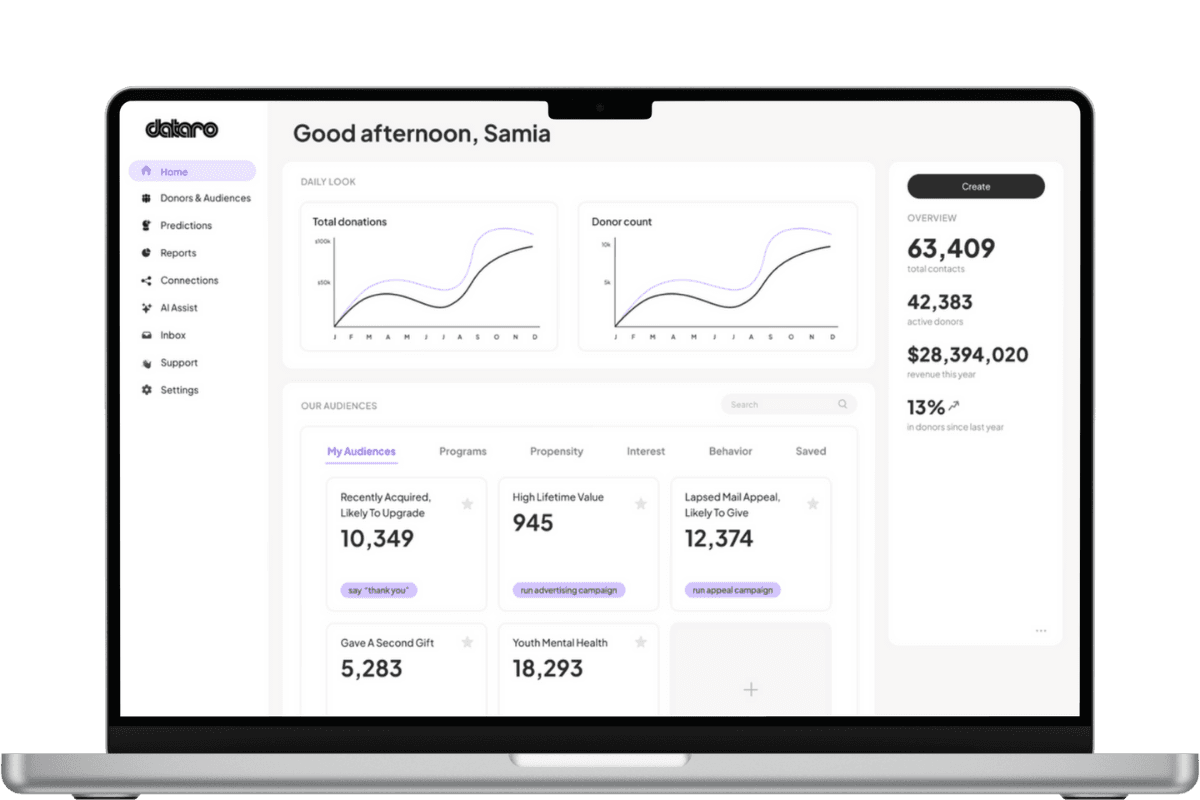
Dataro sits on top of your CRM and turns your donor data into ranked lists, clear cutoffs and a recommended next action for each record, so you can decide who to focus on and what to do next.
Related articles
Find more not-for-profit fundraising and data insights from the Dataro team.